Bubble chamber tracks
1344×768 · AVIF · CC BY 4.0
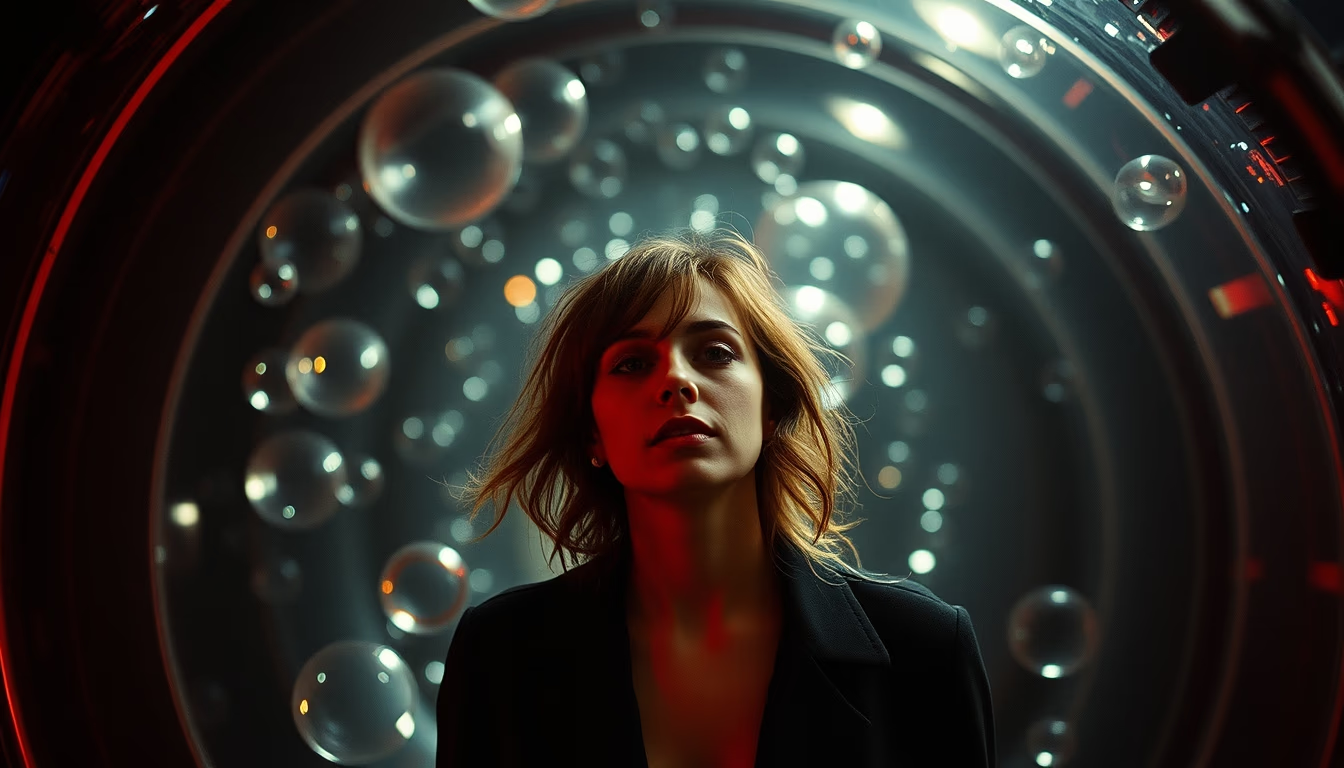
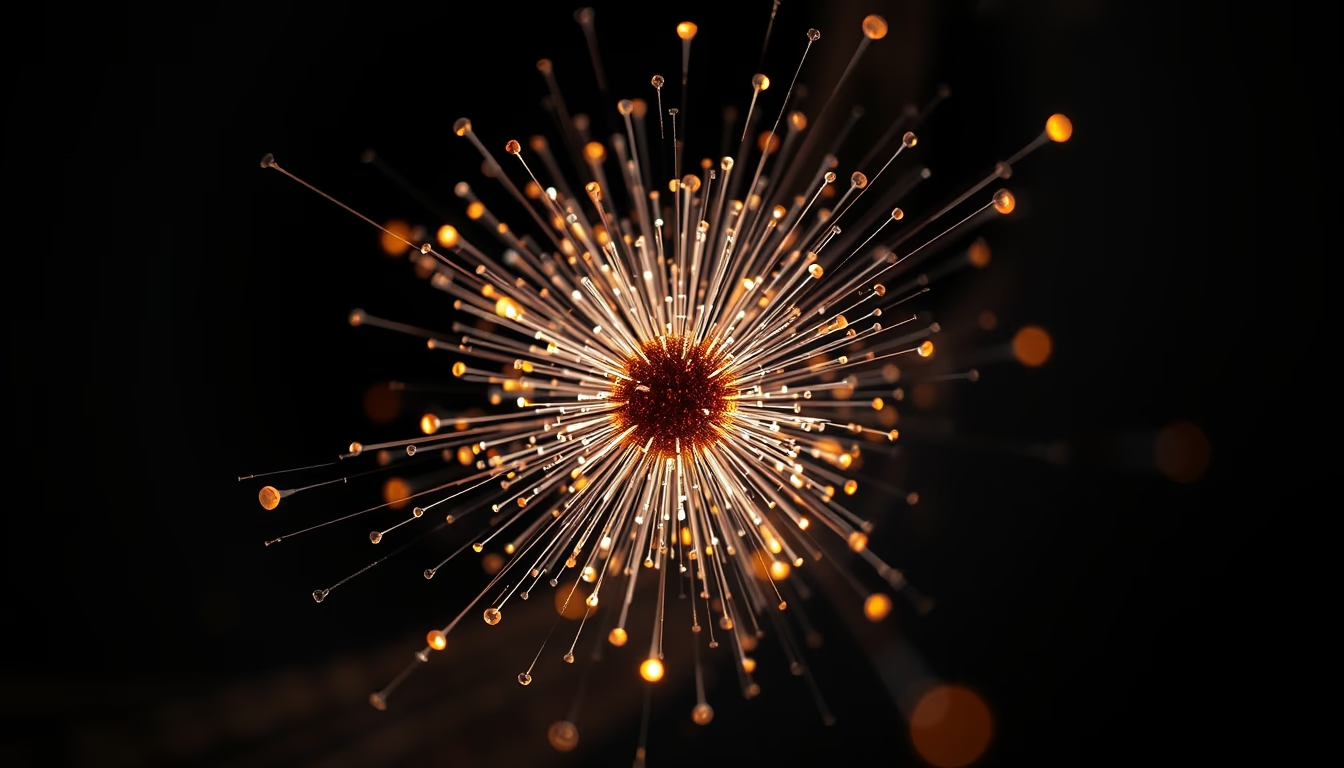
Bubble chambers revolutionized particle physics by recording tracks of subatomic particles in superheated liquid.
About this subject
The bubble chamber was invented by physicist Donald Glaser in 1952, a breakthrough that earned him the Nobel Prize in Physics in 1960. The device consists of a vessel filled with a transparent liquid, such as liquid hydrogen or propane, kept near its boiling point under controlled pressure. When a charged particle passes through the liquid, it interacts with atoms, depositing energy and causing small bubbles to form along its path. These bubbles are then photographed by cameras positioned around the tank, producing iconic images of spirals, curves, and branches that reveal the identity and momentum of the particles.
The resulting images are densely informative: each curve corresponds to a different particle, and the radius of curvature indicates its linear momentum in an applied magnetic field. For instance, electrons produce thin, tightly curved tracks, while protons leave thicker, straighter marks. Phenomena such as decays and annihilations appear as vertices from which new tracks emerge. Bubble chambers were instrumental in discovering several elementary particles, including the K meson, sigma, and omega, and helped establish the Standard Model of particle physics.
Although bubble chambers were largely replaced by faster electronic detectors from the 1970s onward, they left an invaluable visual legacy. Major laboratories like CERN and Fermilab operated hydrogen bubble chambers that generated millions of photographs, manually analyzed by scientists worldwide. These images are now a historical treasure, preserving the aesthetics of 20th-century experimental science and serving as an educational resource for new generations.
Frequently Asked Questions
How does a bubble chamber work?
A bubble chamber uses a superheated liquid sensitive to the passage of charged particles. As a particle traverses the liquid, it ionizes atoms along its path, causing bubble nucleation. The bubbles grow rapidly and are photographed, revealing the particle's trajectory.
Which particles can be detected using a bubble chamber?
Almost any charged particle can be detected: electrons, protons, muons, pions, etc. Neutral particles leave no direct tracks, but their decays into charged particles can be observed.
Why were bubble chambers replaced?
They were gradually retired in favor of electronic detectors that offer higher data acquisition rates, better time resolution, and the ability to handle higher energies, such as time projection chambers (TPCs) and calorimeters.
Direct URL
https://pub-c7d6a6ea828543ac903a74a341ccb2e1.r2.dev/imagens/bubble-chamber-tracks-film-grain-authentic-p7.avifHow to credit
Include a visible link back to UtilizAí. Copy one of the snippets below:
<a href="https://xn--utiliza-eza.com/en/midia/imagens/bubble-chamber-tracks-film-grain-authentic-p7">Bubble chamber tracks</a> by <a href="https://xn--utiliza-eza.com">UtilizAí</a>, licensed under <a href="https://creativecommons.org/licenses/by/4.0/">CC BY 4.0</a>.
[Bubble chamber tracks](https://xn--utiliza-eza.com/en/midia/imagens/bubble-chamber-tracks-film-grain-authentic-p7) by [UtilizAí](https://xn--utiliza-eza.com), CC BY 4.0
License: CC-BY-4.0