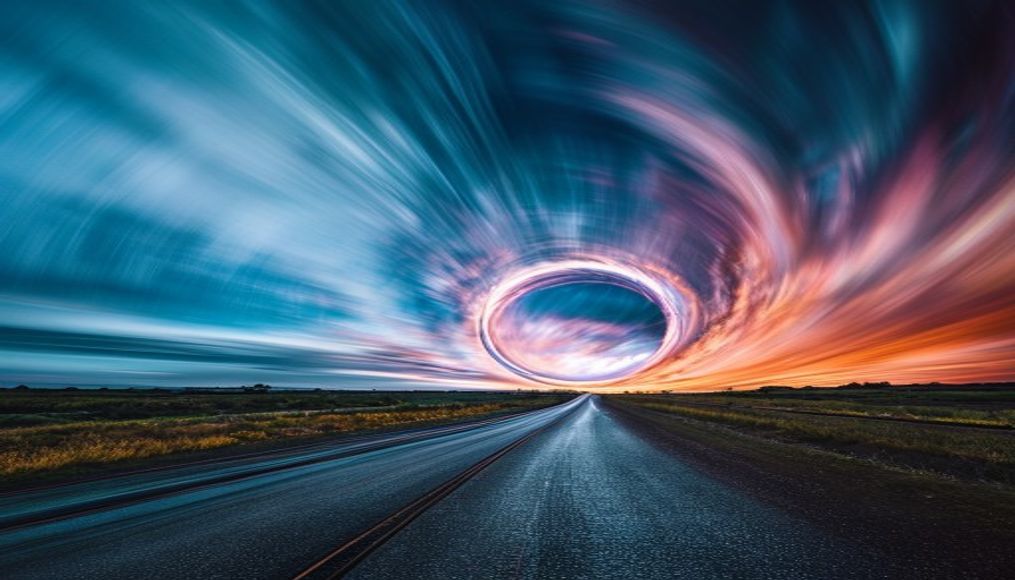
Black hole event horizon
1344×768 · AVIF · CC BY 4.0

The event horizon of a black hole is the point of no return where gravity is so intense that not even light can escape, one of the most extreme phenomena in the universe.
About this subject
The event horizon is the boundary that defines a black hole. Once any matter or radiation crosses this limit, it is irreversibly pulled toward the singularity, where density becomes infinite. This concept was theoretically proposed from Einstein's general relativity equations, but only in 2019 did humanity obtain the first direct image of an event horizon, of the supermassive black hole M87*, located about 55 million light-years from Earth. The image, captured by the Event Horizon Telescope (EHT), showed a dark shadow surrounded by a ring of light, confirming theoretical predictions.
Black holes can have masses ranging from a few solar masses (stellar black holes) to billions of solar masses (supermassive). The event horizon of a typical stellar black hole has a radius of about 30 kilometers, while that of a supermassive one can be larger than the solar system. Sagittarius A*, the black hole at the center of the Milky Way, has an event horizon approximately 12 million kilometers in diameter. Moreover, the event horizon is not a solid physical surface but a region of spacetime where the laws of physics as we know them behave extremely.
Interestingly, from the perspective of a distant observer, an object falling toward the event horizon appears to slow down and never cross it due to gravitational time dilation. However, for the object itself, the crossing occurs in finite time. This effect is a direct consequence of general relativity and was the subject of debates among physicists like Stephen Hawking and Kip Thorne. The study of event horizons remains an active area of research, especially with the possibility of detecting gravitational waves from black hole mergers.
Frequently Asked Questions
What happens to matter when it crosses the event horizon?
Once matter crosses the event horizon, it is inevitably pulled toward the singularity, where it is compressed to extreme densities. No signal can escape, making the process invisible to outside observers.
Can the event horizon be seen?
Directly, no, because it does not emit light. However, its silhouette can be observed indirectly, as in the M87* image captured by the Event Horizon Telescope, which shows the black hole's shadow against the glowing surrounding gas.
What distinguishes the event horizon of one black hole from another?
The size of the event horizon is proportional to the black hole's mass. Stellar black holes have horizons of a few kilometers, while supermassive ones can have horizons larger than planetary orbits.
Direct URL
https://pub-c7d6a6ea828543ac903a74a341ccb2e1.r2.dev/imagens/black-hole-event-horizon-studio-editorial-portrait-p7.avifHow to credit
Include a visible link back to UtilizAí. Copy one of the snippets below:
<a href="https://xn--utiliza-eza.com/en/midia/imagens/black-hole-event-horizon-studio-editorial-portrait-p7">Black hole event horizon</a> by <a href="https://xn--utiliza-eza.com">UtilizAí</a>, licensed under <a href="https://creativecommons.org/licenses/by/4.0/">CC BY 4.0</a>.
[Black hole event horizon](https://xn--utiliza-eza.com/en/midia/imagens/black-hole-event-horizon-studio-editorial-portrait-p7) by [UtilizAí](https://xn--utiliza-eza.com), CC BY 4.0
License: CC-BY-4.0