Black hole event horizon
1344×768 · AVIF · CC BY 4.0
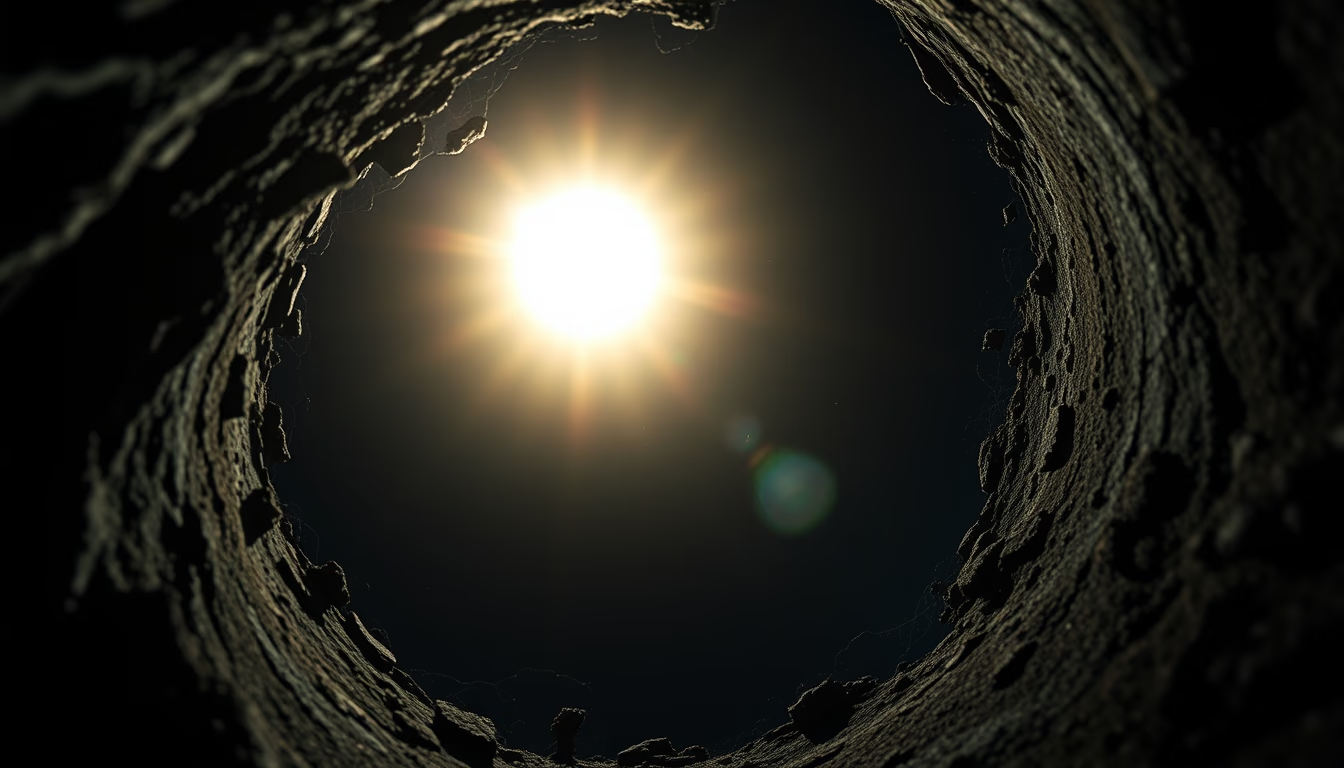
The event horizon of a black hole is the gravitational boundary from which nothing, not even light, can escape. Learn about its physics and significance.
About this subject
The event horizon is the point of no return around a black hole. First defined by physicist Karl Schwarzschild in 1916, it marks the critical radius where the escape velocity equals the speed of light. Inside this boundary, gravity is so intense that any matter or radiation is inevitably pulled toward the central singularity. Einstein's general relativity predicts that, to a distant observer, an object crossing the event horizon appears to freeze in time and become infinitely redshifted due to gravitational redshift.
Although we cannot directly observe the interior of the event horizon, its indirect effects are detectable. In 2019, the Event Horizon Telescope (EHT) produced the first image of the shadow of a supermassive black hole at the center of galaxy M87, revealing a bright ring of heated material orbiting just outside the horizon. This observation confirmed theoretical predictions and opened new avenues for studying extreme gravity.
Black holes can be stellar-mass, formed from the collapse of massive stars, or supermassive, with millions to billions of solar masses, found at the centers of galaxies. The event horizon of a typical stellar black hole has a radius of a few kilometers; that of a supermassive one can be larger than the solar system. Hawking radiation, proposed by Stephen Hawking in 1974, suggests that black holes can emit particles and eventually evaporate, a process involving quantum fluctuations near the event horizon.
Frequently Asked Questions
What is the event horizon of a black hole?
It is the boundary around a black hole from which nothing, including light, can escape. It corresponds to the Schwarzschild radius, where the escape velocity equals the speed of light.
What happens if something crosses the event horizon?
Any matter or radiation crossing the horizon is inevitably pulled into the central singularity. To an outside observer, the object appears to freeze and fade due to gravitational redshift.
Can the event horizon be observed directly?
Not directly, but its effect is detected indirectly. The Event Horizon Telescope (EHT) imaged the shadow of the black hole in M87, showing the dark region corresponding to the horizon.
Direct URL
https://pub-c7d6a6ea828543ac903a74a341ccb2e1.r2.dev/imagens/black-hole-event-horizon-documentary-photography-p5.avifHow to credit
Include a visible link back to UtilizAí. Copy one of the snippets below:
<a href="https://xn--utiliza-eza.com/en/midia/imagens/black-hole-event-horizon-documentary-photography-p5">Black hole event horizon</a> by <a href="https://xn--utiliza-eza.com">UtilizAí</a>, licensed under <a href="https://creativecommons.org/licenses/by/4.0/">CC BY 4.0</a>.
[Black hole event horizon](https://xn--utiliza-eza.com/en/midia/imagens/black-hole-event-horizon-documentary-photography-p5) by [UtilizAí](https://xn--utiliza-eza.com), CC BY 4.0
License: CC-BY-4.0