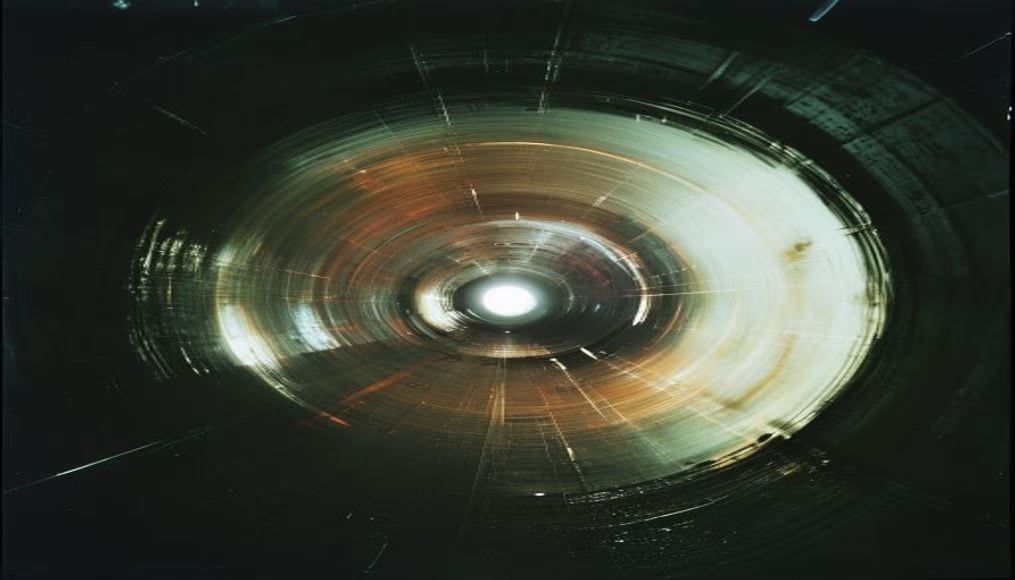
Black hole accretion disk
1344×768 · AVIF · CC BY 4.0

Black hole accretion disk: superheated matter orbiting the event horizon, revealing extreme relativistic phenomena.
About this subject
A black hole accretion disk is a structure of gas and dust spiraling toward the black hole, heating to millions of degrees due to friction and gravitational compression. This process generates intense X-ray and other electromagnetic radiation, enabling astronomers to detect black holes that would otherwise be invisible. Accretion disks are fundamental to the growth of supermassive black holes at galaxy centers, such as M87 and Sagittarius A, the latter at the center of the Milky Way.
The dynamics of accretion disks are described by Einstein's general theory of relativity. Near the event horizon, relativistic effects become dominant: emitted light undergoes gravitational redshift and gravitational lensing distorts the image. Recent observations by the Event Horizon Telescope (EHT) produced the first direct image of a black hole's shadow and its accretion disk, confirming theoretical predictions. The image reveals a bright asymmetric ring due to relativistic beaming (Doppler effect) and the black hole's spin.
Interestingly, the accretion disk is not a stable structure. Magnetohydrodynamic instabilities can cause brightness variations from minutes to years. Additionally, some matter can be ejected as relativistic jets extending thousands of light-years. These jets are powered by extraction of the black hole's rotational energy via the Blandford-Znajek mechanism. Studies of accretion disks also help understand the formation of X-ray binary systems and distant quasars.
Frequently Asked Questions
What is a black hole accretion disk?
It is a structure of superheated gas and dust orbiting a black hole, emitting intense radiation as it spirals toward the event horizon.
How are accretion disks detected?
They are detected mainly by the X-ray and radio radiation they emit. Telescopes like the Event Horizon Telescope can image the black hole's shadow and surrounding disk.
Why are accretion disks important in astrophysics?
They are crucial for black hole growth, production of relativistic jets, and testing general relativity under extreme conditions.
Direct URL
https://pub-c7d6a6ea828543ac903a74a341ccb2e1.r2.dev/imagens/black-hole-accretion-disk-fine-art-photography-p2.avifHow to credit
Include a visible link back to UtilizAí. Copy one of the snippets below:
<a href="https://xn--utiliza-eza.com/en/midia/imagens/black-hole-accretion-disk-fine-art-photography-p2">Black hole accretion disk</a> by <a href="https://xn--utiliza-eza.com">UtilizAí</a>, licensed under <a href="https://creativecommons.org/licenses/by/4.0/">CC BY 4.0</a>.
[Black hole accretion disk](https://xn--utiliza-eza.com/en/midia/imagens/black-hole-accretion-disk-fine-art-photography-p2) by [UtilizAí](https://xn--utiliza-eza.com), CC BY 4.0
License: CC-BY-4.0