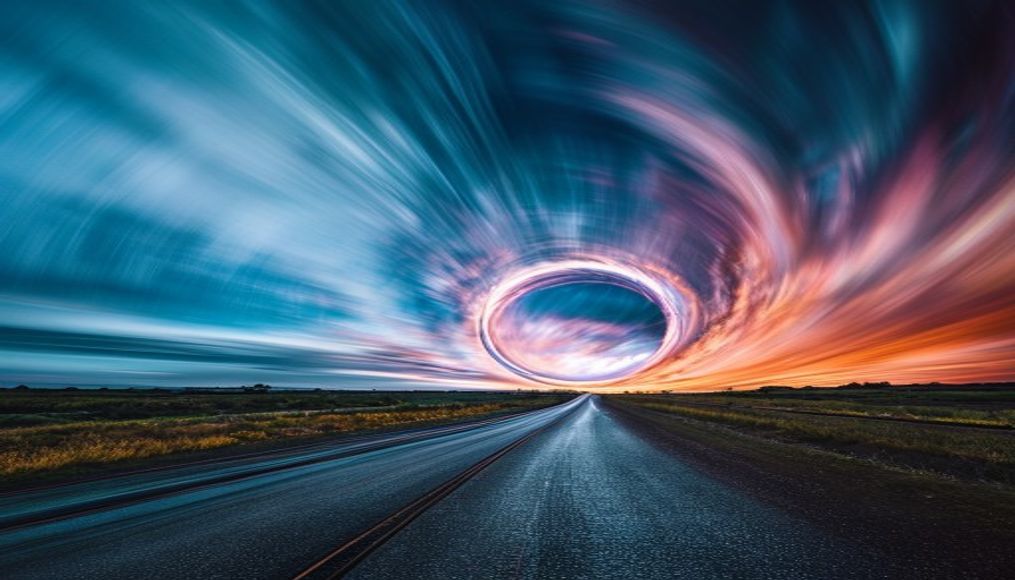
Big bang artistic concept
1344×768 · AVIF · CC BY 4.0

The Big Bang is the scientific theory describing the universe's origin from a singularity about 13.8 billion years ago. This primordial explosion initiated cosmic expansion, shaping the cosmos we know.
About this subject
The Big Bang was not an explosion in space but an expansion of spacetime itself. The theory emerged from Edwin Hubble's observations in the 1920s, showing that distant galaxies were receding, indicating cosmic expansion. Earlier, Belgian priest-astronomer Georges Lemaître had proposed the 'primeval atom' hypothesis, a precursor to the Big Bang. The name 'Big Bang' was coined pejoratively by astrophysicist Fred Hoyle, a proponent of the steady-state theory, in 1949.
The main observational evidence is the cosmic microwave background radiation, discovered accidentally in 1965 by Arno Penzias and Robert Wilson. This 'afterglow' of the Big Bang has a temperature of about 2.7 Kelvin, permeating the entire universe. Another strong piece of evidence is the abundance of light elements such as hydrogen and helium, predicted by primordial nucleosynthesis.
The Big Bang marks the beginning of the universe, but does not explain what came before, if there was a 'before'. Time and space emerged from this event. The universe's expansion continues to accelerate, driven by dark energy, discovered in the 1990s. Studying the Big Bang is essential to modern cosmology, helping to understand the evolution of the cosmos from the earliest moments to the formation of galaxies and stars.
Frequently Asked Questions
What was the Big Bang?
The Big Bang is the theory explaining the universe's origin from an extremely hot and dense singularity that began expanding about 13.8 billion years ago, giving rise to space, time, and matter.
Who proposed the Big Bang theory?
The idea was proposed by Belgian priest-astronomer Georges Lemaître in 1927, based on Einstein's general relativity equations. Edwin Hubble later provided observational evidence by discovering the expansion of galaxies.
What are the main pieces of evidence for the Big Bang?
The main evidence includes the cosmic microwave background radiation, the abundance of light elements (hydrogen and helium), and the observation of the universe's expansion through the redshift of galaxies.
Direct URL
https://pub-c7d6a6ea828543ac903a74a341ccb2e1.r2.dev/imagens/big-bang-artistic-concept-fine-art-photography-p2.avifHow to credit
Include a visible link back to UtilizAí. Copy one of the snippets below:
<a href="https://xn--utiliza-eza.com/en/midia/imagens/big-bang-artistic-concept-fine-art-photography-p2">Big bang artistic concept</a> by <a href="https://xn--utiliza-eza.com">UtilizAí</a>, licensed under <a href="https://creativecommons.org/licenses/by/4.0/">CC BY 4.0</a>.
[Big bang artistic concept](https://xn--utiliza-eza.com/en/midia/imagens/big-bang-artistic-concept-fine-art-photography-p2) by [UtilizAí](https://xn--utiliza-eza.com), CC BY 4.0
License: CC-BY-4.0