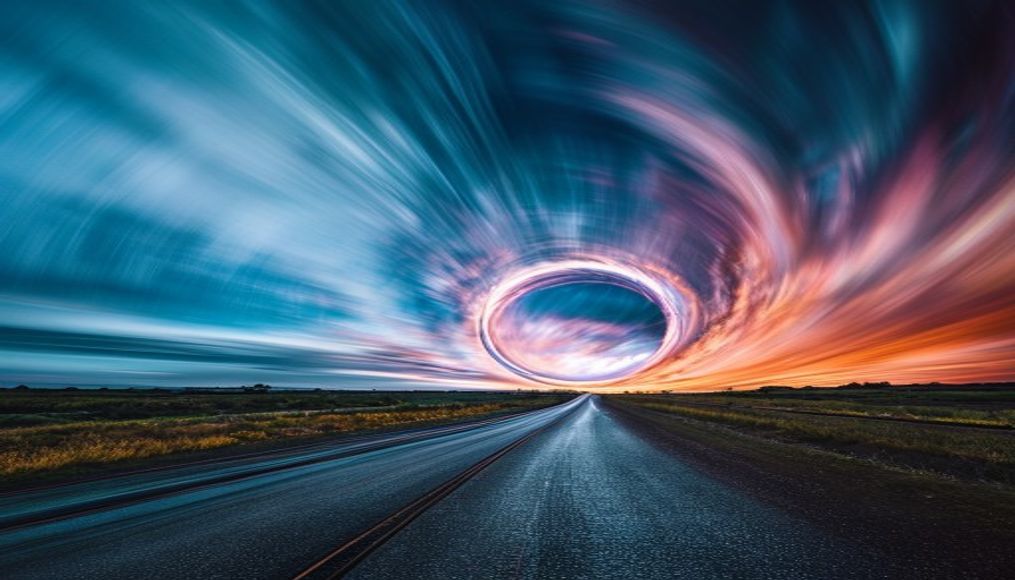
Big bang artistic concept
1344×768 · AVIF · CC BY 4.0

Artistic depiction of the Big Bang, the event that created the universe about 13.8 billion years ago.
About this subject
The Big Bang is the prevailing cosmological model explaining the origin and evolution of the universe. According to this theory, the universe emerged from an extremely hot and dense state about 13.8 billion years ago and has been expanding and cooling ever since. The term "Big Bang" was coined by astronomer Fred Hoyle during a 1949 radio broadcast, originally as a derisive label, but it was later adopted by the scientific community.
Key evidence for the Big Bang includes the cosmic microwave background (CMB) radiation, discovered in 1965 by Arno Penzias and Robert Wilson. This radiation is a remnant of the early universe, uniform in all directions with a temperature of 2.7 K. Another pillar is Hubble-Lemaître's law, which shows that galaxies are receding from each other, indicating expansion. The observed abundances of light elements like hydrogen and helium also match predictions from primordial nucleosynthesis.
The Big Bang was not an explosion in space; it was an expansion of spacetime itself. In the first moments, the universe underwent a rapid exponential expansion known as cosmic inflation. About 380,000 years later, protons and electrons combined to form atoms, releasing radiation that we now detect as the CMB. Over time, small density fluctuations led to the formation of galaxies and stars.
Interestingly, the name "Big Bang" is misleading: there was no center or conventional explosion. The theory faced early opposition, especially from proponents of the steady state model. Today, it is widely accepted, though details about dark matter and dark energy remain mysteries. Telescopes like the James Webb Space Telescope continue to probe the first billion years of cosmic history, testing the theory's limits.
Frequently Asked Questions
What is the Big Bang theory?
It is the scientific explanation for the origin of the universe, which started as an extremely hot and dense point 13.8 billion years ago and has been expanding ever since.
How do we know the Big Bang happened?
Key evidence includes the cosmic microwave background radiation (CMB), the expansion of galaxies (Hubble's law), and the observed abundance of light elements like hydrogen and helium.
Was the Big Bang an explosion in space?
No. It was not a conventional explosion but an expansion of spacetime itself. There is no center from which everything expanded.
Direct URL
https://pub-c7d6a6ea828543ac903a74a341ccb2e1.r2.dev/imagens/big-bang-artistic-concept-film-grain-authentic-p9.avifHow to credit
Include a visible link back to UtilizAí. Copy one of the snippets below:
<a href="https://xn--utiliza-eza.com/en/midia/imagens/big-bang-artistic-concept-film-grain-authentic-p9">Big bang artistic concept</a> by <a href="https://xn--utiliza-eza.com">UtilizAí</a>, licensed under <a href="https://creativecommons.org/licenses/by/4.0/">CC BY 4.0</a>.
[Big bang artistic concept](https://xn--utiliza-eza.com/en/midia/imagens/big-bang-artistic-concept-film-grain-authentic-p9) by [UtilizAí](https://xn--utiliza-eza.com), CC BY 4.0
License: CC-BY-4.0