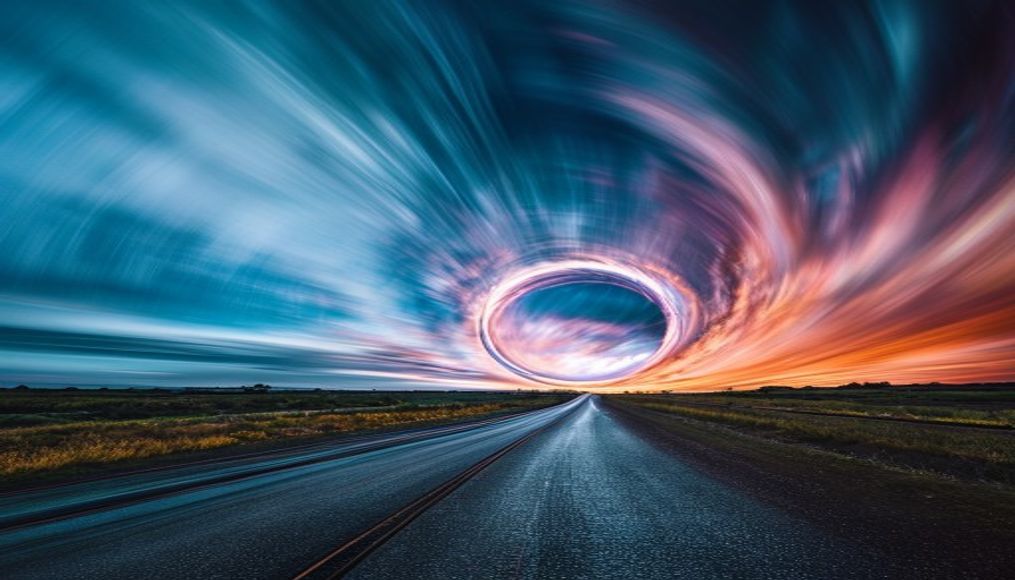
Big bang artistic concept
1344×768 · AVIF · CC BY 4.0
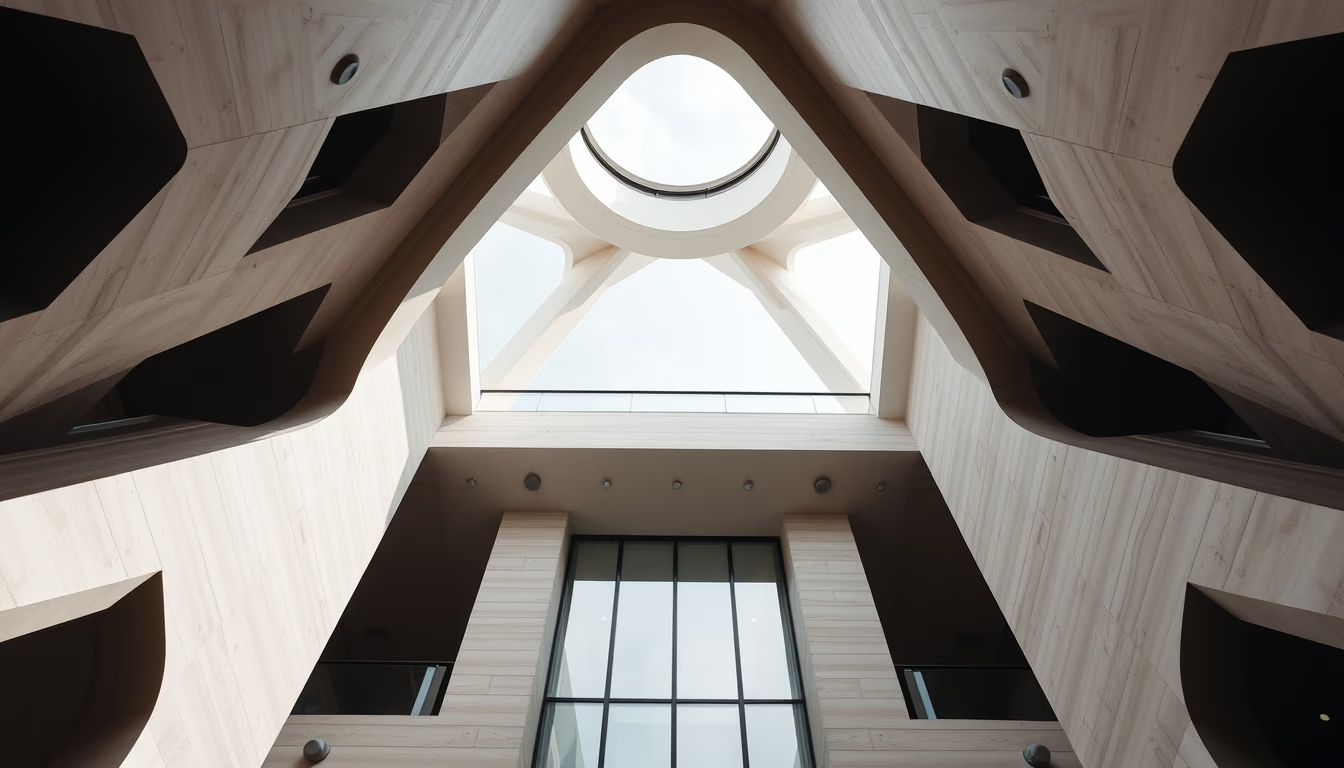
The Big Bang is the scientific theory describing the origin of the universe about 13.8 billion years ago from an extremely hot and dense state.
About this subject
The Big Bang was not an explosion in space but an expansion of spacetime itself. The theory was developed from Einstein's general relativity equations and Edwin Hubble's 1929 observation that galaxies are moving away from each other, indicating an expanding universe. The term 'Big Bang' was coined by astronomer Fred Hoyle, a critic of the theory, during a 1949 radio broadcast.
The cosmic microwave background radiation, discovered by Penzias and Wilson in 1965, is considered one of the key pieces of evidence for the Big Bang. It represents the primordial light of the universe, emitted about 380,000 years after the expansion began, when the universe had cooled enough for protons and electrons to combine into neutral atoms. This radiation fills the entire universe and has a temperature of approximately 2.7 Kelvin.
In the first moments after the Big Bang, the universe underwent a rapid expansion called cosmic inflation, which explains the observed large-scale homogeneity. Primordial nucleosynthesis, occurring within the first few minutes, produced light elements such as hydrogen, helium, and lithium. As the universe expanded and cooled, matter clumped together to form stars and galaxies, a process that continues today.
Although the Big Bang is widely accepted by the scientific community, open questions remain, such as what caused inflation and what came before. Models like loop quantum gravity and string theory attempt to address these questions, but there is no consensus yet.
Frequently Asked Questions
What came before the Big Bang?
The Big Bang theory describes what happened from the initial moment onward, but does not explain what came before. Hypotheses like cyclic universe or quantum gravity suggest possibilities, but there is no definitive answer.
How do we know the Big Bang really happened?
Key evidence includes the expansion of the universe observed by Hubble, the cosmic microwave background radiation, and the abundance of light elements like helium and lithium, matching predictions of primordial nucleosynthesis.
Was the Big Bang an explosion?
No, it was an expansion of spacetime itself. The universe did not explode from a fixed point; all of space expanded from an extremely dense and hot state.
Direct URL
https://pub-c7d6a6ea828543ac903a74a341ccb2e1.r2.dev/imagens/big-bang-artistic-concept-architectural-photography-p8.avifHow to credit
Include a visible link back to UtilizAí. Copy one of the snippets below:
<a href="https://xn--utiliza-eza.com/en/midia/imagens/big-bang-artistic-concept-architectural-photography-p8">Big bang artistic concept</a> by <a href="https://xn--utiliza-eza.com">UtilizAí</a>, licensed under <a href="https://creativecommons.org/licenses/by/4.0/">CC BY 4.0</a>.
[Big bang artistic concept](https://xn--utiliza-eza.com/en/midia/imagens/big-bang-artistic-concept-architectural-photography-p8) by [UtilizAí](https://xn--utiliza-eza.com), CC BY 4.0
License: CC-BY-4.0