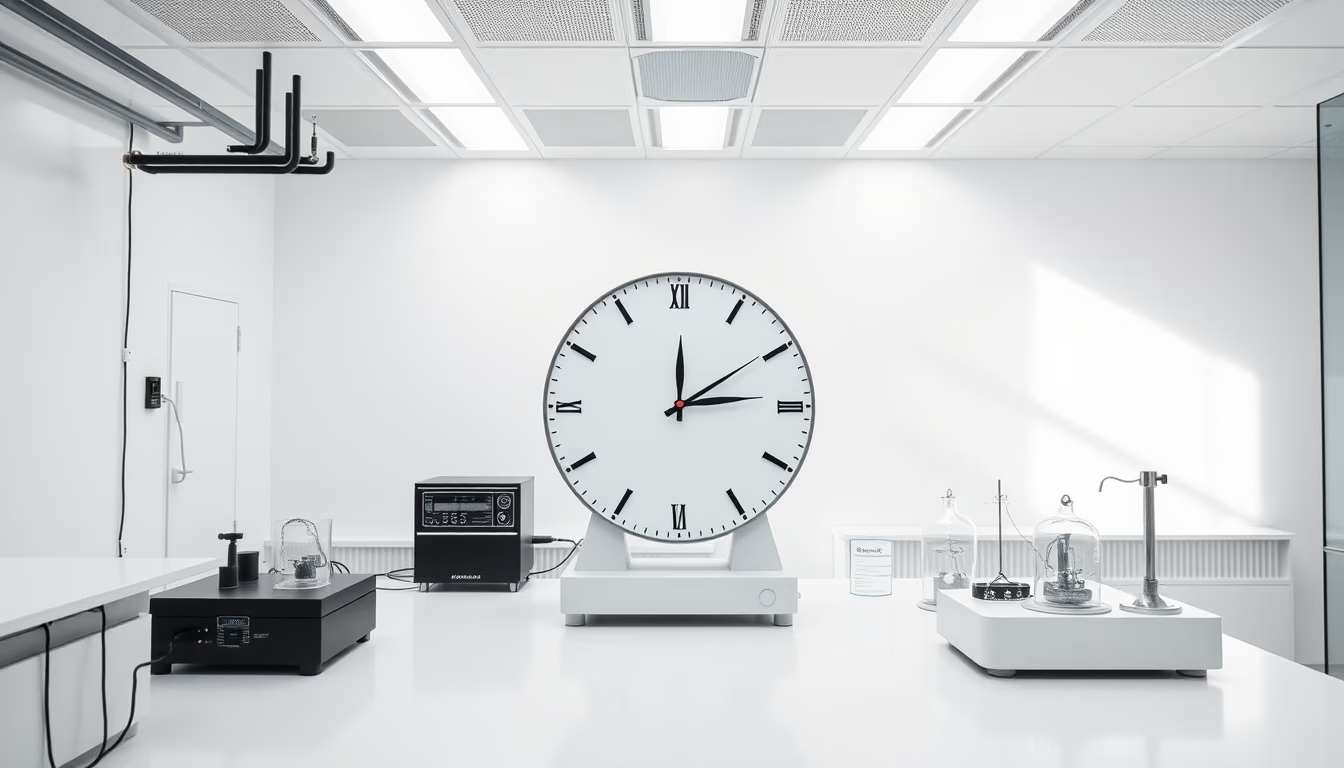
Atomic clock laboratory
1344×768 · AVIF · CC BY 4.0
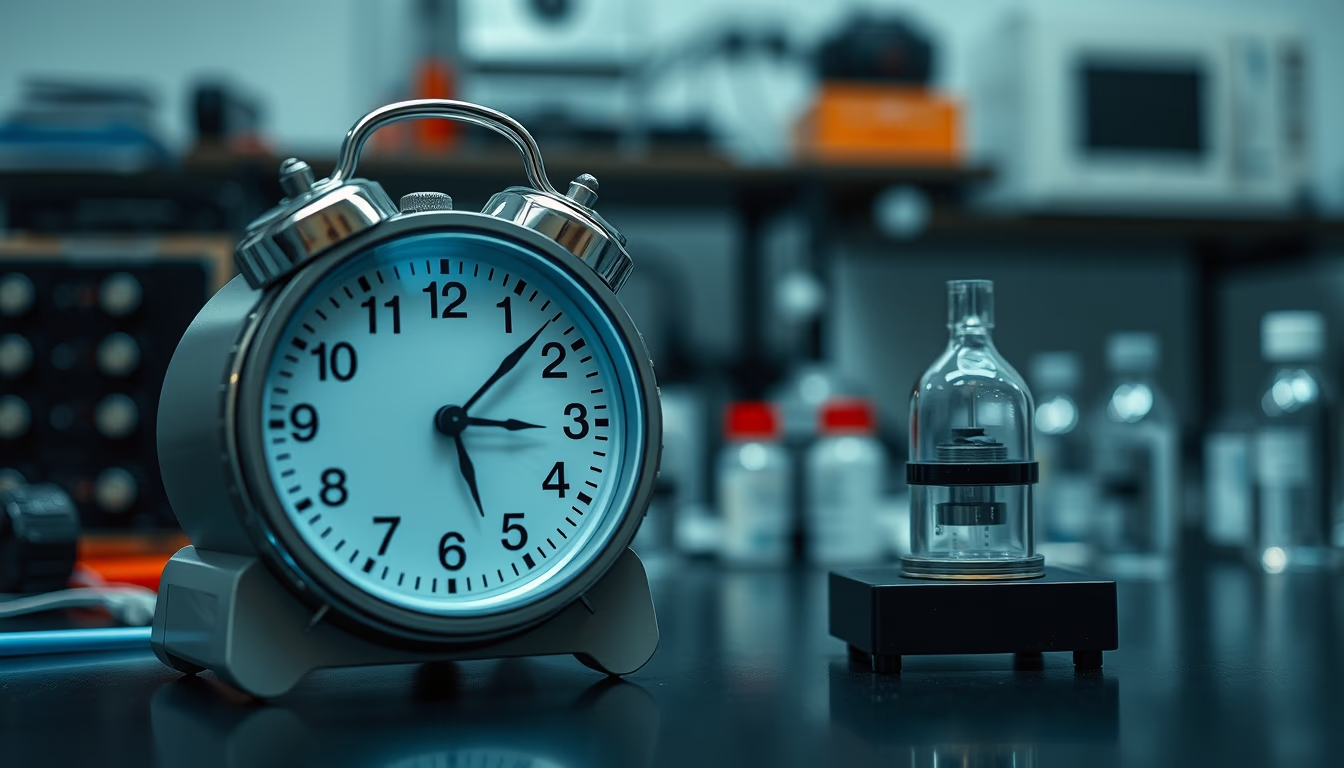
Atomic clock laboratories are centers of temporal precision that define the international standard of the second, based on transitions of cesium or rubidium atoms.
About this subject
An atomic clock measures time using the oscillation frequency of atoms, such as cesium-133. The official second is defined as 9,192,631,770 oscillations of the cesium atom. These instruments are essential for satellite navigation systems (GPS), telecommunications, and scientific experiments requiring extreme precision.
The first atomic clock was developed in 1949 at the National Institute of Standards and Technology (NIST) in the United States, using ammonia. In 1955, Louis Essen built the first cesium clock in the United Kingdom. Since then, accuracy has increased dramatically: modern clocks can lose less than one second in 300 million years.
Atomic clocks work by cooling atoms to near absolute zero and using lasers to measure their transition frequency. The main types are: cesium (primary standard), rubidium (more compact and cheaper, used in satellites), and hydrogen (high stability). NIST-F2 in the USA is one of the most precise in the world.
Brazil has the Observatório Nacional, which maintains the official Brazilian time synchronized with atomic clocks. Internationally, the International Bureau of Weights and Measures coordinates International Atomic Time (TAI). Without such laboratories, global synchronization of power grids, internet, and GPS would be impossible.
Frequently Asked Questions
How does an atomic clock work?
It uses the vibration of atoms (e.g., cesium) as a pendulum. Atoms are cooled and exposed to microwaves; the frequency that causes resonance defines the second.
Where are atomic clocks used in daily life?
In GPS satellites, 5G networks, financial data transmission, and power grid synchronization.
What is the most accurate atomic clock in the world?
Currently, the NIST-F2 (USA) has an uncertainty of 1 second in 300 million years, but experimental optical clocks are even more precise.
Direct URL
https://pub-c7d6a6ea828543ac903a74a341ccb2e1.r2.dev/imagens/atomic-clock-laboratory-studio-still-life-p2.avifHow to credit
Include a visible link back to UtilizAí. Copy one of the snippets below:
<a href="https://xn--utiliza-eza.com/en/midia/imagens/atomic-clock-laboratory-studio-still-life-p2">Atomic clock laboratory</a> by <a href="https://xn--utiliza-eza.com">UtilizAí</a>, licensed under <a href="https://creativecommons.org/licenses/by/4.0/">CC BY 4.0</a>.
[Atomic clock laboratory](https://xn--utiliza-eza.com/en/midia/imagens/atomic-clock-laboratory-studio-still-life-p2) by [UtilizAí](https://xn--utiliza-eza.com), CC BY 4.0
License: CC-BY-4.0