Atomic clock laboratory
1344×768 · AVIF · CC BY 4.0

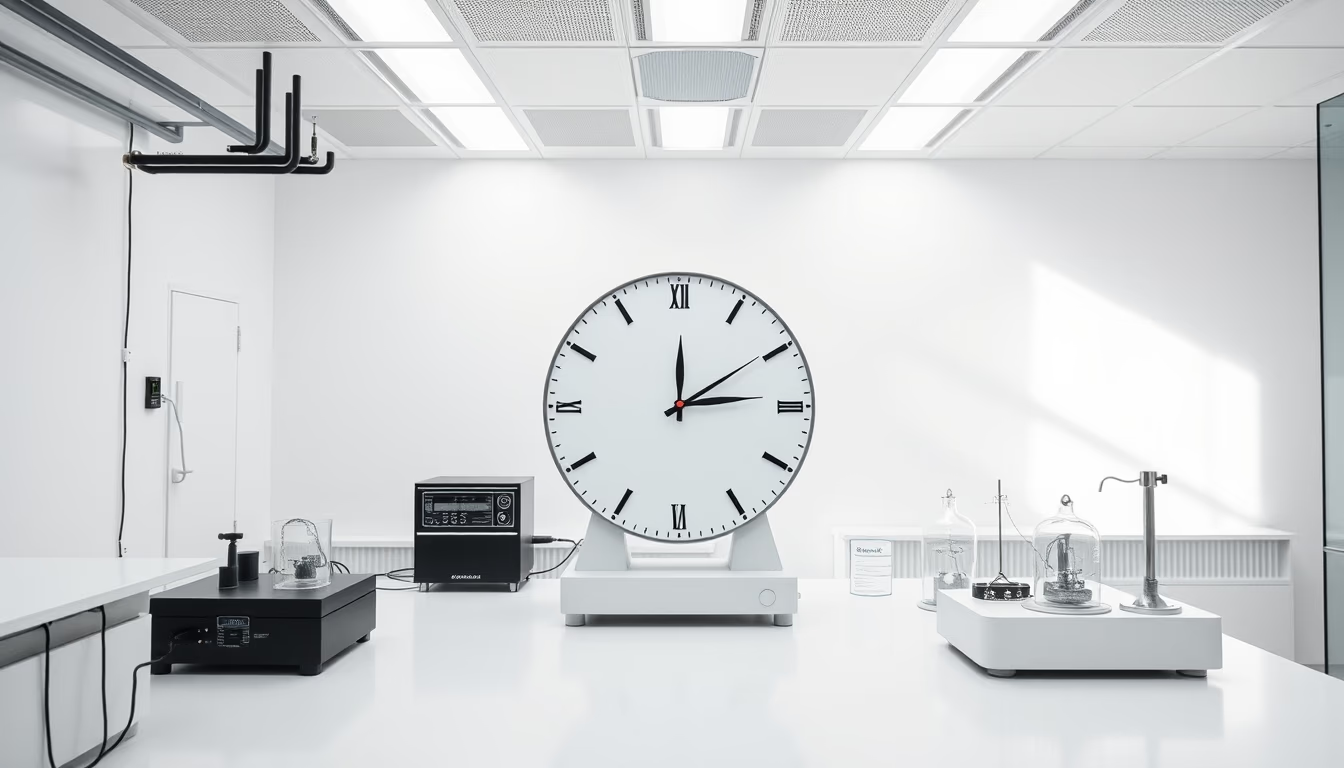
Atomic clock laboratory: time precision based on quantum transitions. Learn how these devices define universal time.
About this subject
Atomic clocks are the most precise timekeeping devices ever built. They operate by exploiting the transitions between energy levels of atoms, typically cesium-133, rubidium, or hydrogen. The modern definition of the second, in the International System of Units (SI), is based on the radiation frequency emitted by the cesium atom: 9,192,631,770 oscillations. This standard is maintained in metrology laboratories around the world, such as the National Institute of Standards and Technology (NIST) in the USA and the National Observatory in Brazil, which operates the generation and dissemination system for the Brazilian Legal Time.
These laboratories use laser-cooled atomic beams, cesium ovens, and microwave cavities to stabilize a quartz oscillator. The resulting accuracy can achieve an error of just 1 second every 300 million years. Atomic clocks are critical for satellite navigation systems (GPS, GLONASS, Galileo), synchronization of telecommunications networks, fundamental physics experiments, and even high-precision astronomical observations.
Brazil contributes to the field through the National Observatory (ON/MCTI), which maintains the country's primary time and frequency standard. Although it still uses a commercial cesium standard, research is underway to develop optical atomic clocks, promising even greater precision based on strontium or ytterbium ions. A visit to a laboratory like the one depicted in the image reveals racks of equipment, vacuum systems, and lasers that compose these ultra-stable timepieces.
Frequently Asked Questions
What is an atomic clock and how does it work?
An atomic clock measures time using the natural vibrations of atoms, typically cesium. It locks a microwave field to the exact frequency that makes atoms change energy states, counting those oscillations to define the second.
Where are atomic clocks used in everyday life?
They are crucial for GPS, which relies on atomic clocks in satellites for precise positioning. They also synchronize power grids, financial transactions, and telecommunications.
How accurate is an atomic clock?
The best cesium atomic clocks lose less than 1 second every 300 million years. Experimental optical clocks can achieve an accuracy of 1 second in 30 billion years.
Direct URL
https://pub-c7d6a6ea828543ac903a74a341ccb2e1.r2.dev/imagens/atomic-clock-laboratory-aerial-drone-shot-p10.avifHow to credit
Include a visible link back to UtilizAí. Copy one of the snippets below:
<a href="https://xn--utiliza-eza.com/en/midia/imagens/atomic-clock-laboratory-aerial-drone-shot-p10">Atomic clock laboratory</a> by <a href="https://xn--utiliza-eza.com">UtilizAí</a>, licensed under <a href="https://creativecommons.org/licenses/by/4.0/">CC BY 4.0</a>.
[Atomic clock laboratory](https://xn--utiliza-eza.com/en/midia/imagens/atomic-clock-laboratory-aerial-drone-shot-p10) by [UtilizAí](https://xn--utiliza-eza.com), CC BY 4.0
License: CC-BY-4.0