Asteroid belt artistic
1344×768 · AVIF · CC BY 4.0
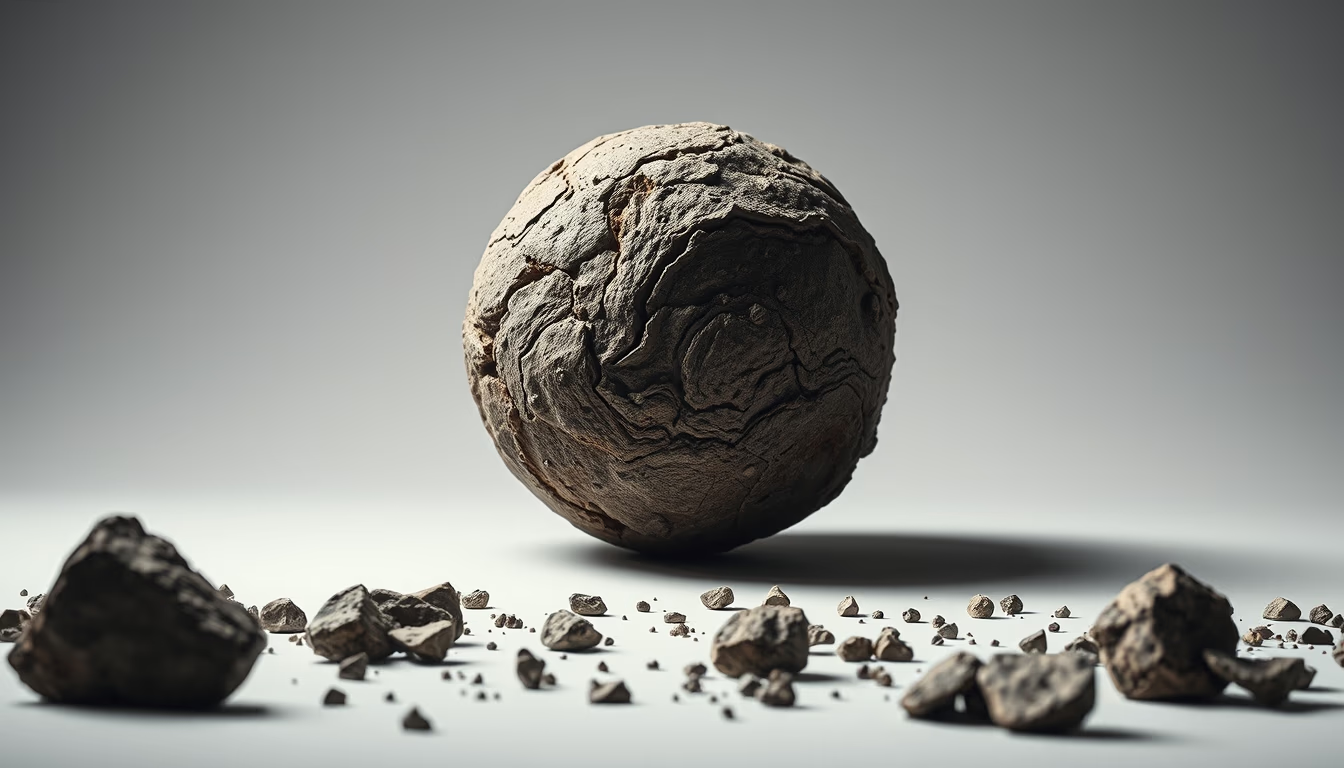
The asteroid belt, a region between Mars and Jupiter, contains millions of rocky bodies that are remnants from the early Solar System.
About this subject
The asteroid belt is a region of the Solar System located between the orbits of Mars and Jupiter, approximately 2.2 to 3.2 astronomical units from the Sun. It is estimated to contain millions of asteroids, of which hundreds of thousands are larger than one kilometer in diameter. The largest is the dwarf planet Ceres, about 940 km in diameter, followed by Vesta, Pallas, and Hygiea. These bodies are composed mainly of rock and metal, and their distribution is not uniform: there are gaps, called Kirkwood gaps, caused by orbital resonances with Jupiter.
The origin of the belt dates back to the formation of the Solar System about 4.6 billion years ago. At that time, primordial matter clumped together to form planets, but Jupiter's strong gravity prevented material in this region from coalescing into a large planet. Instead, they collided and fragmented, creating the current population of asteroids. Studies indicate that the total mass of the belt is less than 4% of the Moon's mass, much smaller than previously thought.
The asteroid belt has great scientific importance. Missions like NASA's Dawn visited Ceres and Vesta, providing valuable data on the composition and history of these bodies. Additionally, asteroids are considered potential sources of mineral resources, such as precious metals and water, sparking interest for future exploitation. However, distance and technical challenges still make this idea difficult. The belt is also a source of meteorites that fall to Earth, enabling laboratory studies of the early Solar System's composition.
Frequently Asked Questions
What is the asteroid belt?
It is a region of the Solar System between Mars and Jupiter containing millions of rocky and metallic bodies, remnants from planetary formation.
What is the largest asteroid in the belt?
Ceres, classified as a dwarf planet, about 940 km in diameter, followed by Vesta, Pallas, and Hygiea.
Why didn't the asteroid belt form a planet?
Jupiter's gravitational influence disrupted the material in the region, preventing it from coalescing into a larger body and resulting in the current asteroids.
Direct URL
https://pub-c7d6a6ea828543ac903a74a341ccb2e1.r2.dev/imagens/asteroid-belt-artistic-studio-still-life-p12.avifHow to credit
Include a visible link back to UtilizAí. Copy one of the snippets below:
<a href="https://xn--utiliza-eza.com/en/midia/imagens/asteroid-belt-artistic-studio-still-life-p12">Asteroid belt artistic</a> by <a href="https://xn--utiliza-eza.com">UtilizAí</a>, licensed under <a href="https://creativecommons.org/licenses/by/4.0/">CC BY 4.0</a>.
[Asteroid belt artistic](https://xn--utiliza-eza.com/en/midia/imagens/asteroid-belt-artistic-studio-still-life-p12) by [UtilizAí](https://xn--utiliza-eza.com), CC BY 4.0
License: CC-BY-4.0