Asteroid belt artistic
1344×768 · AVIF · CC BY 4.0
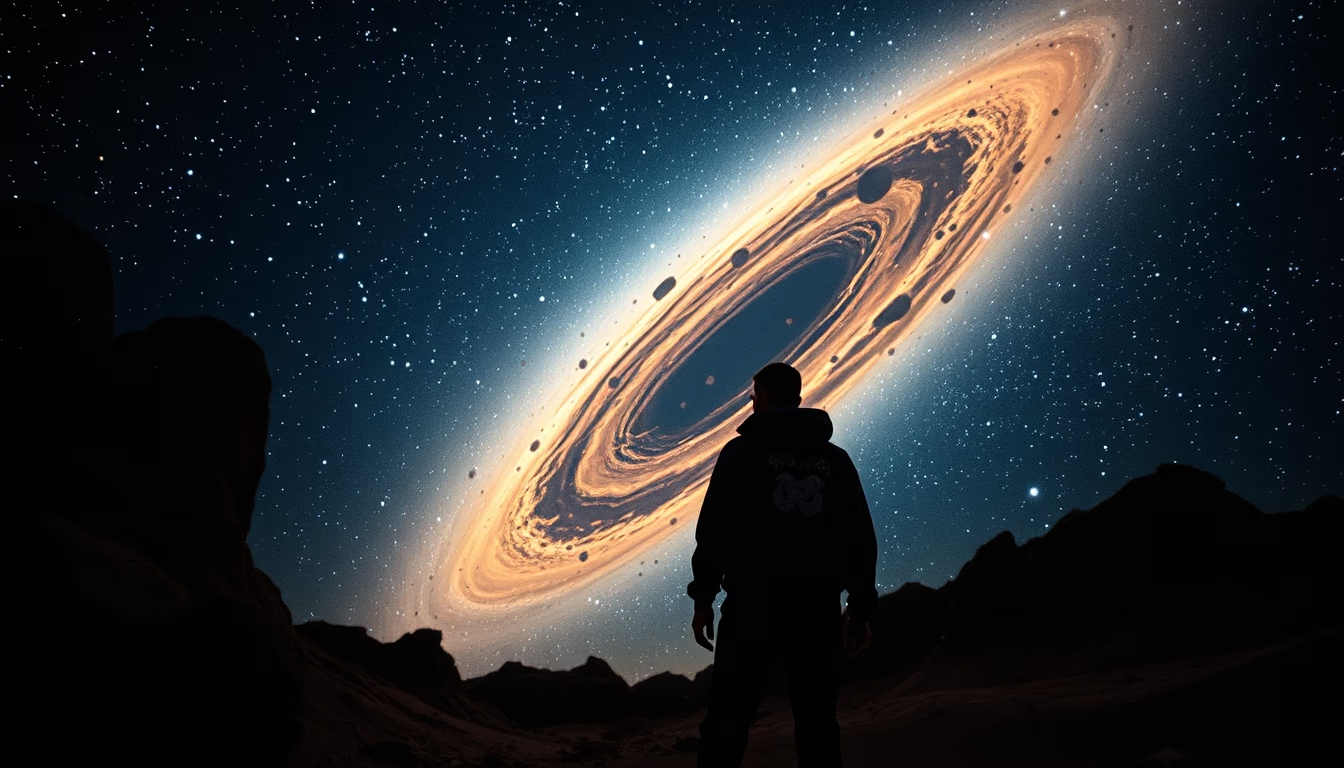
The asteroid belt, a region between Mars and Jupiter, is one of the largest remnants of the Solar System's formation.
About this subject
The asteroid belt is a vast region of space between Mars and Jupiter, located about 2.1 to 3.3 astronomical units from the Sun. It contains millions of rocky and metallic bodies ranging from dust particles to dwarf planets like Ceres, which is about 940 km across. The total mass of the belt is estimated to be only 4% of the Moon's mass, distributed among roughly 1.9 million objects larger than 1 km in diameter.
Formed around 4.6 billion years ago, the asteroid belt is a remnant of the early Solar System. Jupiter's strong gravity prevented the material in this region from accreting into a full planet, leaving behind a population of primitive bodies that preserve clues about the solar nebula. The main compositional types are S-type (silicaceous), C-type (carbonaceous), and M-type (metallic), with carbonaceous asteroids containing organic compounds and water.
Space missions have provided invaluable data: NASA's Dawn spacecraft visited Vesta and Ceres from 2011 to 2018, revealing complex geology. Vesta has a basaltic crust and a massive south pole impact basin, while Ceres shows cryovolcanoes and salt deposits, indicating recent internal activity. Sample-return missions like Hayabusa2 and OSIRIS-REx have collected material from near-Earth asteroids that originated in the main belt.
Contrary to popular science fiction, the asteroid belt is not a dense, hazardous field. The average distance between asteroids is about 1.6 million kilometers, making collisions incredibly rare. However, occasional impacts can send fragments toward the inner Solar System, producing meteoroids that sometimes fall to Earth as meteorites. Studying these objects helps scientists understand the early Solar System's composition and planetary formation processes.
Frequently Asked Questions
What is the asteroid belt?
It is a region of the Solar System between the orbits of Mars and Jupiter where the majority of known asteroids are located, composed mainly of rock and metal.
What is the largest object in the asteroid belt?
The largest is Ceres, a dwarf planet about 940 km in diameter, which contains roughly one-third of the belt's total mass.
Is the asteroid belt dangerous for spacecraft?
No. The density of objects is extremely low; the average distance between asteroids is about 1.6 million km, and spacecraft can traverse it safely.
Direct URL
https://pub-c7d6a6ea828543ac903a74a341ccb2e1.r2.dev/imagens/asteroid-belt-artistic-film-grain-authentic-p10.avifHow to credit
Include a visible link back to UtilizAí. Copy one of the snippets below:
<a href="https://xn--utiliza-eza.com/en/midia/imagens/asteroid-belt-artistic-film-grain-authentic-p10">Asteroid belt artistic</a> by <a href="https://xn--utiliza-eza.com">UtilizAí</a>, licensed under <a href="https://creativecommons.org/licenses/by/4.0/">CC BY 4.0</a>.
[Asteroid belt artistic](https://xn--utiliza-eza.com/en/midia/imagens/asteroid-belt-artistic-film-grain-authentic-p10) by [UtilizAí](https://xn--utiliza-eza.com), CC BY 4.0
License: CC-BY-4.0