Andromeda galaxy spiral
1344×768 · AVIF · CC BY 4.0
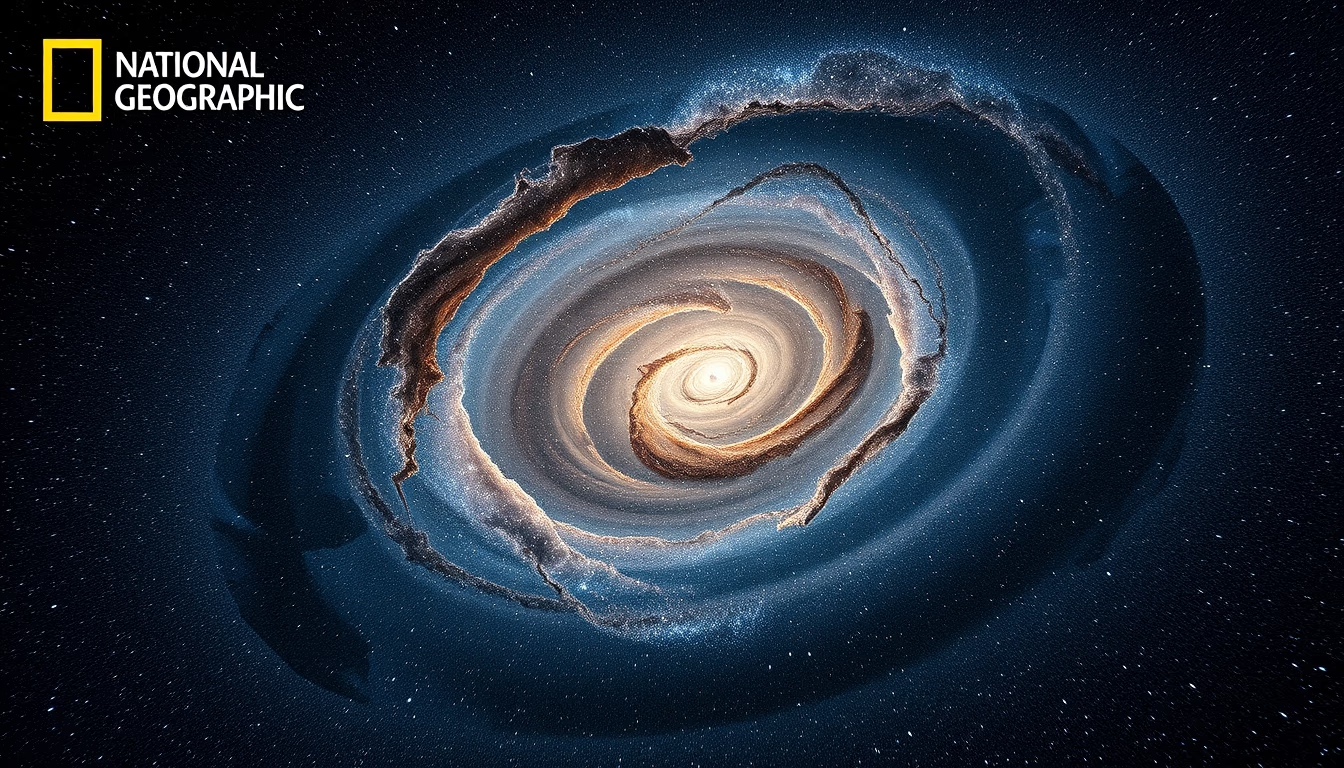
The Andromeda Galaxy (M31), the nearest giant spiral to the Milky Way, is approaching our system at 300 km/s.
About this subject
The Andromeda Galaxy, cataloged as Messier 31 or NGC 224, is the largest galaxy in the Local Group, a collection of over 50 galaxies that includes the Milky Way and the Triangulum Galaxy. Located approximately 2.5 million light-years from Earth in the constellation Andromeda, it stands out for its apparent brightness and well-defined spiral structure. With a diameter of about 220,000 light-years, Andromeda is considerably larger than the Milky Way, containing approximately one trillion stars, twice as many as our galaxy.
Observed since ancient times, it was described by the Persian astronomer Al-Sufi in the 10th century as a "small cloud." In the 18th century, Charles Messier cataloged it as M31, although its extragalactic nature was only confirmed by Edwin Hubble in the 1920s when he identified Cepheid variable stars in its halo. This discovery revolutionized astronomy by proving that the universe was much larger than the Milky Way.
Today, it is known that Andromeda and the Milky Way are on a collision course, expected to occur in about 4.5 billion years. The two galaxies are approaching each other at 300 km/s, and upon merging, they will form a new giant elliptical galaxy, nicknamed "Milkomeda" or "Milkdromeda." During the process, the spiral structures will be destroyed, but individual stars are unlikely to collide due to the immense distances between them.
The galaxy has two prominent satellites visible in amateur telescopes: M32, a compact elliptical galaxy, and M110, a dwarf elliptical galaxy. These satellites orbit Andromeda and interact gravitationally with it, distorting its disk. For observers in the Northern Hemisphere, Andromeda is visible to the naked eye on dark nights as an elongated fuzzy patch, being one of the most distant objects that can be seen without optical aid.
Frequently Asked Questions
How far is the Andromeda Galaxy from Earth?
Andromeda is located approximately 2.5 million light-years away from Earth in the constellation Andromeda.
Will the Andromeda Galaxy collide with the Milky Way?
Yes, the two galaxies are on a collision course and are expected to merge in about 4.5 billion years, forming a new giant elliptical galaxy.
Can the Andromeda Galaxy be seen with the naked eye?
Yes, on dark nights without light pollution, Andromeda is visible to the naked eye as an elongated fuzzy patch in the Northern Hemisphere sky.
Direct URL
https://pub-c7d6a6ea828543ac903a74a341ccb2e1.r2.dev/imagens/andromeda-galaxy-spiral-national-geographic-style-p0.avifHow to credit
Include a visible link back to UtilizAí. Copy one of the snippets below:
<a href="https://xn--utiliza-eza.com/en/midia/imagens/andromeda-galaxy-spiral-national-geographic-style-p0">Andromeda galaxy spiral</a> by <a href="https://xn--utiliza-eza.com">UtilizAí</a>, licensed under <a href="https://creativecommons.org/licenses/by/4.0/">CC BY 4.0</a>.
[Andromeda galaxy spiral](https://xn--utiliza-eza.com/en/midia/imagens/andromeda-galaxy-spiral-national-geographic-style-p0) by [UtilizAí](https://xn--utiliza-eza.com), CC BY 4.0
License: CC-BY-4.0