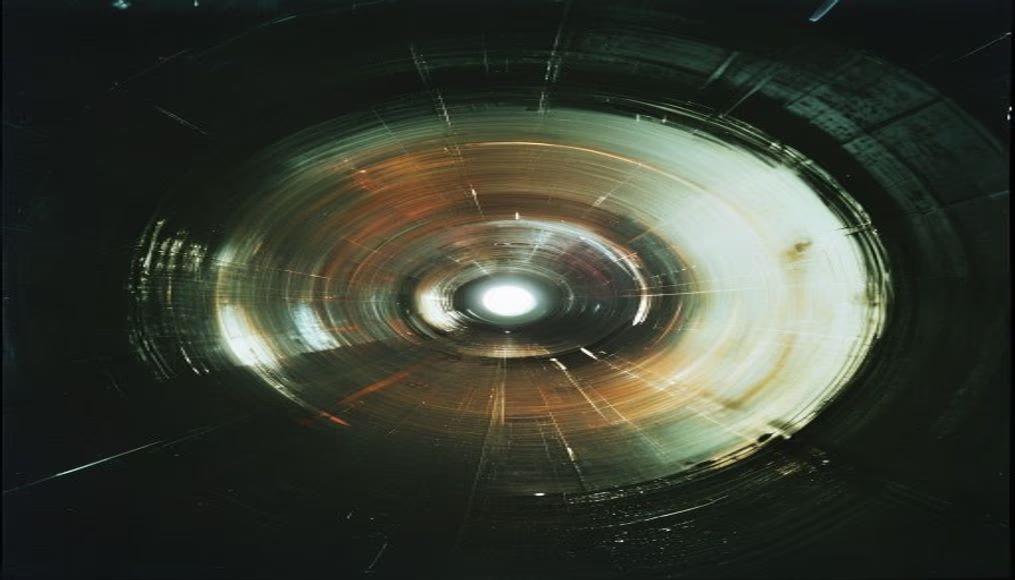
White dwarf star fading
1344×768 · AVIF · CC BY 4.0

White dwarfs are dead stars that gradually cool and fade over billions of years, a process known as fading.
About this subject
A white dwarf is the remnant core of a low- to medium-mass star after it has exhausted its nuclear fuel and expelled its outer layers. This stellar object is extremely dense, with a mass comparable to the Sun compressed into a volume similar to Earth. Once formed, the white dwarf has no internal energy source; it shines only by residual heat. This heat is gradually radiated into space, causing the star to cool and dim over time, a phenomenon called fading.
The cooling process of a white dwarf is extremely slow. A typical white dwarf is estimated to take tens of billions of years to cool enough to become a black dwarf, an object so cold it emits no visible radiation. Since the universe is about 13.8 billion years old, no black dwarfs exist yet. The oldest known white dwarfs, aged about 10 to 12 billion years, are still relatively hot, with surface temperatures of a few thousand degrees Celsius.
A well-studied example of a white dwarf is Sirius B, the companion of the brightest star in the night sky, Sirius. Sirius B has roughly the mass of the Sun but the size of Earth. Its surface temperature is about 25,000 K, but it is gradually cooling. Observing white dwarfs like Sirius B allows astronomers to test models of stellar evolution and high-density physics. Studying the fading of these stars also provides clues about the age of stellar populations, such as globular clusters.
Interestingly, the cooling rate of a white dwarf is not constant. Initially, it is faster, but as the star cools, the rate decreases. This is because the white dwarf is composed mainly of carbon and oxygen in a degenerate state, and its specific heat changes with temperature. Eventually, crystallization of the interior may release latent heat, further slowing the cooling. This phenomenon makes the time for a white dwarf to become a black dwarf even longer than predicted by simple models.
Frequently Asked Questions
How long does it take for a white dwarf to cool completely?
A white dwarf takes tens of billions of years to cool enough to become a black dwarf. Since the universe is only 13.8 billion years old, no black dwarfs have formed yet.
What is a black dwarf?
A black dwarf is the hypothetical final stage of a white dwarf, when it has cooled completely and no longer emits significant visible or infrared radiation. None have been observed.
Are there white dwarfs visible to the naked eye?
Yes, Sirius B is a white dwarf visible with amateur telescopes, but not to the naked eye due to the intense brightness of Sirius A. Other white dwarfs, such as 40 Eridani B, are also observable.
Direct URL
https://pub-c7d6a6ea828543ac903a74a341ccb2e1.r2.dev/imagens/white-dwarf-star-fading-macro-closeup-p7.avifHow to credit
Include a visible link back to UtilizAí. Copy one of the snippets below:
<a href="https://xn--utiliza-eza.com/en/midia/imagens/white-dwarf-star-fading-macro-closeup-p7">White dwarf star fading</a> by <a href="https://xn--utiliza-eza.com">UtilizAí</a>, licensed under <a href="https://creativecommons.org/licenses/by/4.0/">CC BY 4.0</a>.
[White dwarf star fading](https://xn--utiliza-eza.com/en/midia/imagens/white-dwarf-star-fading-macro-closeup-p7) by [UtilizAí](https://xn--utiliza-eza.com), CC BY 4.0
License: CC-BY-4.0