Voyager 1 deep space
1344×768 · AVIF · CC BY 4.0

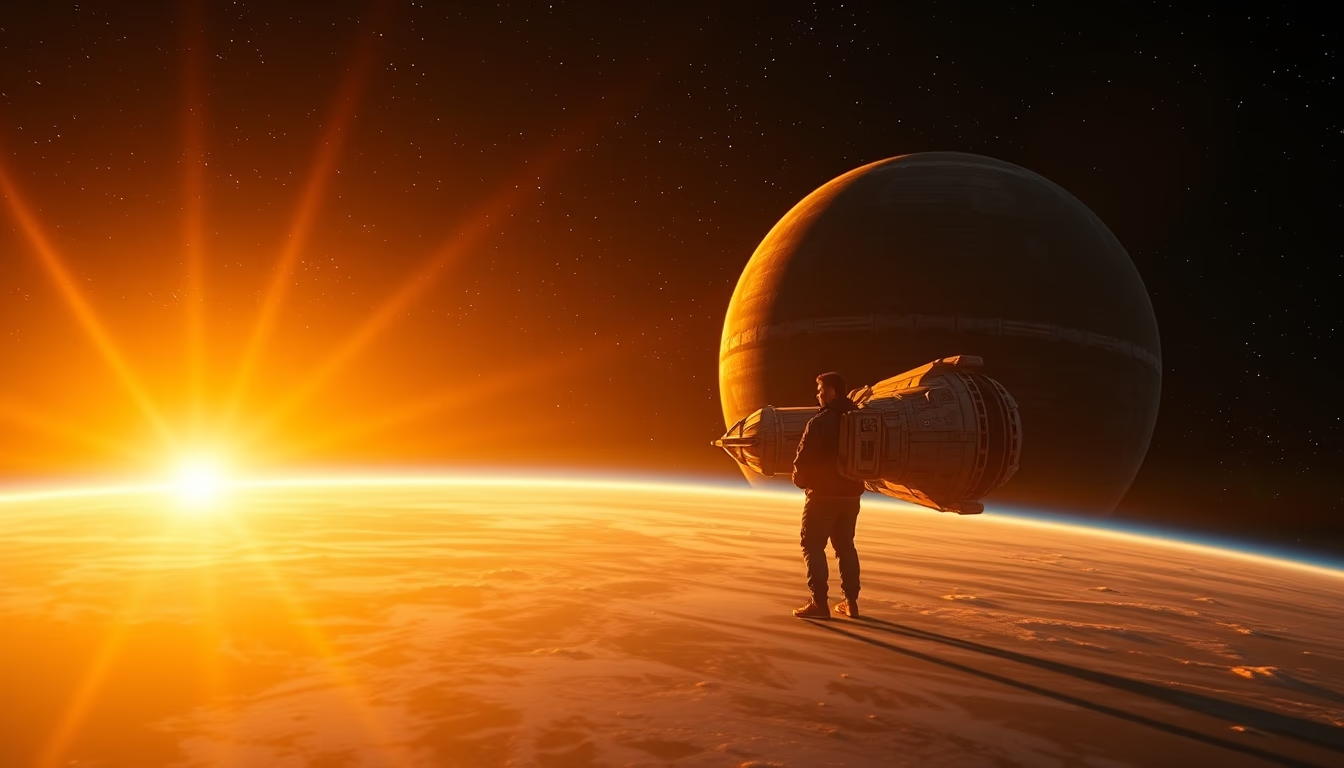
Launched in 1977, Voyager 1 is the farthest human-made object from Earth, exploring interstellar space since 2012.
About this subject
Voyager 1 is a NASA space probe launched on September 5, 1977, alongside its twin Voyager 2. Its initial mission was to study Jupiter and Saturn, but after completing that, it continued its journey into deep space. On August 25, 2012, it became the first human-made object to enter interstellar space, the region between stars where the Sun's plasma no longer dominates. Currently more than 24 billion kilometers from Earth, it still sporadically sends data via the Deep Space Network.
The probe carries the Golden Record, a phonograph with greetings and sounds of Earth, designed to communicate human existence to any alien civilization. This record includes 115 images, greetings in 55 languages, and music from different cultures, such as Beethoven's Fifth Symphony. The content selection was led by Carl Sagan, who also helped choose the famous “Pale Blue Dot” image, taken by Voyager 1 in 1990 at his request.
Voyager 1's longevity is remarkable: its plutonium-238 batteries are expected to last until around 2025, when instruments will be turned off one by one. The probe will continue its silent journey through the Milky Way for millions of years, one of the most enduring legacies of human scientific ambition. Unlike modern missions, Voyager 1 has not had a course correction for decades, traveling inertially through space.
Frequently Asked Questions
How far is Voyager 1 from Earth now?
Voyager 1 is over 24 billion kilometers from Earth, about 160 times the Earth-Sun distance. Signals take approximately 22 hours to reach NASA.
What is the Golden Record on Voyager?
It is a copper phonograph plated with gold that contains 115 images, natural sounds, greetings in 55 languages, and music. It was designed to represent humanity if the probe is found by aliens.
When will Voyager 1 stop working?
Voyager 1's scientific instruments are expected to operate until around 2025, when the plutonium batteries will no longer provide enough power. After that, it will continue traveling but will no longer transmit data.
Direct URL
https://pub-c7d6a6ea828543ac903a74a341ccb2e1.r2.dev/imagens/voyager-1-deep-space-high-fashion-editorial-fresh6.avifHow to credit
Include a visible link back to UtilizAí. Copy one of the snippets below:
<a href="https://xn--utiliza-eza.com/en/midia/imagens/voyager-1-deep-space-high-fashion-editorial-fresh6">Voyager 1 deep space</a> by <a href="https://xn--utiliza-eza.com">UtilizAí</a>, licensed under <a href="https://creativecommons.org/licenses/by/4.0/">CC BY 4.0</a>.
[Voyager 1 deep space](https://xn--utiliza-eza.com/en/midia/imagens/voyager-1-deep-space-high-fashion-editorial-fresh6) by [UtilizAí](https://xn--utiliza-eza.com), CC BY 4.0
License: CC-BY-4.0