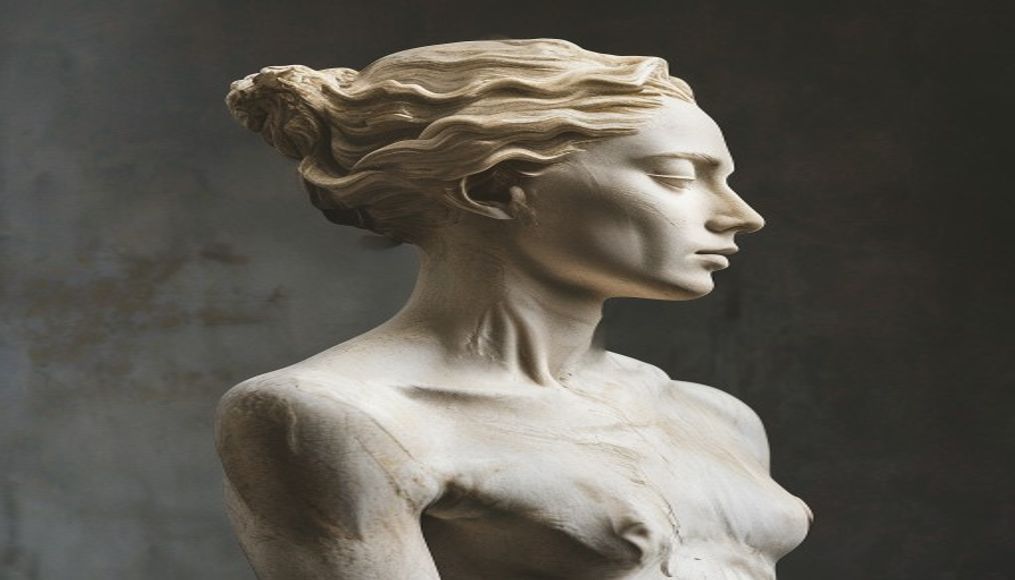
Venus de milo armless
1344×768 · JPG · CC BY 4.0
Venus, the second planet from the Sun, is one of the brightest celestial bodies in the night sky, known as the Evening Star.
About this subject
Venus is a rocky planet similar in size and mass to Earth, often called Earth's 'sister planet.' It has a thick atmosphere composed mainly of carbon dioxide, with clouds of sulfuric acid, creating a runaway greenhouse effect that heats its surface to about 465°C, hot enough to melt lead. Its rotation is retrograde and extremely slow: one Venusian day lasts 243 Earth days, longer than its year (225 days).
The surface of Venus is covered by vast volcanic plains, mountains, and thousands of volcanoes, some possibly active. NASA's Magellan spacecraft mapped 98% of the surface using radar in the 1990s, revealing features such as Maxwell Montes, the highest point, and the region Aphrodite Terra. Despite extreme conditions, Venus may have had liquid oceans in its distant past, making it a candidate for ancient life.
Culturally, Venus plays a central role in Roman mythology as the goddess of love and beauty, and in the sky it is the third brightest object after the Sun and Moon. Its appearance at twilight earned it the popular names Morning Star and Evening Star. Telescopic observations reveal phases like the Moon, confirming its orbit inside Earth's.
Recent explorations, such as the BepiColombo mission (en route to Mercury) and future NASA missions DAVINCI+ and VERITAS, aim to unravel the mysteries of its atmosphere and geology. Venus continues to intrigue scientists for its similarities and differences with Earth, serving as a natural laboratory to study extreme greenhouse effects and planetary evolution.
Frequently Asked Questions
Why is Venus called the Evening Star?
Venus is visible to the naked eye shortly before sunrise or after sunset, earning the names Morning Star and Evening Star. Its intense brightness comes from its proximity to Earth and the high reflectivity of its clouds.
What are the main differences between Venus and Earth?
Despite similar size, Venus has a dense toxic atmosphere, surface pressure 90 times that of Earth, extreme temperatures, and retrograde rotation. It lacks active plate tectonics and its surface is dominated by volcanism.
Is there any possibility of life on Venus?
On the surface, no, due to extreme conditions. However, in the upper atmosphere at about 50 km altitude, temperature and pressure are milder, and some studies suggest possible airborne microorganisms.
Direct URL
https://pub-c7d6a6ea828543ac903a74a341ccb2e1.r2.dev/imagens/venus-de-milo-armless-national-geographic-style-p3.jpgHow to credit
Include a visible link back to UtilizAí. Copy one of the snippets below:
<a href="https://xn--utiliza-eza.com/en/midia/imagens/venus-de-milo-armless-national-geographic-style-p3">Venus de milo armless</a> by <a href="https://xn--utiliza-eza.com">UtilizAí</a>, licensed under <a href="https://creativecommons.org/licenses/by/4.0/">CC BY 4.0</a>.
[Venus de milo armless](https://xn--utiliza-eza.com/en/midia/imagens/venus-de-milo-armless-national-geographic-style-p3) by [UtilizAí](https://xn--utiliza-eza.com), CC BY 4.0
License: CC-BY-4.0