Uranus blue tilted
1344×768 · AVIF · CC BY 4.0
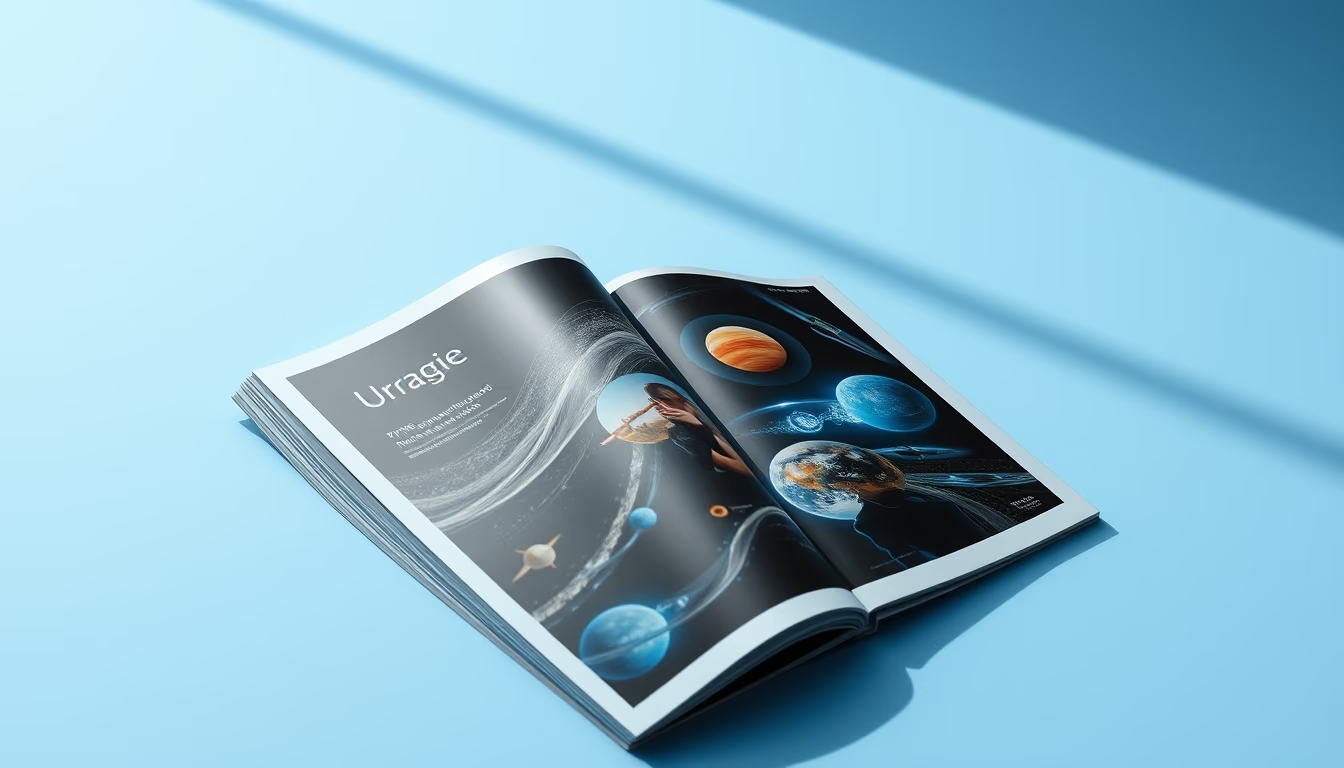
Uranus is the seventh planet from the Sun, famous for its distinctive blue color and extreme axial tilt of 98 degrees, causing it to 'roll' on its side as it orbits.
About this subject
Discovered by William Herschel in 1781, Uranus was the first planet identified using a telescope, expanding the known boundaries of the Solar System. Its blue-green color comes from methane in the atmosphere absorbing red light and reflecting blue wavelengths. This composition classifies it as an ice giant, distinct from gas giants like Jupiter and Saturn, with an interior rich in frozen water, methane, and ammonia.
Uranus's most striking feature is its axial tilt of about 98 degrees relative to its orbital plane. Unlike other planets that spin nearly upright, Uranus essentially 'rolls' on its side. This causes extreme seasons: each pole faces the Sun directly for 42 Earth years, followed by 42 years of complete darkness. This tilt is thought to result from a massive collision with an Earth-sized object in the distant past.
Uranus has a faint ring system discovered in 1977 during a stellar occultation. The Voyager 2 spacecraft, in 1986, is the only probe to have visited it, revealing 10 new rings and 11 moons, bringing the total known to 27 natural satellites. The moons are named after characters from the works of William Shakespeare and Alexander Pope, including Miranda, Ariel, Umbriel, Titania, and Oberon. Voyager also detected a tilted magnetic field offset from the planet's center, as well as winds reaching up to 900 km/h in the stratosphere.
Future exploration of Uranus is a priority for the scientific community. NASA is planning the Uranus Orbiter and Probe mission, with a launch targeted for the 2030s, which could study its internal structure, atmosphere, and moons in unprecedented detail. Understanding Uranus helps unravel the formation of icy planets in other star systems, as such exoplanets are common in the Milky Way.
Frequently Asked Questions
Why is Uranus blue?
Uranus's atmosphere contains methane, which absorbs red light and reflects blue light, giving the planet its characteristic color. Other components like hydrogen, helium, and hydrocarbons also contribute to the blue-green hue.
What is Uranus's axial tilt and how does it affect its seasons?
Uranus has an axial tilt of about 98 degrees, meaning its rotation axis is nearly parallel to its orbital plane. This results in extreme seasons: each pole faces the Sun for 42 Earth years, followed by 42 years of darkness.
How many moons does Uranus have and what are their main features?
Uranus has 27 known moons, all named after characters from Shakespeare and Pope. The five largest are Miranda, Ariel, Umbriel, Titania, and Oberon. Miranda has a surface with cliffs and canyons, indicating past geological activity.
Direct URL
https://pub-c7d6a6ea828543ac903a74a341ccb2e1.r2.dev/imagens/uranus-blue-tilted-magazine-editorial-p7.avifHow to credit
Include a visible link back to UtilizAí. Copy one of the snippets below:
<a href="https://xn--utiliza-eza.com/en/midia/imagens/uranus-blue-tilted-magazine-editorial-p7">Uranus blue tilted</a> by <a href="https://xn--utiliza-eza.com">UtilizAí</a>, licensed under <a href="https://creativecommons.org/licenses/by/4.0/">CC BY 4.0</a>.
[Uranus blue tilted](https://xn--utiliza-eza.com/en/midia/imagens/uranus-blue-tilted-magazine-editorial-p7) by [UtilizAí](https://xn--utiliza-eza.com), CC BY 4.0
License: CC-BY-4.0