Thai script ornate
1344×768 · AVIF · CC BY 4.0
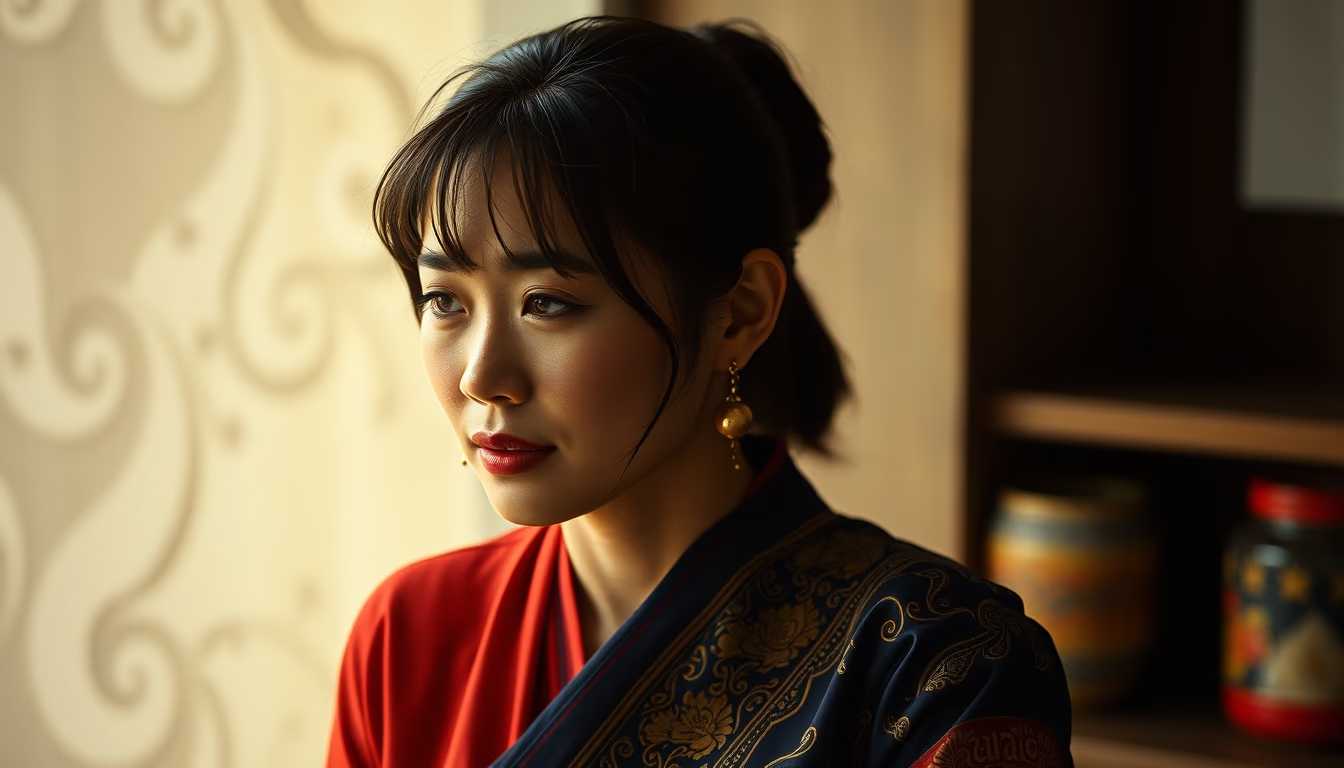
Ornate Thai script merges calligraphic elegance with centuries of tradition, found in temples, royal manuscripts, and contemporary art.
About this subject
The Thai script (อักษรไทย) is an abugida derived from the Khmer alphabet, which itself traces back to the Indian Brahmi script. Developed in the 13th century by King Ramkhamhaeng, the script underwent significant modifications over the centuries, especially during the Ayutthaya period (1351, 1767), when it acquired more curvilinear and ornamental forms. Today, the alphabet consists of 44 consonants, 32 vowels (represented as diacritics), and 4 tone markers, allowing it to represent the five tones of the Thai language.
Ornate versions of this script are frequently used in ceremonial and artistic contexts. In Buddhist temples, palm-leaf manuscripts (ใบลาน) and murals feature elaborate calligraphy with fine strokes and pronounced curves. During the Rattanakosin period (1782, present), royal calligraphy became a symbol of prestige, employed in official documents and court correspondence. Contemporary Thai artists, such as Chalermchai Kositpipat, incorporate ornamental characters into installations and paintings, blending tradition with modernity.
An intriguing aspect is that Thai script does not use spaces between words; instead, line breaks serve as natural sentence delimiters. Reading requires contextual knowledge to identify word boundaries. In ornamental calligraphy, this continuous flow of characters is exploited to create visually rhythmic compositions, where letterforms intertwine like arabesques. The "Khom" (ขอม) style, influenced by Khmer script, is particularly ornate and used in sacred texts.
Preservation of this graphical heritage is encouraged by institutions such as the Thai Calligraphy Association, which promotes workshops and exhibitions. Furthermore, digital typography has adapted ornamental fonts for graphic design and social media, keeping the tradition alive. Thai script is recognized as an intangible cultural heritage, appreciated for its aesthetic beauty and technical complexity, making it one of the most visually distinctive writing systems in Southeast Asia.
Frequently Asked Questions
How many characters does the Thai alphabet have?
The Thai alphabet has 44 consonants, 32 vowel symbols, and 4 tone markers, totaling 80 basic characters. However, some consonants are now obsolete.
Is ornate Thai script only used in religious contexts?
No. While common in temples and Buddhist manuscripts, ornamental calligraphy also appears in royal documents, contemporary art, graphic design, and even traditional tattoos (sak yant).
What is the difference between standard Thai script and ornate script?
Ornate script prioritizes aesthetics, with more pronounced curves, fine strokes, and variations in thickness. Standard script is more functional and standardized for everyday use.
Direct URL
https://pub-c7d6a6ea828543ac903a74a341ccb2e1.r2.dev/imagens/thai-script-ornate-film-grain-authentic-fresh11.avifHow to credit
Include a visible link back to UtilizAí. Copy one of the snippets below:
<a href="https://xn--utiliza-eza.com/en/midia/imagens/thai-script-ornate-film-grain-authentic-fresh11">Thai script ornate</a> by <a href="https://xn--utiliza-eza.com">UtilizAí</a>, licensed under <a href="https://creativecommons.org/licenses/by/4.0/">CC BY 4.0</a>.
[Thai script ornate](https://xn--utiliza-eza.com/en/midia/imagens/thai-script-ornate-film-grain-authentic-fresh11) by [UtilizAí](https://xn--utiliza-eza.com), CC BY 4.0
License: CC-BY-4.0