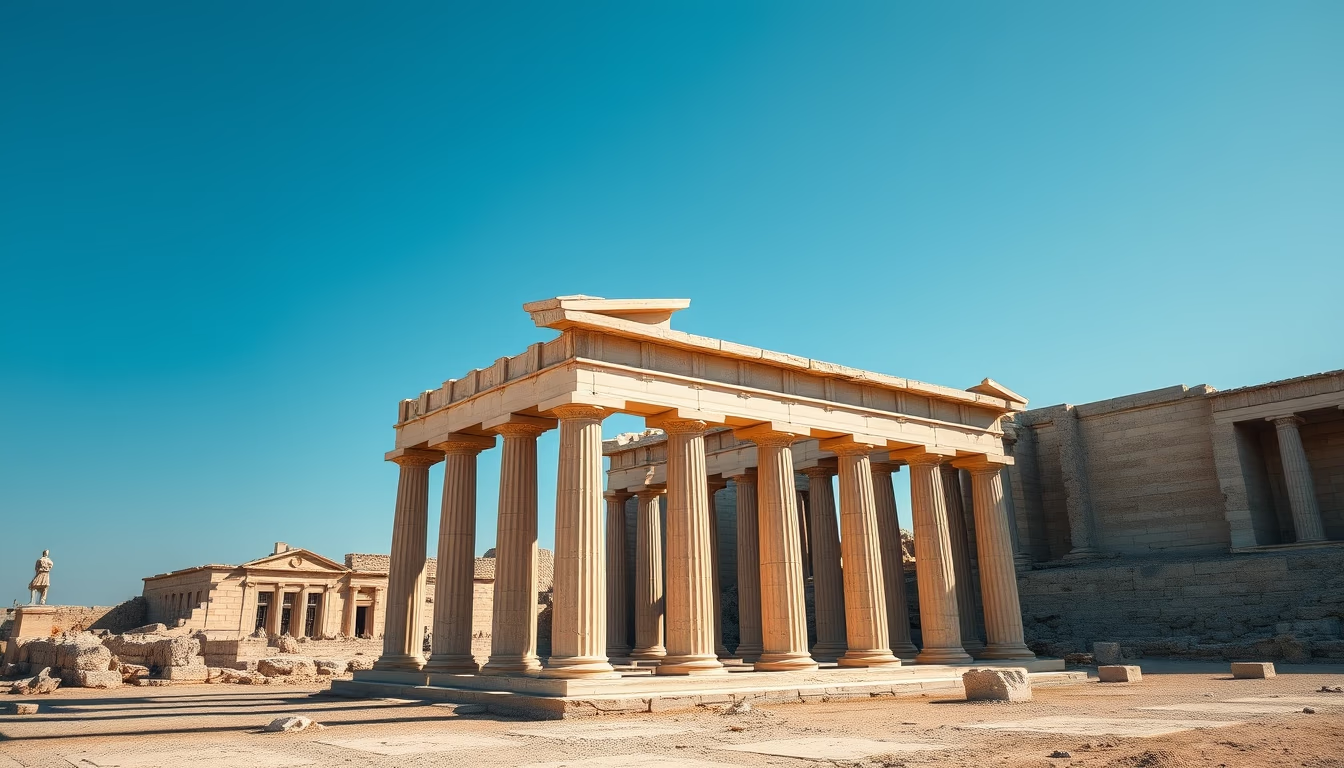
Temple columns ancient
1344×768 · AVIF · CC BY 4.0

Ancient temple columns are landmarks of classical architecture, with Greek and Roman orders that influence buildings to this day.
About this subject
Ancient temple columns play a central role in architectural history, combining structural function with artistic expression. In the classical world, especially Greece and Rome, columns not only supported the roof weight but also defined the visual identity of sacred buildings. The Greeks developed three main orders: Doric, Ionic, and Corinthian. The Doric order, the simplest and most massive, was used in the Parthenon in Athens (5th century BC), with fluted columns and no base. The Ionic order, more slender, features volutes on the capital and appears in the Temple of Athena Nike on the Acropolis. The Corinthian order, the most ornate, with a capital decorated by acanthus leaves, was favored by the Romans, as seen in the Temple of Olympian Zeus in Athens.
The Romans adapted the Greek orders and spread their use throughout the empire. The Pantheon in Rome (2nd century AD) has Corinthian columns of granite and marble supporting its imposing portico. Columns were also used in basilicas, forums, and aqueducts, becoming symbols of power and civilization. Techniques such as stacking stone drums and fitting them precisely demonstrate advanced engineering. Freestanding columns, like those of the Temple of Hera at Olympia, show the evolution of design over centuries.
The legacy of ancient columns persists in Neoclassical architecture of the 18th and 19th centuries. In Brazil, notable examples include the Palácio do Itamaraty in Brasília, with external columns inspired by the Ionic order, and the National Museum of Quinta da Boa Vista in Rio de Janeiro, which features Corinthian columns on its facade. Even in contemporary photography with a lo-fi aesthetic, as in the image that originated this record, ancient columns continue to evoke transcendence and history.
Frequently Asked Questions
What is the difference between the Greek orders of columns?
The Greek orders differ in capital and proportions. Doric is sturdy, without a base, with a simple capital. Ionic is slender, with volutes on the capital. Corinthian is the most ornate, with a capital shaped like acanthus leaves.
What were columns used for in ancient temples?
Besides supporting the structure, columns defined the aesthetics and symbolized cosmic order. They also marked sacred spaces and were used in entrance porticos.
Where can I see examples of ancient columns in Brazil?
At Palácio do Itamaraty (Brasília), the National Museum (Rio de Janeiro), and Neoclassical buildings like the Teatro Municipal do Rio de Janeiro, which have columns inspired by classical orders.
Direct URL
https://pub-c7d6a6ea828543ac903a74a341ccb2e1.r2.dev/imagens/temple-columns-ancient-lo-fi-disposable-camera-p2.avifHow to credit
Include a visible link back to UtilizAí. Copy one of the snippets below:
<a href="https://xn--utiliza-eza.com/en/midia/imagens/temple-columns-ancient-lo-fi-disposable-camera-p2">Temple columns ancient</a> by <a href="https://xn--utiliza-eza.com">UtilizAí</a>, licensed under <a href="https://creativecommons.org/licenses/by/4.0/">CC BY 4.0</a>.
[Temple columns ancient](https://xn--utiliza-eza.com/en/midia/imagens/temple-columns-ancient-lo-fi-disposable-camera-p2) by [UtilizAí](https://xn--utiliza-eza.com), CC BY 4.0
License: CC-BY-4.0