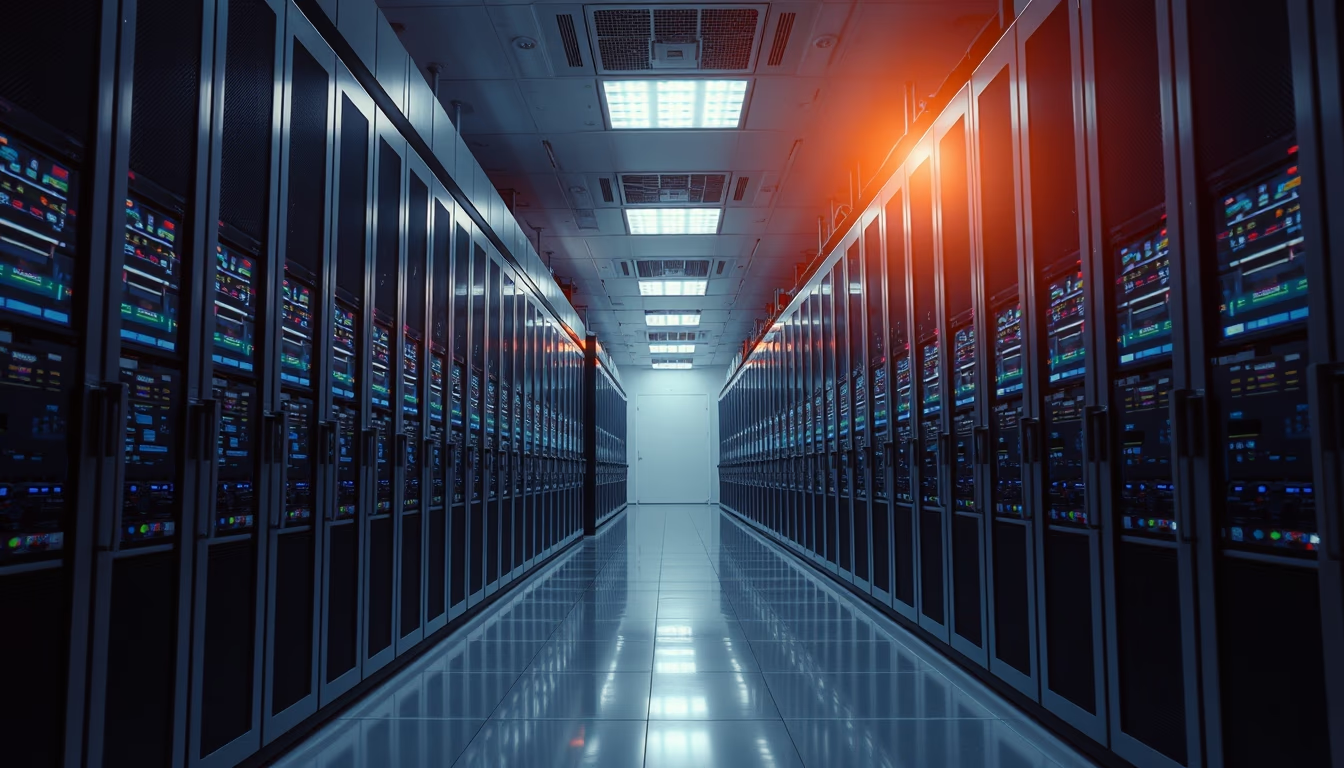
Supercomputer hall
1344×768 · AVIF · CC BY 4.0
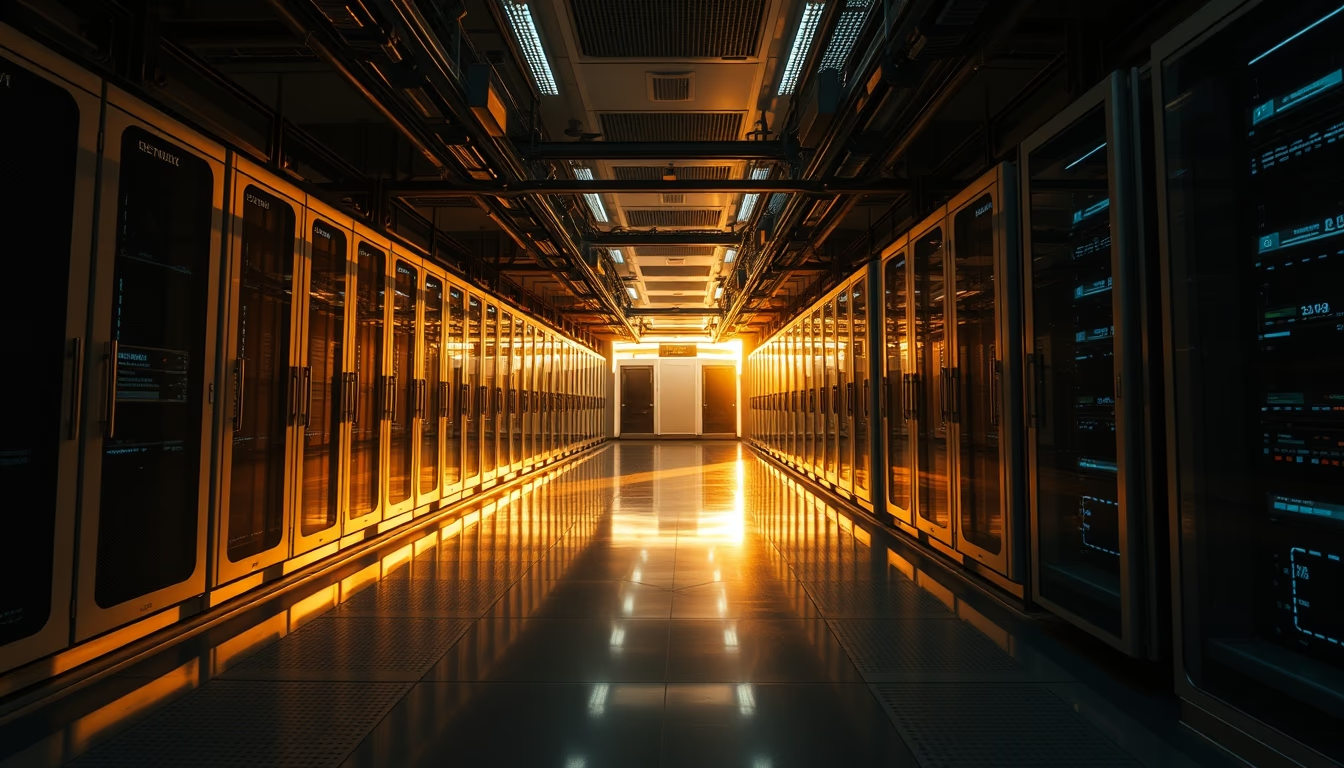
Supercomputers are high-performance machines used for complex simulations, scientific research, and artificial intelligence, operating in specialized data centers.
About this subject
Supercomputers represent the pinnacle of computational capability, with thousands of processors working in parallel to solve problems requiring immense processing power. These systems are essential in fields like weather forecasting, climate modeling, drug discovery, particle physics, and artificial intelligence. The TOP500, a semiannual list of the world's fastest supercomputers, is currently led by Frontier at Oak Ridge National Laboratory (USA), with exaflop performance, floating-point operations per second at the exa (10^18) scale.
In Brazil, the Santos Dumont supercomputer at the National Laboratory for Scientific Computing (LNCC) in Petrópolis (RJ) is one of the most powerful in Latin America, used for bioinformatics, astrophysics, and engineering studies. Each supercomputer occupies vast halls with specialized cooling systems, as they dissipate heat equivalent to thousands of homes. Modern architecture leverages graphics accelerators (GPUs) and high-speed interconnects like InfiniBand to maximize efficiency.
The history of supercomputers began in the 1960s with Seymour Cray's CDC 6600, which was 10 times faster than its competitors. Since then, evolution followed Moore's Law, with advances in parallelism and vector architectures. Today, the race for exascale computing (10^18 operations/second) involves the United States, China, Japan, and Europe. These systems consume megawatts of power, requiring clean energy sources and innovative cooling solutions, such as immersion in dielectric fluid.
Supercomputers are also critical for simulating natural phenomena like earthquakes and hurricanes, and for training large language models (LLMs) that power virtual assistants and generative AI applications. The trend is integration with quantum and neuromorphic computing, further expanding the boundaries of computational possibility.
Frequently Asked Questions
What is the fastest supercomputer in the world today?
Frontier, located at Oak Ridge National Laboratory in the United States, leads the TOP500 with exaflop performance, meaning over 10^18 floating-point operations per second.
What are supercomputers used for?
Supercomputers are used for complex simulations in science and engineering, such as climate prediction, molecular modeling, astrophysics, drug development, and artificial intelligence training.
How do supercomputers manage the heat they generate?
They employ advanced cooling systems, including precision air conditioning, liquid cooling via cold plates, or immersion in dielectric fluid, dissipating heat equivalent to thousands of homes.
Direct URL
https://pub-c7d6a6ea828543ac903a74a341ccb2e1.r2.dev/imagens/supercomputer-hall-cinematic-wide-shot-p6.avifHow to credit
Include a visible link back to UtilizAí. Copy one of the snippets below:
<a href="https://xn--utiliza-eza.com/en/midia/imagens/supercomputer-hall-cinematic-wide-shot-p6">Supercomputer hall</a> by <a href="https://xn--utiliza-eza.com">UtilizAí</a>, licensed under <a href="https://creativecommons.org/licenses/by/4.0/">CC BY 4.0</a>.
[Supercomputer hall](https://xn--utiliza-eza.com/en/midia/imagens/supercomputer-hall-cinematic-wide-shot-p6) by [UtilizAí](https://xn--utiliza-eza.com), CC BY 4.0
License: CC-BY-4.0