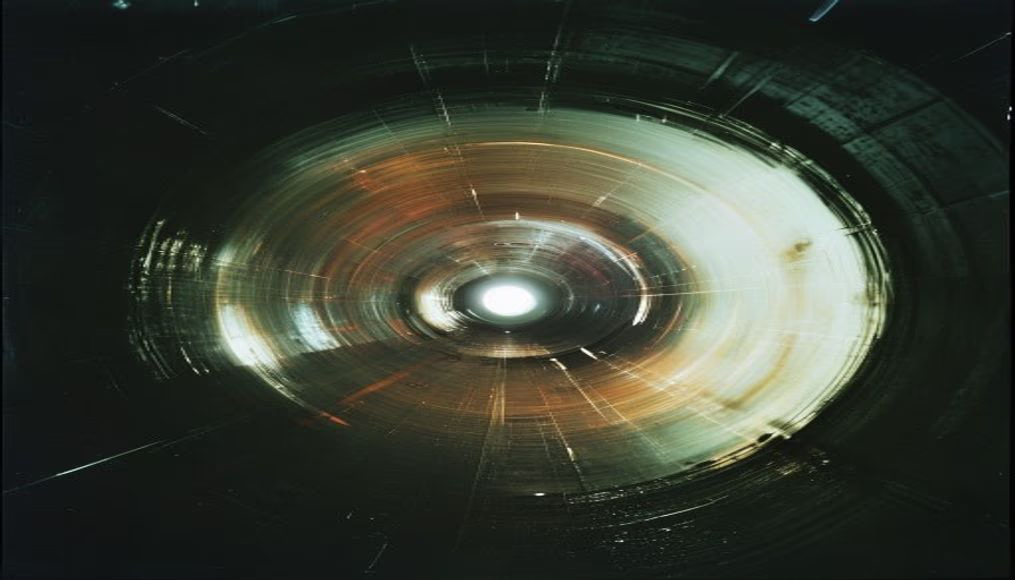
Sun corona solar flare
1344×768 · AVIF · CC BY 4.0

Solar flares release energy equivalent to billions of atomic bombs, heating the solar corona to millions of degrees.
About this subject
Solar flares are intense explosions in the Sun's atmosphere that release enormous amounts of energy, primarily as electromagnetic radiation. They occur when magnetic field lines reconnect, accelerating charged particles. The solar corona, the outer atmospheric layer, reaches temperatures up to 2 million degrees Celsius, much hotter than the visible surface (5,500°C), a paradox that puzzles scientists. Flares last from minutes to hours and are classified by their X-ray peak: classes A, B, C, M, and X, with X being the most powerful.
These events directly impact Earth. Intense flares can cause geomagnetic storms, capable of damaging satellites, disrupting radio communications, and even inducing currents in power grids. Radiation from class X flares poses risks to astronauts in low orbit. Continuous monitoring is done by observatories like NASA's Solar Dynamics Observatory (SDO), which captures images in various wavelengths to study the corona and predict space weather events.
Historically, the largest recorded flare was in 2003, class X28, which overloaded sensors. The 11-year solar cycle influences frequency: at solar maximum, flares occur daily. Studying the corona also unraveled the solar wind, a stream of particles traveling at 400 km/s. Understanding these phenomena is essential to protect modern technologies and future space missions.
Frequently Asked Questions
What causes a solar flare?
A solar flare is caused by the sudden rearrangement of magnetic fields in the Sun's atmosphere, a process called magnetic reconnection. This accelerates charged particles, generating intense radiation.
What is the difference between the solar corona and the Sun's surface?
The visible surface, the photosphere, is about 5,500°C, while the corona, millions of kilometers above, reaches up to 2 million degrees. The reason for this extreme heating is still studied, possibly due to magnetic waves or microflares.
How does a solar flare affect life on Earth?
Intense flares can cause geomagnetic storms that disrupt satellites, radio communications, and power grids. They also increase radiation, affecting astronauts and equipment in orbit.
Direct URL
https://pub-c7d6a6ea828543ac903a74a341ccb2e1.r2.dev/imagens/sun-corona-solar-flare-national-geographic-style-p4.avifHow to credit
Include a visible link back to UtilizAí. Copy one of the snippets below:
<a href="https://xn--utiliza-eza.com/en/midia/imagens/sun-corona-solar-flare-national-geographic-style-p4">Sun corona solar flare</a> by <a href="https://xn--utiliza-eza.com">UtilizAí</a>, licensed under <a href="https://creativecommons.org/licenses/by/4.0/">CC BY 4.0</a>.
[Sun corona solar flare](https://xn--utiliza-eza.com/en/midia/imagens/sun-corona-solar-flare-national-geographic-style-p4) by [UtilizAí](https://xn--utiliza-eza.com), CC BY 4.0
License: CC-BY-4.0