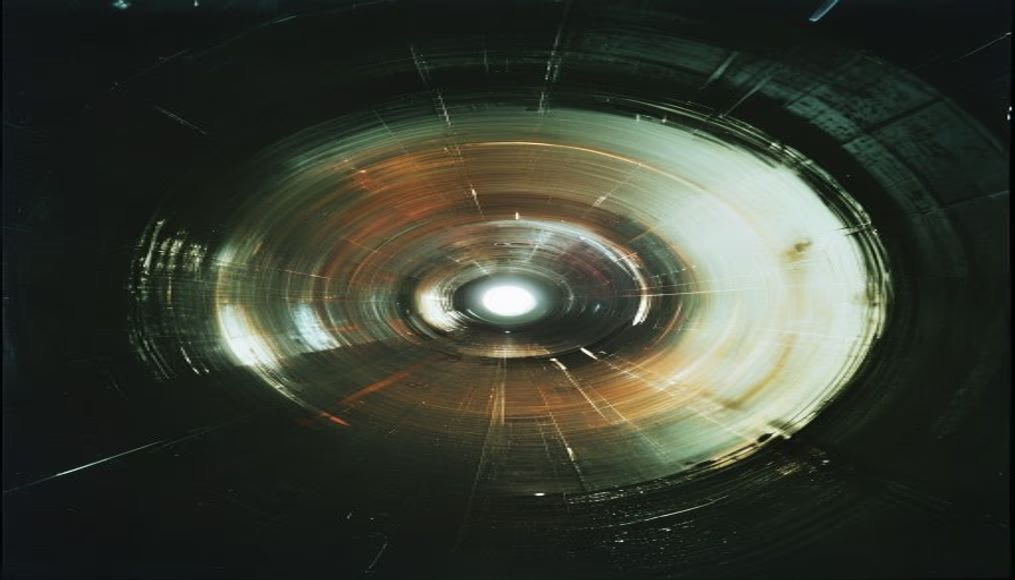
Sun corona solar flare
1344×768 · AVIF · CC BY 4.0

The solar corona is the Sun's outermost layer, visible during eclipses and the site of solar flares.
About this subject
The solar corona is a region of extremely rarefied plasma extending millions of kilometers beyond the Sun's visible surface, the photosphere. Despite being farther from the Sun's core, the corona reaches astonishing temperatures of 1 to 3 million degrees Celsius, much hotter than the photosphere's ~5,500°C. This paradox, known as the coronal heating problem, remains one of solar physics' greatest mysteries, possibly explained by plasma waves and magnetic reconnection.
Solar flares are violent explosions in the Sun's atmosphere that release enormous amounts of energy in minutes. They occur when magnetic field lines in the corona reconnect, accelerating charged particles. These events can eject coronal mass ejections (CMEs), which travel through space and, upon reaching Earth, interact with the magnetosphere, causing geomagnetic storms. The northern and southern lights are visible effects of these interactions.
Studying the solar corona and flares is crucial for space weather prediction. Observatories like SOHO (Solar and Heliospheric Observatory) and NASA's Parker Solar Probe continuously monitor the Sun. Launched in 2018, the Parker Solar Probe has already 'touched' the Sun by crossing the corona, collecting unprecedented data on the solar wind and coronal dynamics. Flares can disrupt satellite communications, power grids, and navigation systems, making understanding these phenomena essential.
Frequently Asked Questions
What is the solar corona?
The solar corona is the outermost layer of the Sun's atmosphere, composed of ionized plasma. It extends millions of kilometers and is visible during total solar eclipses.
How do solar flares affect Earth?
Solar flares can release charged particles and electromagnetic radiation. When they reach Earth, they cause geomagnetic storms that disrupt satellite communications, power grids, and GPS systems, while also intensifying auroras.
Why is the solar corona hotter than the Sun's surface?
The corona reaches millions of degrees, much hotter than the photosphere (~5,500°C). This anomalous heating is thought to be caused by plasma waves, nanoflares, and magnetic reconnection, but it remains an active research area.
Direct URL
https://pub-c7d6a6ea828543ac903a74a341ccb2e1.r2.dev/imagens/sun-corona-solar-flare-architectural-photography-p6.avifHow to credit
Include a visible link back to UtilizAí. Copy one of the snippets below:
<a href="https://xn--utiliza-eza.com/en/midia/imagens/sun-corona-solar-flare-architectural-photography-p6">Sun corona solar flare</a> by <a href="https://xn--utiliza-eza.com">UtilizAí</a>, licensed under <a href="https://creativecommons.org/licenses/by/4.0/">CC BY 4.0</a>.
[Sun corona solar flare](https://xn--utiliza-eza.com/en/midia/imagens/sun-corona-solar-flare-architectural-photography-p6) by [UtilizAí](https://xn--utiliza-eza.com), CC BY 4.0
License: CC-BY-4.0