Sun corona eclipse
1344×768 · AVIF · CC BY 4.0
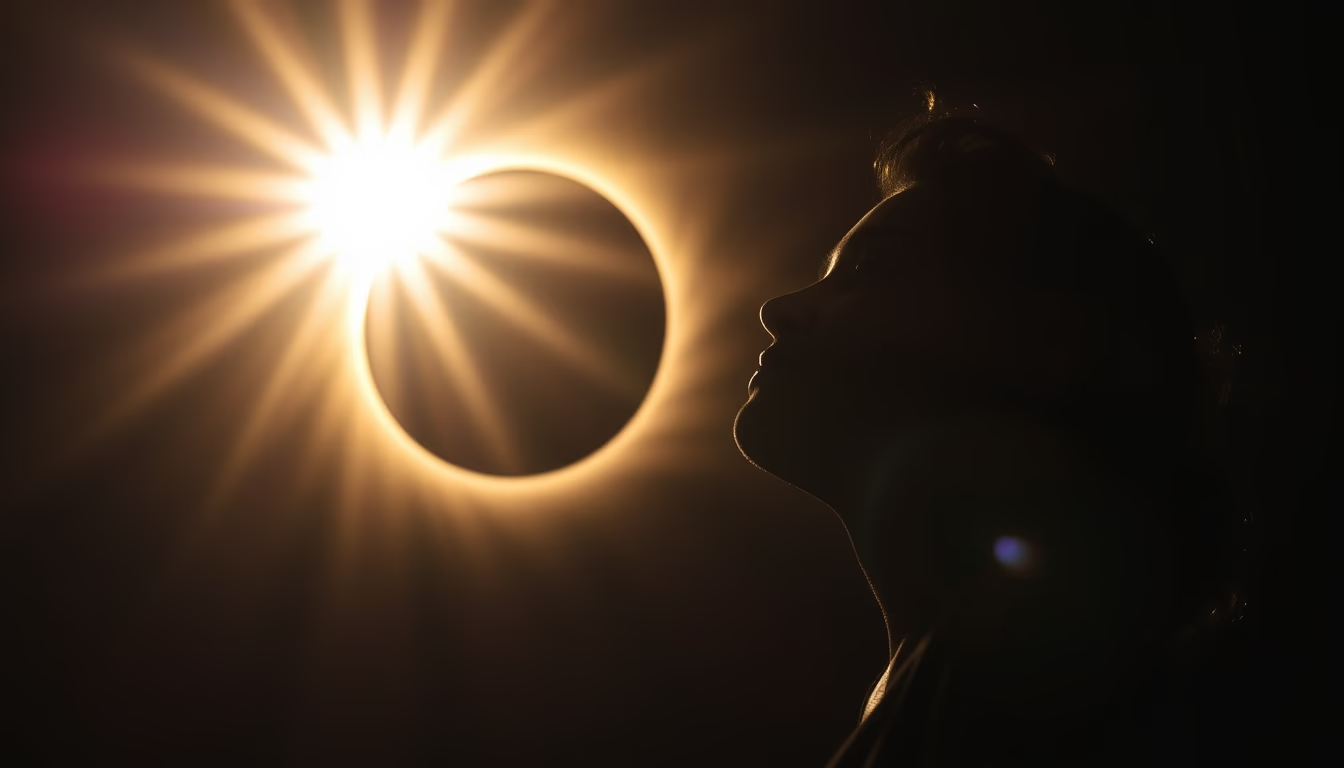
The solar corona, visible only during a total solar eclipse, is a plasma structure stretching millions of kilometers into space.
About this subject
The solar corona is the outermost layer of the Sun's atmosphere, composed of extremely hot plasma with temperatures exceeding 1 million degrees Celsius. During a total solar eclipse, the Moon completely blocks the solar disk, revealing this white, iridescent aura that is normally overwhelmed by the bright surface light. The corona is not uniform: it features structures like plumes, loops, and jets, whose shape varies with the 11-year solar cycle, becoming more symmetrical during solar maximum.
Historically, observations of the corona during eclipses have been crucial for scientific breakthroughs. In 1868, English astronomer Norman Lockyer detected an unknown spectral line in the corona's light, leading to the discovery of helium, a chemical element previously unknown on Earth. Later, in 1930, Bernard Lyot invented the coronagraph, allowing study of the corona without an eclipse, yet total eclipses remain unique opportunities for high-resolution observations.
The corona is the source of the solar wind, a continuous stream of charged particles that affects Earth's magnetic field and causes phenomena like auroras. During eclipses, prominences can also be seen: cooler, denser gas clouds that stand out in red on the Sun's edge. A total eclipse at a given location is rare: it occurs on average every 375 years, but globally there is one every 18 months.
Frequently Asked Questions
Why is the solar corona white during an eclipse?
The corona appears white because its light is composed of photons scattered by free electrons in the plasma, in a process called Thomson scattering. The visible light from the corona is actually sunlight that has been scattered, retaining its white color.
What is the temperature of the solar corona?
The temperature of the solar corona ranges from 1 to 3 million degrees Celsius, and can reach up to 10 million in active regions. This is paradoxical because the Sun's surface (photosphere) is only about 5,500°C.
How often does a total solar eclipse occur?
Total solar eclipses occur approximately every 18 months, but at different locations on Earth. A given point on the Earth's surface sees a total eclipse on average once every 375 years.
Direct URL
https://pub-c7d6a6ea828543ac903a74a341ccb2e1.r2.dev/imagens/sun-corona-eclipse-fine-art-photography-p6.avifHow to credit
Include a visible link back to UtilizAí. Copy one of the snippets below:
<a href="https://xn--utiliza-eza.com/en/midia/imagens/sun-corona-eclipse-fine-art-photography-p6">Sun corona eclipse</a> by <a href="https://xn--utiliza-eza.com">UtilizAí</a>, licensed under <a href="https://creativecommons.org/licenses/by/4.0/">CC BY 4.0</a>.
[Sun corona eclipse](https://xn--utiliza-eza.com/en/midia/imagens/sun-corona-eclipse-fine-art-photography-p6) by [UtilizAí](https://xn--utiliza-eza.com), CC BY 4.0
License: CC-BY-4.0