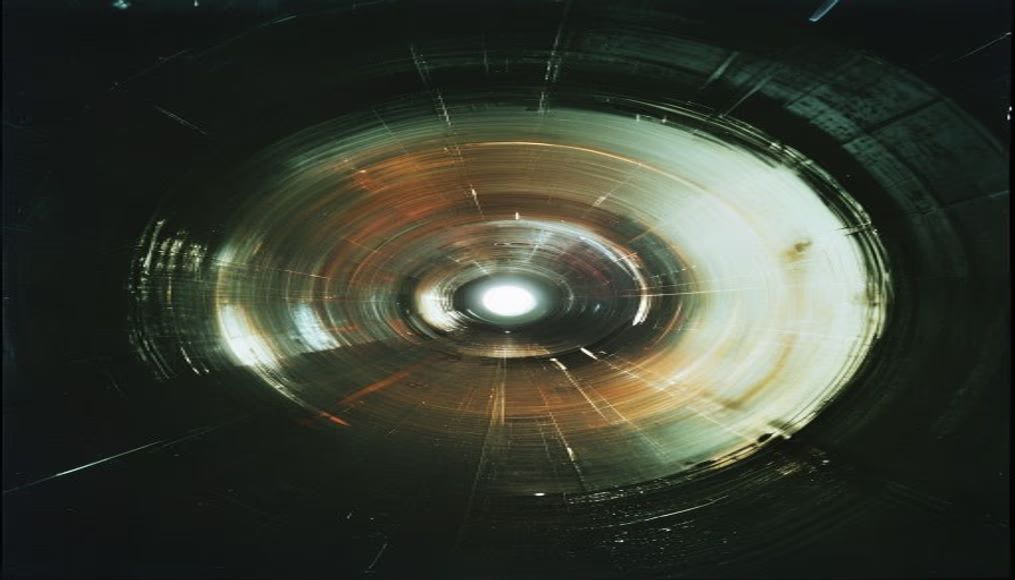
Sun corona eclipse
1344×768 · AVIF · CC BY 4.0

The solar corona, the Sun's outermost layer, becomes visible during a total eclipse, revealing plasma at millions of degrees Celsius.
About this subject
The solar corona is the plasma aura that surrounds the Sun, extending millions of kilometers into space. During a total solar eclipse, the Moon blocks the intense light of the photosphere, allowing the corona to be seen with the naked eye as a white, pearly halo. This phenomenon has fascinated astronomers and laypeople for centuries; in an 1868 eclipse, helium was discovered in the corona's spectrum.
One of the greatest puzzles in solar physics is why the corona reaches temperatures between 1 and 3 million degrees Celsius, while the Sun's surface (photosphere) is about 5,500°C. This paradox is attributed to processes such as magnetic reconnection and plasma waves that transfer energy from the surface to the outer layers. The corona is also the source of the solar wind, a stream of charged particles that influences space weather on Earth.
Corona observation is not limited to eclipses. Instruments such as coronagraphs, which create artificial eclipses by blocking direct sunlight, allow constant study aboard satellites like SOHO and the Parker Solar Probe. In 2026, a total eclipse will be visible over parts of the Arctic, Europe, Africa, and North America, offering a unique opportunity for new corona observations. Wide-angle cinematic images like this one capture the full extent of the corona and its delicate details, from equatorial streamers to polar jets.
The solar corona is not just a visual spectacle; it is key to understanding the Sun's magnetic activity and predicting solar storms that can affect satellites and power grids. Ongoing study of the corona during eclipses and with space missions helps unravel the secrets of our star.
Frequently Asked Questions
What is the solar corona?
The solar corona is the outermost layer of the Sun's atmosphere, composed of extremely hot plasma (millions of degrees). It extends for millions of kilometers and is visible only during total solar eclipses or with special instruments.
Why is the solar corona hotter than the Sun's surface?
This is a paradox known as the coronal heating problem. It is believed that the Sun's magnetic energy, through magnetic reconnection and plasma waves, heats the corona to far higher temperatures than the photosphere.
How do scientists study the solar corona without an eclipse?
They use coronagraphs, special telescopes that block direct sunlight, creating an artificial eclipse. Space observatories like SOHO and the Parker Solar Probe use these instruments to monitor the corona continuously.
Direct URL
https://pub-c7d6a6ea828543ac903a74a341ccb2e1.r2.dev/imagens/sun-corona-eclipse-cinematic-wide-shot-p1.avifHow to credit
Include a visible link back to UtilizAí. Copy one of the snippets below:
<a href="https://xn--utiliza-eza.com/en/midia/imagens/sun-corona-eclipse-cinematic-wide-shot-p1">Sun corona eclipse</a> by <a href="https://xn--utiliza-eza.com">UtilizAí</a>, licensed under <a href="https://creativecommons.org/licenses/by/4.0/">CC BY 4.0</a>.
[Sun corona eclipse](https://xn--utiliza-eza.com/en/midia/imagens/sun-corona-eclipse-cinematic-wide-shot-p1) by [UtilizAí](https://xn--utiliza-eza.com), CC BY 4.0
License: CC-BY-4.0