Sun corona eclipse
1344×768 · AVIF · CC BY 4.0
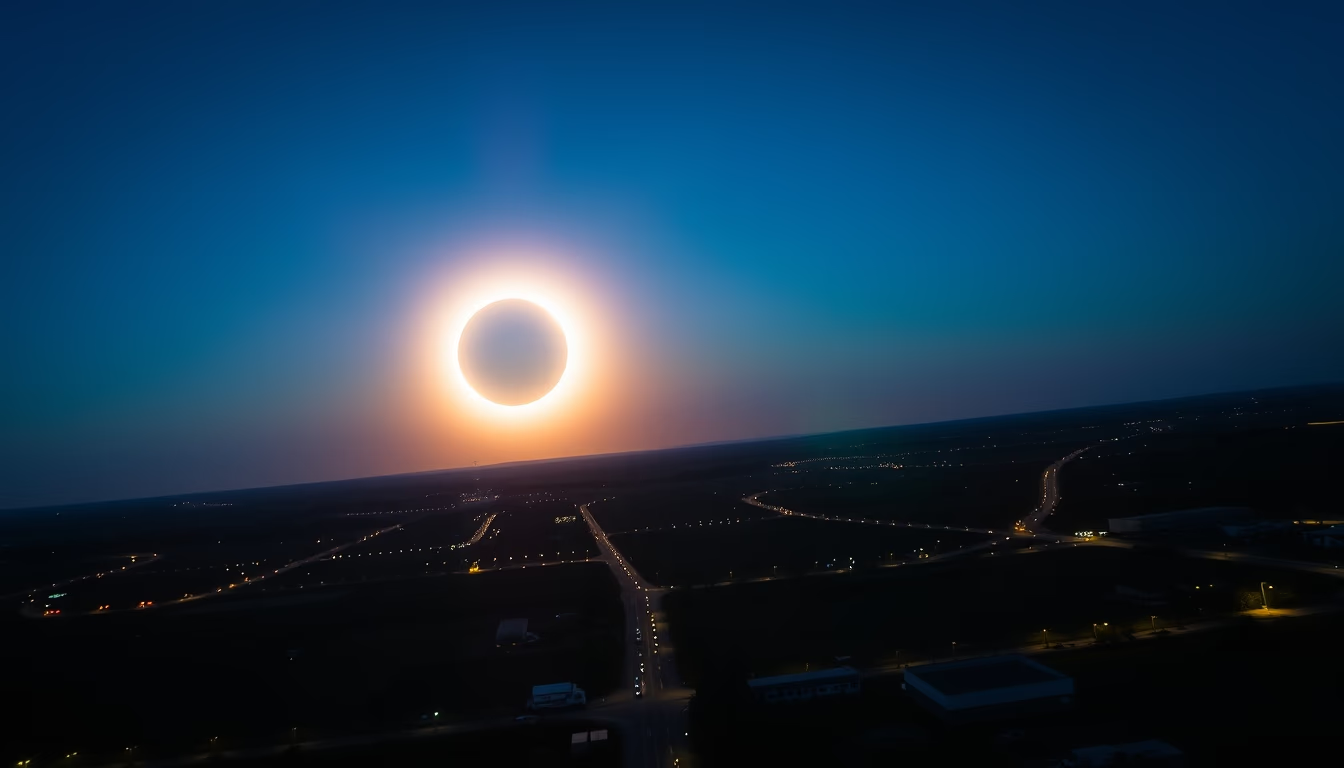
A total solar eclipse reveals the solar corona, a rare and fascinating phenomenon that has intrigued astronomers and enthusiasts for centuries.
About this subject
During a total solar eclipse, the Moon completely covers the Sun's disk, making the solar corona, its outer atmosphere, visible to the naked eye. The corona is an extremely hot plasma region, with temperatures exceeding 1 million degrees Celsius, much hotter than the Sun's surface (about 5,500°C). This mystery of solar physics is not fully understood, but intense magnetic fields and plasma waves are known to play key roles. The corona extends millions of kilometers into space and is the source of the solar wind, which affects Earth's space weather.
Observing the corona during an eclipse is a rare event: a total eclipse at a given location occurs on average only once every 375 years. Scientists use these brief moments to study the corona's structure, including plumes, loops, and coronal mass ejections. Historical expeditions, such as Arthur Eddington's in 1919, used eclipses to confirm Einstein's general theory of relativity by measuring the deflection of starlight passing near the Sun.
In Brazil, total visible eclipses are infrequent. The last major event was an annular eclipse in 1994, and the next total will be in 2045. During an eclipse, the sudden drop in brightness and the appearance of the silvery corona create a unique atmosphere, thrilling observers. Photographing the corona requires special equipment like filters and telephoto lenses, but the beauty of the phenomenon can be appreciated without any technology.
Frequently Asked Questions
Why is the solar corona hotter than the Sun's surface?
This is one of the biggest mysteries in astrophysics. It is believed that the Sun's magnetic energy is transferred to the corona through plasma waves and magnetic reconnections, heating it to temperatures far higher than the surface.
How often does a total solar eclipse occur?
Total solar eclipses happen approximately every 18 months somewhere on Earth, but the same location may wait centuries for another. On average, a specific point is visited by a total eclipse every 375 years.
What is the importance of the solar corona for space weather?
The corona emits the solar wind, a continuous flow of charged particles that can disrupt satellites, communications, and power grids on Earth. Explosions called coronal mass ejections (CMEs) are particularly energetic events that can cause geomagnetic storms.
Direct URL
https://pub-c7d6a6ea828543ac903a74a341ccb2e1.r2.dev/imagens/sun-corona-eclipse-aerial-drone-shot-p3.avifHow to credit
Include a visible link back to UtilizAí. Copy one of the snippets below:
<a href="https://xn--utiliza-eza.com/en/midia/imagens/sun-corona-eclipse-aerial-drone-shot-p3">Sun corona eclipse</a> by <a href="https://xn--utiliza-eza.com">UtilizAí</a>, licensed under <a href="https://creativecommons.org/licenses/by/4.0/">CC BY 4.0</a>.
[Sun corona eclipse](https://xn--utiliza-eza.com/en/midia/imagens/sun-corona-eclipse-aerial-drone-shot-p3) by [UtilizAí](https://xn--utiliza-eza.com), CC BY 4.0
License: CC-BY-4.0