Stone tools paleolithic
1344×768 · AVIF · CC BY 4.0
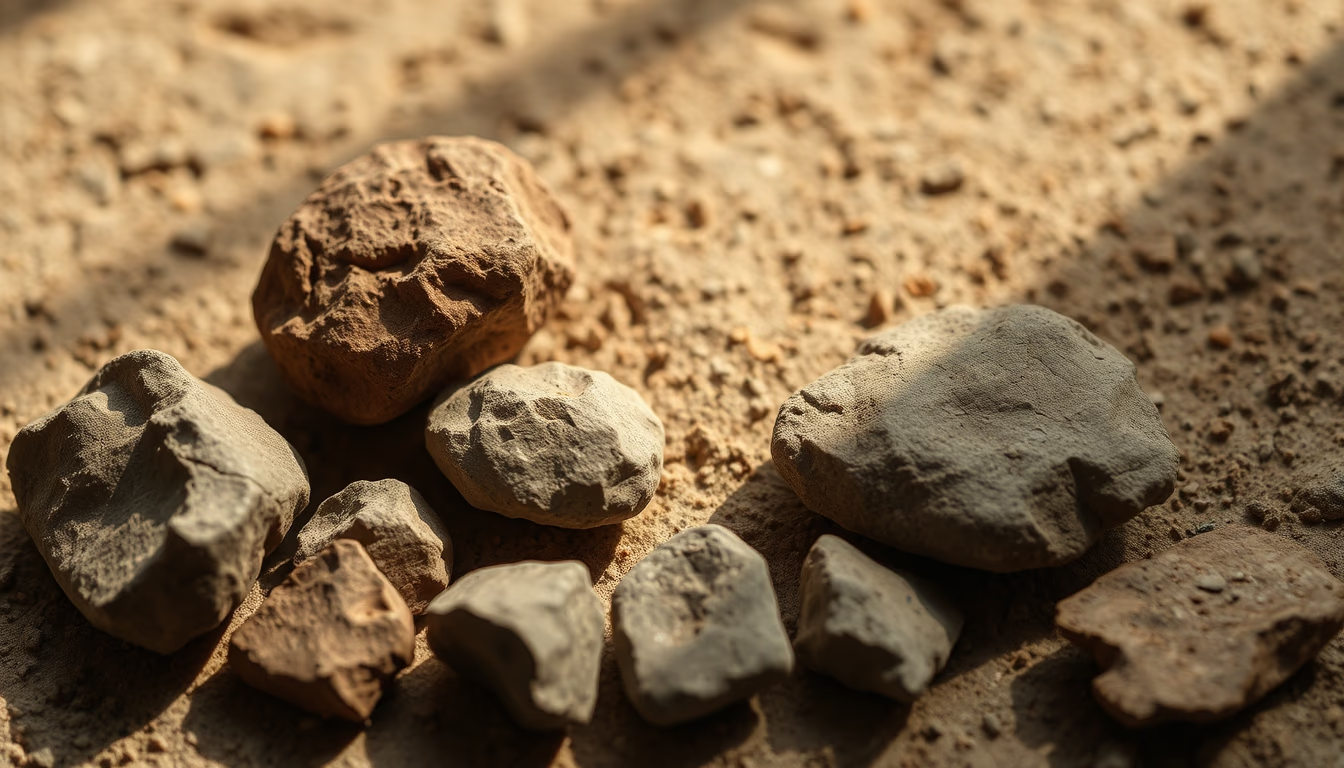
Paleolithic stone tools represent the earliest implements created by hominids, marking the dawn of human technology and revealing ancestral cognitive and adaptive skills.
About this subject
Paleolithic stone tools, produced between roughly 2.5 million and 10,000 years ago, represent the earliest evidence of human technology. This period is divided into Lower, Middle, and Upper Paleolithic, each with characteristic techniques and artifacts. The most common raw material was flint, but quartz, basalt, and obsidian were also used, knapped by percussion to create sharp edges.
Major lithic industries include the Oldowan, with simple choppers and flakes, exemplified at Olduvai Gorge (Tanzania). The Acheulean introduced symmetrical handaxes, found in African and European sites over 1.5 million years old. In the Middle Paleolithic, the Mousterian culture, associated with Neanderthals, produced points and scrapers. The Upper Paleolithic saw blades, burins, and projectile points, accompanying the expansion of Homo sapiens.
In South America, sites like Pedra Furada (Brazil) and Monte Verde (Chile) have yielded Paleolithic stone tools with dates exceeding 12,000 years, challenging earlier migration models. These artifacts are crucial for understanding diet, mobility, and social networks of early humans. Wear analysis and refitting studies help reconstruct activities such as hunting, plant processing, and woodworking.
Knapping techniques evolved from direct percussion (using a hammerstone) to indirect percussion and pressure flaking, allowing greater control and refinement. Discovery of tools in geologically dated contexts using potassium-argon and radiocarbon methods helps trace human evolution chronology. Recent research suggests that stone tool production required planning and social learning, driving cognitive and cultural development of hominins.
Frequently Asked Questions
What is the difference between Lower and Upper Paleolithic tools?
Lower Paleolithic (Oldowan and Acheulean) features choppers and large handaxes, while Upper Paleolithic introduces blades, burins, and bone points, reflecting greater specialization and technological complexity.
Where were some of the oldest Paleolithic tools found?
The oldest sites are Olduvai Gorge (Tanzania) at 2.6 million years and Gona (Ethiopia) at 2.5 million years, both associated with the Oldowan industry.
How do archaeologists date Paleolithic stone tools?
They use relative dating (stratigraphy, fossil association) and absolute methods such as potassium-argon on volcanic ash, radiocarbon on organic sediments, and thermoluminescence on associated sediment.
Direct URL
https://pub-c7d6a6ea828543ac903a74a341ccb2e1.r2.dev/imagens/stone-tools-paleolithic-magazine-editorial-p11.avifHow to credit
Include a visible link back to UtilizAí. Copy one of the snippets below:
<a href="https://xn--utiliza-eza.com/en/midia/imagens/stone-tools-paleolithic-magazine-editorial-p11">Stone tools paleolithic</a> by <a href="https://xn--utiliza-eza.com">UtilizAí</a>, licensed under <a href="https://creativecommons.org/licenses/by/4.0/">CC BY 4.0</a>.
[Stone tools paleolithic](https://xn--utiliza-eza.com/en/midia/imagens/stone-tools-paleolithic-magazine-editorial-p11) by [UtilizAí](https://xn--utiliza-eza.com), CC BY 4.0
License: CC-BY-4.0