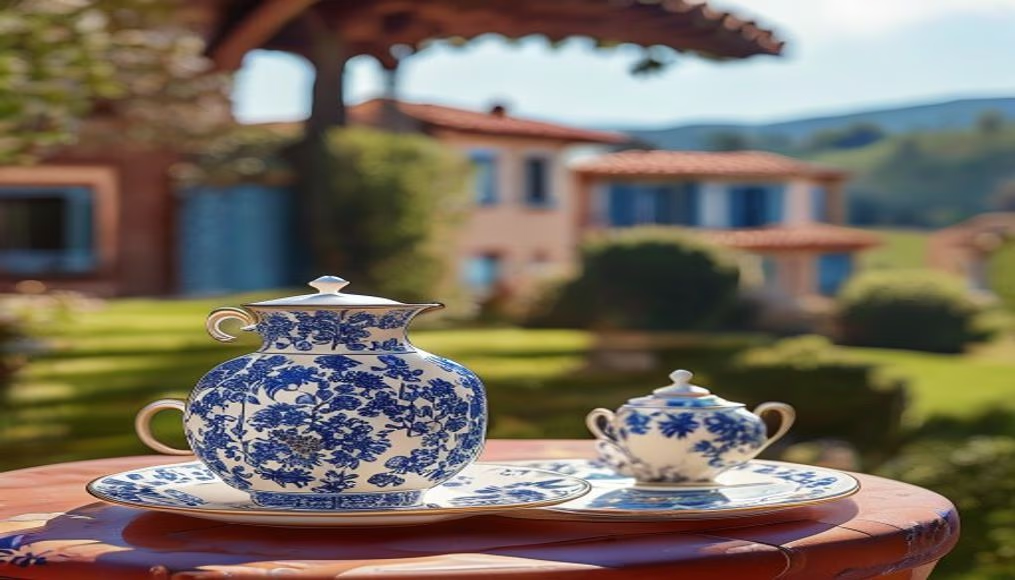
Spode blue italian charger
1344×768 · AVIF · CC BY 4.0

The Spode Blue Italian charger is an icon of English ceramics, launched in 1816 with Italian scenes inspired by Giovanni Battista Piranesi's work.
About this subject
Spode, founded by Josiah Spode in 1770 in Stoke-on-Trent, England, became famous for its ceramic innovations. The Blue Italian pattern was introduced in 1816 and quickly became one of the most recognized of the brand. The central design features a stylized Italian landscape with classical ruins, cypress trees, and a lake, surrounded by a border with floral and geometric motifs. The technique of underglaze transfer printing in cobalt blue on a creamy white background is characteristic of the period.
The term "charger" refers to a large plate, usually 12 inches in diameter, used for serving or as a decorative piece. Originally, these plates were used to present meats at formal dinners. Today, they are collector's items, valued for their history and craftsmanship. Spode has produced Blue Italian continuously for over two centuries, with variations in size and shape.
The pattern reflects the Regency period's taste for picturesque aesthetics and classical nostalgia. The scenes were inspired by the engravings of Giovanni Battista Piranesi, who depicted Roman ruins and Italian landscapes. Each piece is handmade, with the design transferred before firing, ensuring sharpness of detail. Authenticity can be verified by the marks "Spode" and "Blue Italian" on the back, along with the pattern number.
Despite its English origin, Blue Italian has become a symbol of elegance worldwide, often associated with sophisticated dining and porcelain collections. The versatility of the design allows it to be used in both traditional and contemporary settings. Spode, now part of the Portmeirion Group, continues to produce the pattern, keeping alive a tradition of over 200 years.
Frequently Asked Questions
What is the Spode Blue Italian pattern?
It is a ceramic pattern introduced by Spode in 1816, featuring Italian scenes in cobalt blue on a cream background, using underglaze transfer printing.
How to identify an authentic Spode Blue Italian piece?
Check the back stamp: it should include 'Spode' and 'Blue Italian' along with a pattern number. Authentic pieces have crisp details and a border with floral and geometric motifs.
Is Spode Blue Italian still in production?
Yes, Spode (now part of the Portmeirion Group) still produces the Blue Italian pattern today, maintaining the same traditional technique and design.
Direct URL
https://pub-c7d6a6ea828543ac903a74a341ccb2e1.r2.dev/imagens/spode-blue-italian-charger-manhattan-penthouse-skyline-backdrop-luxo0.avifHow to credit
Include a visible link back to UtilizAí. Copy one of the snippets below:
<a href="https://xn--utiliza-eza.com/en/midia/imagens/spode-blue-italian-charger-manhattan-penthouse-skyline-backdrop-luxo0">Spode blue italian charger</a> by <a href="https://xn--utiliza-eza.com">UtilizAí</a>, licensed under <a href="https://creativecommons.org/licenses/by/4.0/">CC BY 4.0</a>.
[Spode blue italian charger](https://xn--utiliza-eza.com/en/midia/imagens/spode-blue-italian-charger-manhattan-penthouse-skyline-backdrop-luxo0) by [UtilizAí](https://xn--utiliza-eza.com), CC BY 4.0
License: CC-BY-4.0