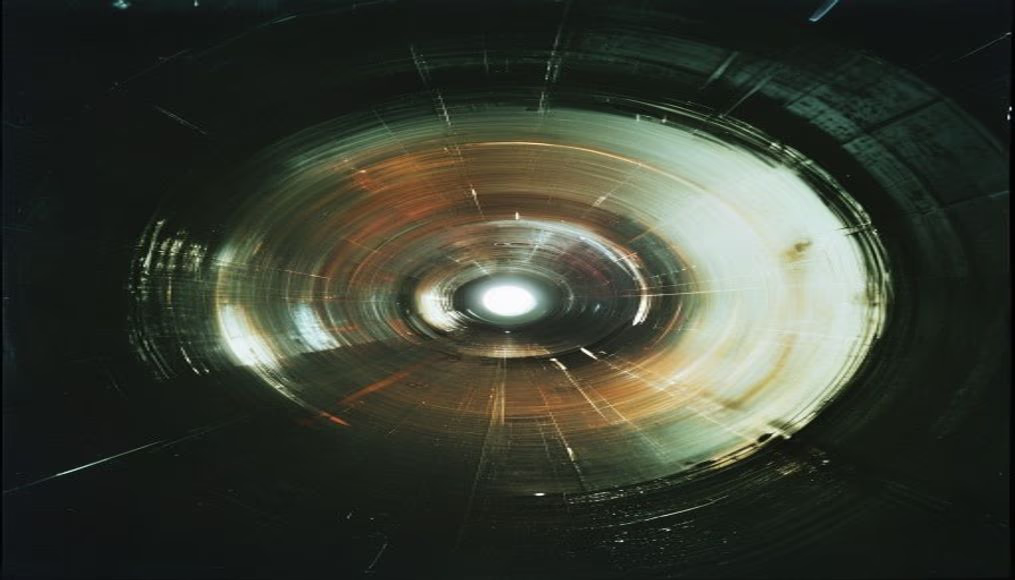
Space telescope hubble photograph
1344×768 · AVIF · CC BY 4.0
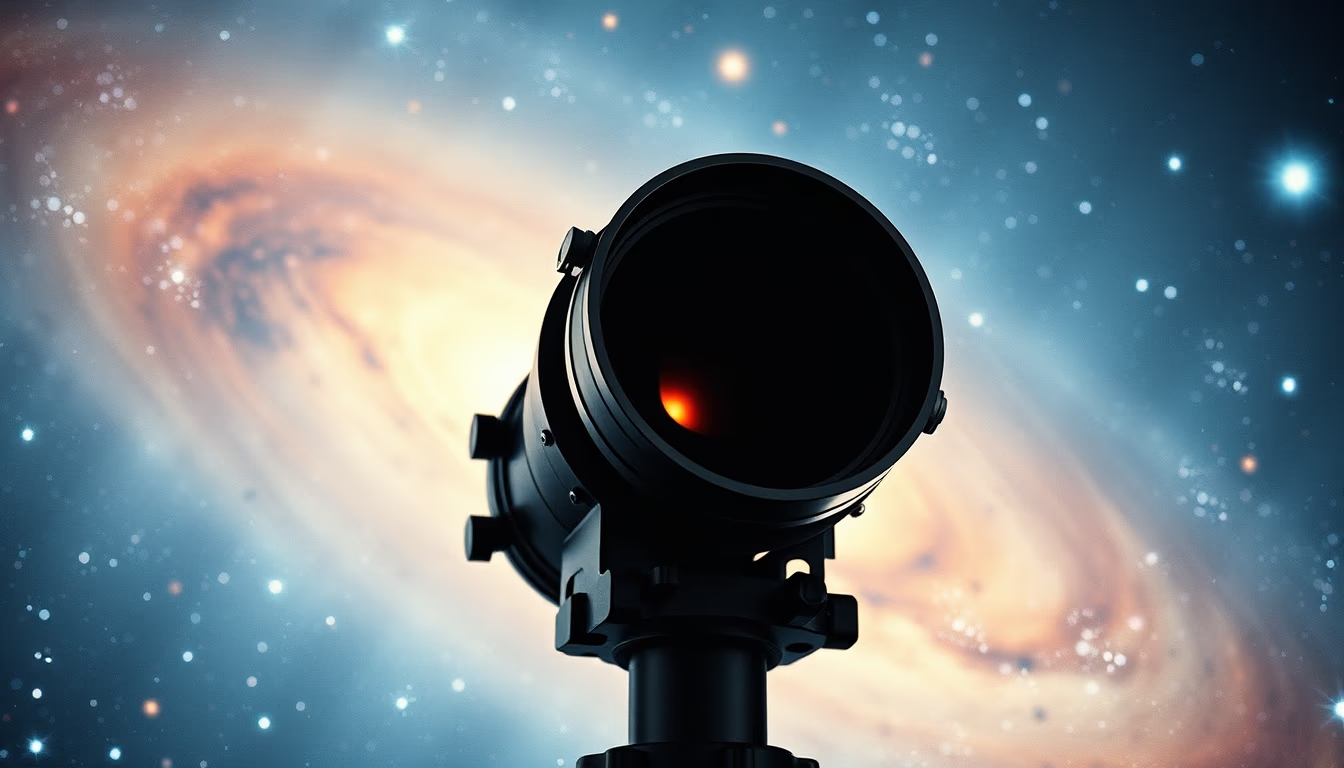
The Hubble Space Telescope revolutionized astronomy with crisp images of the cosmos, from nebulae to distant galaxies, and continues operating after more than three decades.
About this subject
The Hubble Space Telescope, launched in 1990 aboard the Space Shuttle Discovery, is one of the most important scientific instruments ever built. Orbiting Earth at an altitude of about 540 km, it captures images free from atmospheric distortion, enabling observations of celestial objects with unprecedented resolution. Its main instrument, the Wide Field Camera 3, installed during the last servicing mission in 2009, operates from ultraviolet to near-infrared wavelengths.
Hubble has produced iconic images such as the Pillars of Creation in the Eagle Nebula, the Hubble Deep Field (revealing thousands of galaxies in a tiny patch of sky), and recordings of supernovae like SN 1994D. It also contributed to the discovery of the accelerating expansion of the universe, leading to the 2011 Nobel Prize in Physics for Saul Perlmutter, Brian Schmidt, and Adam Riess. The telescope has conducted over 1.5 million observations and generated data for more than 18,000 scientific papers.
Despite technical issues over the years, such as the flawed primary mirror corrected in 1993, Hubble remains active and is expected to operate until the mid-2030s, when it will gradually be replaced by the James Webb Space Telescope. Its longevity is due to five servicing missions performed by NASA astronauts, who replaced instruments, gyroscopes, and batteries. Hubble orbits Earth at about 28,000 km/h, completing a lap every 95 minutes, and has traveled over 6 billion kilometers since launch.
Frequently Asked Questions
How many images has Hubble taken?
Hubble has conducted over 1.5 million observations and generated data for thousands of scientific papers, but the exact number of individual images is hard to estimate, as each observation can produce multiple exposures.
Why do some Hubble images look grainy?
The graininess (noise) in some Hubble images can be due to low exposure, digital zoom, or processing. Film-grain-like appearance is common in long-exposure astronomical photographs, but Hubble uses CCD digital sensors.
What is the Hubble Deep Field?
The Hubble Deep Field is an image of a tiny patch of sky in the constellation Ursa Major, obtained with a total exposure of 10 days. It revealed thousands of distant galaxies, some billions of light-years away, demonstrating the vastness of the observable universe.
Direct URL
https://pub-c7d6a6ea828543ac903a74a341ccb2e1.r2.dev/imagens/space-telescope-hubble-photograph-film-grain-authentic-p3.avifHow to credit
Include a visible link back to UtilizAí. Copy one of the snippets below:
<a href="https://xn--utiliza-eza.com/en/midia/imagens/space-telescope-hubble-photograph-film-grain-authentic-p3">Space telescope hubble photograph</a> by <a href="https://xn--utiliza-eza.com">UtilizAí</a>, licensed under <a href="https://creativecommons.org/licenses/by/4.0/">CC BY 4.0</a>.
[Space telescope hubble photograph](https://xn--utiliza-eza.com/en/midia/imagens/space-telescope-hubble-photograph-film-grain-authentic-p3) by [UtilizAí](https://xn--utiliza-eza.com), CC BY 4.0
License: CC-BY-4.0