Space station orbit earth
1344×768 · AVIF · CC BY 4.0
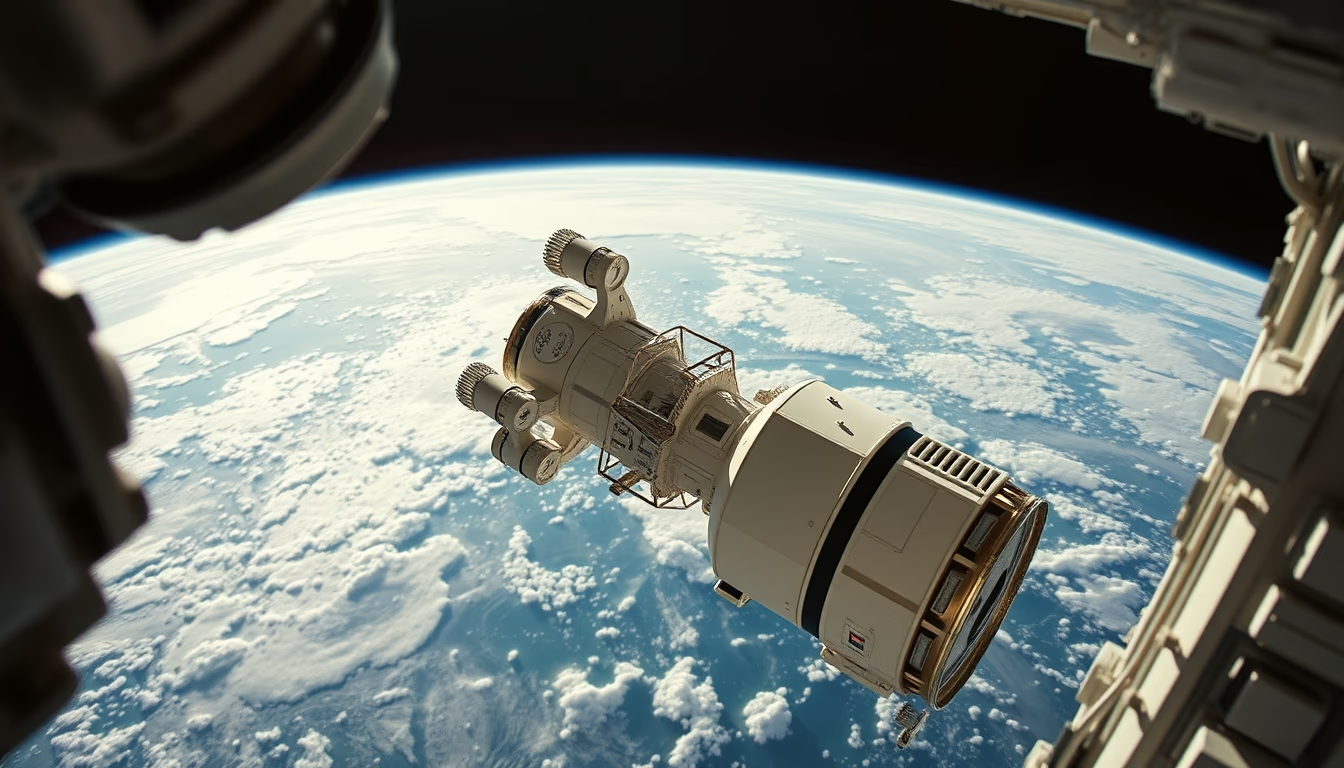
Space stations orbit Earth at hundreds of kilometers in altitude, serving as research laboratories and observation platforms for the planet.
About this subject
Space stations are complex structures designed to remain in low Earth orbit for extended periods. The most famous is the International Space Station (ISS), a collaborative project between the United States, Russia, Europe, Japan, and Canada, orbiting about 400 km in altitude at approximately 28,000 km/h. The ISS completes one orbit every 90 minutes, allowing its crew to witness 16 sunrises and sunsets daily. In addition to the ISS, China operates the Tiangong station, completed in 2022, which also hosts scientific experiments and crewed missions.
The orbit of these stations is chosen to facilitate resupply by spacecraft and offers a privileged view of Earth’s surface. Cameras and sensors onboard record images of climate change, natural disasters, and human activities, contributing to environmental monitoring and meteorology. For instance, the ISS has photographed hurricanes, wildfires, and urban growth over decades.
Culturally, space stations symbolize international cooperation and technological advancement. Over 270 people from 21 countries have visited the ISS, conducting experiments in biology, physics, and medicine. Space tourism, with companies like SpaceX and Axiom Space, will expand access to this extreme environment. Expectations for 2026 include new private missions and expandable modules that could change the shape of future stations.
Fun facts: the ISS is the size of a football field, weighs 420 tons, and its solar panels generate enough power for 50 homes. Microgravity enables studies on crystal growth, fluid behavior, and radiation effects. Life onboard requires adaptation: astronauts sleep in sleeping bags attached to walls and exercise to prevent bone loss.
Frequently Asked Questions
What is the typical altitude of a space station orbiting Earth?
Most stations, like the ISS and Tiangong, orbit at approximately 400 km altitude, within low Earth orbit (LEO). This altitude provides a balance between residual gravity and radiation exposure.
How long does it take for a space station to complete one orbit around Earth?
The ISS takes about 90 minutes to complete an orbit. This means astronauts see 16 sunrises and sunsets each day.
How many space stations are currently in operation?
Currently, two space stations are in operation: the International Space Station (ISS) and the Chinese Tiangong station. Additionally, Russia plans to launch its own station, ROSS, by 2030.
Direct URL
https://pub-c7d6a6ea828543ac903a74a341ccb2e1.r2.dev/imagens/space-station-orbit-earth-documentary-photography-p3.avifHow to credit
Include a visible link back to UtilizAí. Copy one of the snippets below:
<a href="https://xn--utiliza-eza.com/en/midia/imagens/space-station-orbit-earth-documentary-photography-p3">Space station orbit earth</a> by <a href="https://xn--utiliza-eza.com">UtilizAí</a>, licensed under <a href="https://creativecommons.org/licenses/by/4.0/">CC BY 4.0</a>.
[Space station orbit earth](https://xn--utiliza-eza.com/en/midia/imagens/space-station-orbit-earth-documentary-photography-p3) by [UtilizAí](https://xn--utiliza-eza.com), CC BY 4.0
License: CC-BY-4.0