Show jumping arena empty
1344×768 · AVIF · CC BY 4.0
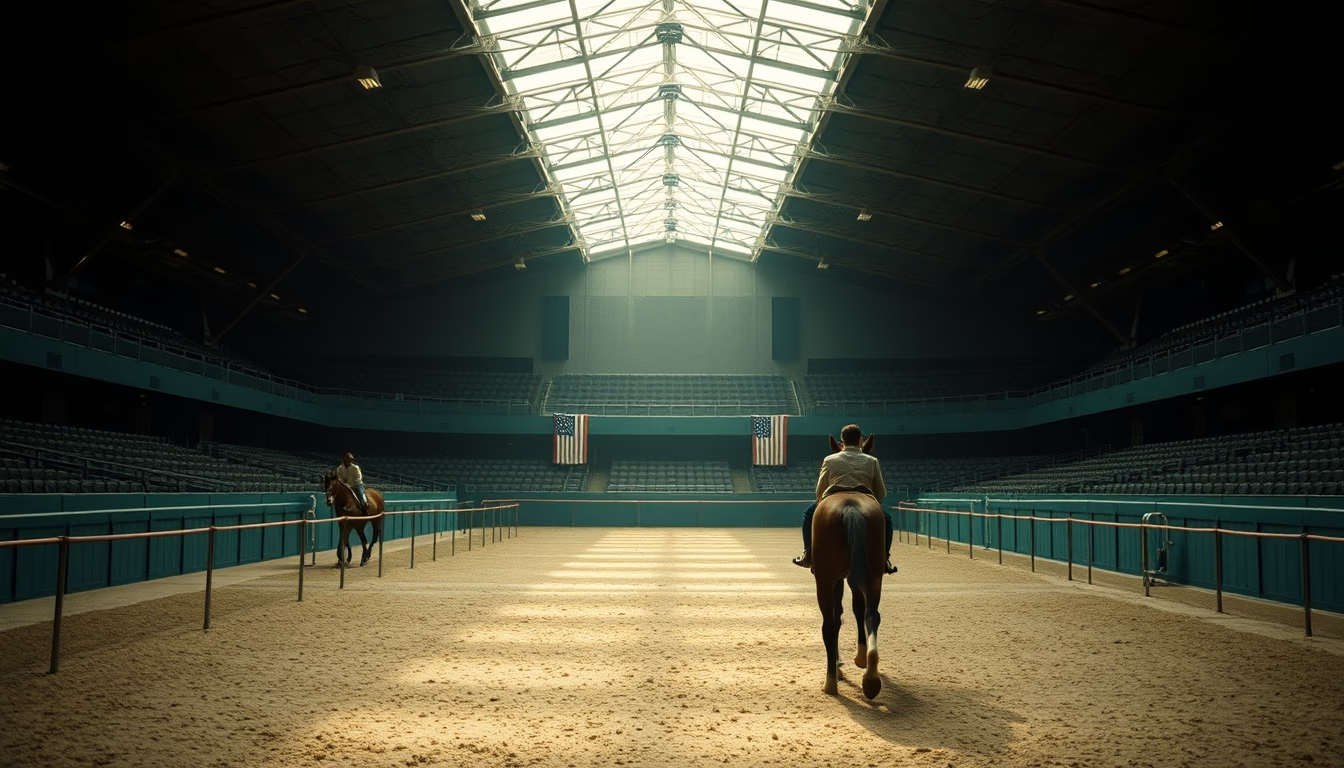
Empty show jumping arenas hold secrets: explore the technical design, historical roots, and equestrian tradition behind these spaces.
About this subject
Show jumping is an equestrian discipline that combines athleticism, precision, and the partnership between horse and rider. Competitions take place in meticulously designed arenas featuring colorful obstacles that test the animals' jumping ability. In Brazil, the sport gained momentum in the 20th century with the construction of equestrian centers in São Paulo and Rio de Janeiro, inspired by European traditions. An empty arena reveals details such as synthetic turf or special sand footing, which absorb impact during jumps, and adjustable poles for varying heights.
The International Equestrian Federation (FEI) sets strict regulations for arena dimensions: a minimum of 80 by 40 meters, with obstacles ranging from 1.20 to 1.60 meters in Olympic events. Course designers create sequences of jumps to evaluate the responsiveness of horse-rider teams. Interestingly, obstacle colors are not random; contrasting hues help horses see better, as they have dichromatic vision.
Beyond competitions, empty arenas host intensive training sessions. Show jumping horses, such as the Brazilian Sport Horse breed, undergo years of preparation. Track maintenance is crucial: footing is watered and compacted daily to prevent inconsistencies that could cause accidents. Spectators often overlook the embedded drainage and irrigation systems that ensure safety even in rain.
Historically, show jumping originated in 18th-century England as an extension of fox hunting, evolving into an Olympic sport in 1900. In Brazil, the Brazilian Equestrian Confederation organizes events drawing thousands of spectators, like the National Jumping Competition. Thus, an empty arena is not an inert space but a testament to the dedication of a global equestrian community.
Frequently Asked Questions
What are the official dimensions of a show jumping arena?
According to the FEI, the minimum dimensions are 80 meters in length by 40 meters in width. Indoor arenas may be smaller, but must still comply with safety regulations.
Why do obstacle colors vary so much?
Contrasting colors help horses distinguish jumps, as they have dichromatic vision and see blue and yellow tones better. Additionally, colors make the course more visible to spectators.
What is the origin of show jumping?
It originated in 18th-century England as an offshoot of fox hunting. Riders needed to jump over fences and ditches during chases, which led to formal jumping competitions.
Direct URL
https://pub-c7d6a6ea828543ac903a74a341ccb2e1.r2.dev/imagens/show-jumping-arena-empty-film-grain-authentic-fresh0.avifHow to credit
Include a visible link back to UtilizAí. Copy one of the snippets below:
<a href="https://xn--utiliza-eza.com/en/midia/imagens/show-jumping-arena-empty-film-grain-authentic-fresh0">Show jumping arena empty</a> by <a href="https://xn--utiliza-eza.com">UtilizAí</a>, licensed under <a href="https://creativecommons.org/licenses/by/4.0/">CC BY 4.0</a>.
[Show jumping arena empty](https://xn--utiliza-eza.com/en/midia/imagens/show-jumping-arena-empty-film-grain-authentic-fresh0) by [UtilizAí](https://xn--utiliza-eza.com), CC BY 4.0
License: CC-BY-4.0