Saturn rings detail
1344×768 · AVIF · CC BY 4.0
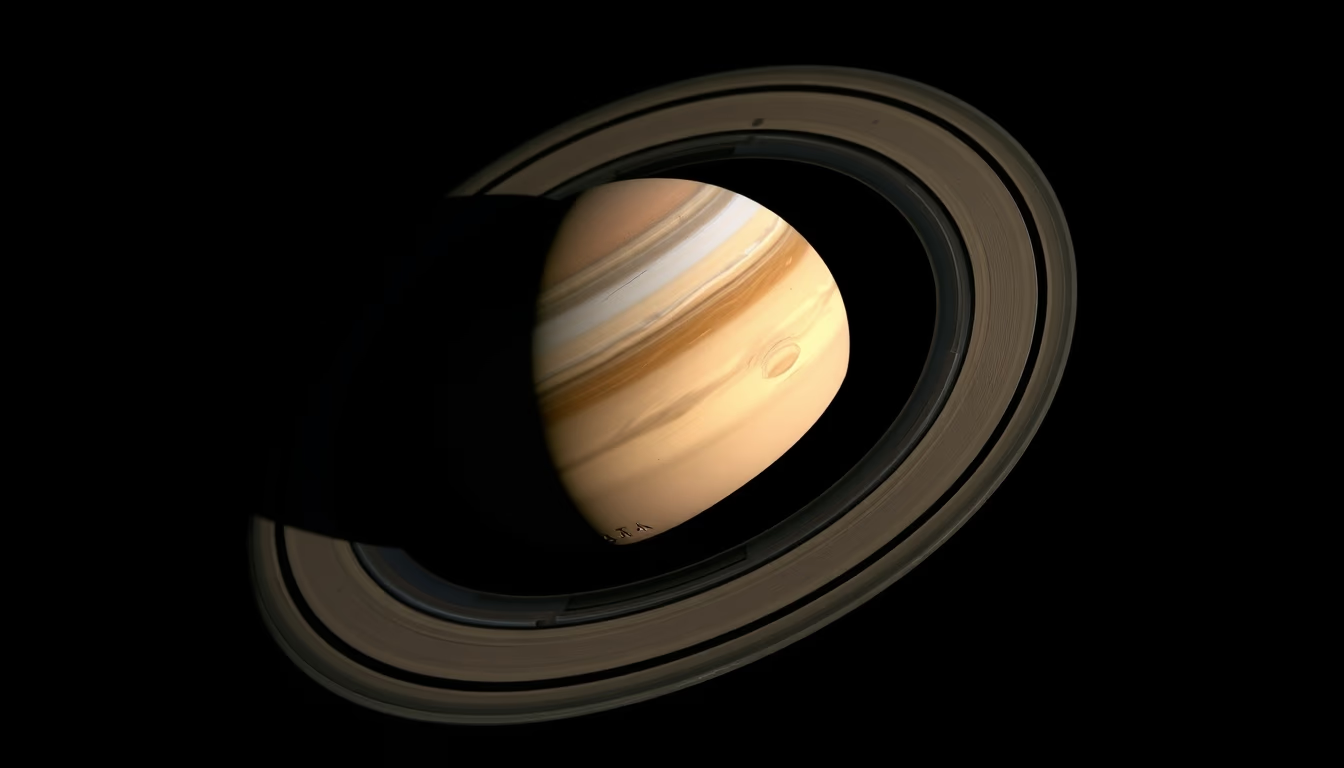
Details of Saturn's rings: composition, structure, and scientific discoveries about one of the most impressive phenomena in the Solar System.
About this subject
Saturn's ring system consists of billions of particles ranging from tiny dust grains to mountain-sized chunks. Composed predominantly of water ice, with a small fraction of rocky material and cosmic dust, they span over 280,000 kilometers but are only tens of meters thick. The initial discovery is credited to Galileo Galilei in 1610, who observed lobes on the planet, but it was Christiaan Huygens who correctly identified the ring structure in 1659. Missions like Voyager and Cassini revealed the system's complexity, including density waves, 'spokes', and small shepherd moons that confine the rings.
The ring structure is divided into major sections: the A, B, and C rings, with the B ring being the brightest and most massive. Between the A and B rings lies the Cassini Division, a apparent gap caused by resonance with the moon Mimas. Fainter rings, such as D, E, F, and G, complete the system. Each ring has unique features, like spiral structures in the B ring and transient clumps in the F ring. It is believed that the rings are remnants of moons shattered by impacts or tidal forces, or primordial Solar System material that never coalesced.
A notable curiosity is that Saturn's rings are slowly losing mass, with material being drawn into the planet's atmosphere. Studies based on Cassini data, which orbited Saturn from 2004 to 2017, suggest that the rings may have formed only 10 to 100 million years ago, an extremely young age in geological terms. Additionally, the rings exhibit phenomena like 'spokes' (dark patches that move radially) and storms that generate wave patterns. Compared to Jupiter, Uranus, and Neptune, Saturn's rings are the most extensive and brightest, making them a constant target for scientific and amateur observation.
Frequently Asked Questions
What are Saturn's rings made of?
The rings are primarily composed of water ice, with small amounts of rocky material and dust. Particles range from microscopic size to a few meters in diameter.
How many rings does Saturn have?
Saturn has seven main rings designated by letters A through G, along with several gaps and fainter rings. The system is divided into sections such as the A, B, and C rings, with the B ring being the brightest.
Why are Saturn's rings disappearing?
The rings are continuously losing mass, with particles being pulled by Saturn's gravity into its atmosphere. It is estimated that they may completely disappear in about 100 million years.
Direct URL
https://pub-c7d6a6ea828543ac903a74a341ccb2e1.r2.dev/imagens/saturn-rings-detail-minimalist-composition-p2.avifHow to credit
Include a visible link back to UtilizAí. Copy one of the snippets below:
<a href="https://xn--utiliza-eza.com/en/midia/imagens/saturn-rings-detail-minimalist-composition-p2">Saturn rings detail</a> by <a href="https://xn--utiliza-eza.com">UtilizAí</a>, licensed under <a href="https://creativecommons.org/licenses/by/4.0/">CC BY 4.0</a>.
[Saturn rings detail](https://xn--utiliza-eza.com/en/midia/imagens/saturn-rings-detail-minimalist-composition-p2) by [UtilizAí](https://xn--utiliza-eza.com), CC BY 4.0
License: CC-BY-4.0