Saturn rings detail closeup
1344×768 · AVIF · CC BY 4.0
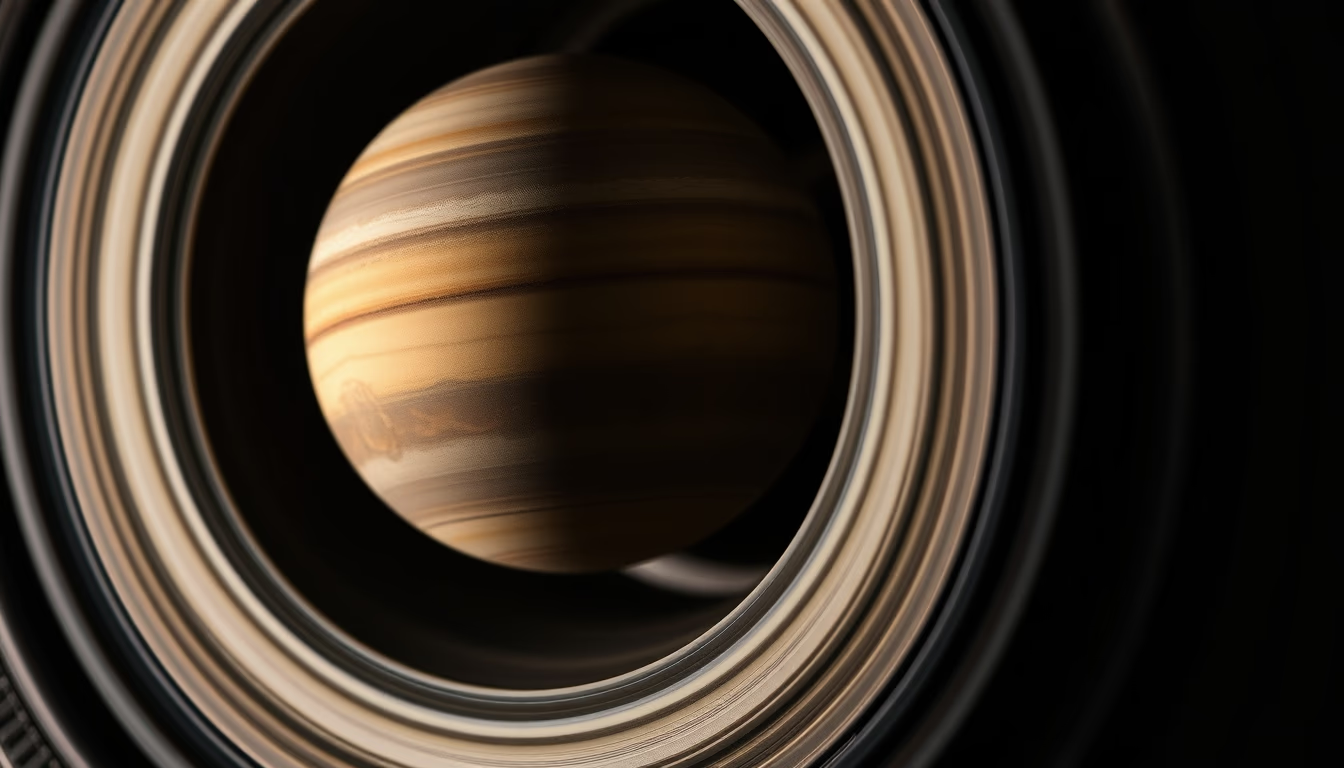
Saturn's rings consist of billions of ice and rock particles, stretching over 280,000 km yet only tens of meters thick.
About this subject
Saturn's rings are one of the most striking features in the Solar System. Unlike early beliefs, they are not solid but composed of countless fragments of water ice and dust, ranging in size from micrometers to meters. These debris are thought to be remnants of comets, asteroids, or shattered moons torn apart by the planet's intense gravity. The ring system is divided into several main sections, named A through G, with the prominent A and B rings separated by the Cassini Division, a gap about 4,700 km wide discovered in 1675 by Giovanni Cassini.
The rings were first observed by Galileo Galilei in 1610, but with his primitive telescope he described them as “ears” or handles. Their true nature was revealed by Christiaan Huygens in 1655, who identified a thin, flat ring encircling the planet. Space missions such as Voyager and Cassini-Huygens revolutionized our knowledge: the Cassini spacecraft, which orbited Saturn from 2004 to 2017, revealed unprecedented details, including vertical structures up to 2.5 km high in the rings, formed by gravitational influences from shepherd moons like Prometheus and Pandora.
Despite their vast extent, the rings are extremely thin: on average only about 10 meters thick, and in some places just a few meters. This intriguing feature is maintained by a delicate dynamic balance between Saturn's gravity, its moons, and interactions among the particles themselves. Recent studies suggest that the rings are geologically young, with an estimated age between 10 and 100 million years, and may be gradually disappearing as material rains onto the planet. This loss was measured by Cassini, which detected roughly 10,000 kg of ring material falling onto Saturn per second.
Frequently Asked Questions
How far do Saturn's rings extend?
The rings stretch about 282,000 km from Saturn's center, yet their average thickness is only about 10 meters.
What are Saturn's rings made of?
They are mostly composed of water ice particles, along with dust and rocky debris. Sizes range from microscopic grains to mountain-sized chunks.
Who discovered Saturn's rings?
Galileo Galilei first observed them in 1610, but Christiaan Huygens correctly identified them as a ring in 1655.
Direct URL
https://pub-c7d6a6ea828543ac903a74a341ccb2e1.r2.dev/imagens/saturn-rings-detail-closeup-studio-editorial-portrait-p3.avifHow to credit
Include a visible link back to UtilizAí. Copy one of the snippets below:
<a href="https://xn--utiliza-eza.com/en/midia/imagens/saturn-rings-detail-closeup-studio-editorial-portrait-p3">Saturn rings detail closeup</a> by <a href="https://xn--utiliza-eza.com">UtilizAí</a>, licensed under <a href="https://creativecommons.org/licenses/by/4.0/">CC BY 4.0</a>.
[Saturn rings detail closeup](https://xn--utiliza-eza.com/en/midia/imagens/saturn-rings-detail-closeup-studio-editorial-portrait-p3) by [UtilizAí](https://xn--utiliza-eza.com), CC BY 4.0
License: CC-BY-4.0