Saturn rings detail closeup
1344×768 · AVIF · CC BY 4.0
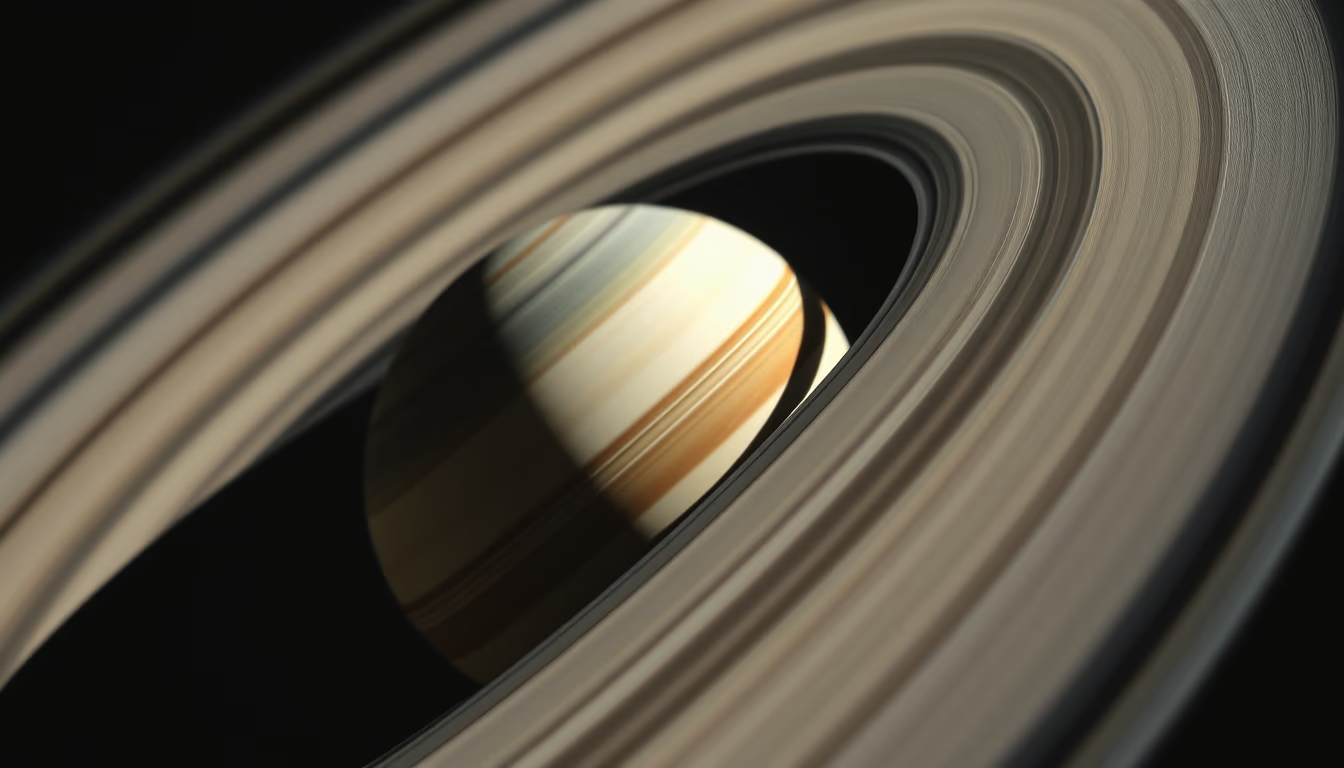
Saturn's rings, composed mainly of ice and dust, are one of the most fascinating structures in the Solar System, spanning thousands of kilometers.
About this subject
Saturn's rings are composed of billions of particles, from microscopic grains to mountain-sized chunks, made primarily of water ice with traces of rocky material. They span about 282,000 km but are only 10 meters thick on average. Divided into seven main groups labeled A through G, with gaps like the 4,800 km-wide Cassini Division between the A and B rings.
Their origin is still debated, but they are thought to be remnants of moons or comets that disintegrated under Saturn's gravity millions of years ago. The Cassini spacecraft, which orbited Saturn from 2004 to 2017, revealed stunning details, such as vertical structures in the rings and the influence of shepherd moons like Prometheus and Pandora, which keep the edges sharp.
The rings are dynamic and change over time. Observations from the Hubble Telescope and Cassini show they may be slowly disappearing, with material falling into Saturn's atmosphere. It is estimated that in 100 million years, the rings might no longer exist.
Gravitationally, the rings interact with Saturn's moons, creating complex waves and patterns. They also reflect sunlight, making them visible from Earth with small telescopes. During the planet's equinox, the rings appear as a thin line, offering unique views.
Frequently Asked Questions
What are Saturn's rings made of?
The rings are composed mainly of water ice, with a small amount of dust and rocky material. Particles range from microscopic size to several meters in diameter.
How many rings does Saturn have?
Saturn has a complex system with seven main rings (A, B, C, D, E, F, and G), along with several gaps and fainter rings. The brightest is the B ring.
Are Saturn's rings disappearing?
Yes, observations indicate the rings are losing material, which falls into Saturn's atmosphere. It is estimated that in 100 million years, they may dissipate completely.
Direct URL
https://pub-c7d6a6ea828543ac903a74a341ccb2e1.r2.dev/imagens/saturn-rings-detail-closeup-minimalist-composition-p6.avifHow to credit
Include a visible link back to UtilizAí. Copy one of the snippets below:
<a href="https://xn--utiliza-eza.com/en/midia/imagens/saturn-rings-detail-closeup-minimalist-composition-p6">Saturn rings detail closeup</a> by <a href="https://xn--utiliza-eza.com">UtilizAí</a>, licensed under <a href="https://creativecommons.org/licenses/by/4.0/">CC BY 4.0</a>.
[Saturn rings detail closeup](https://xn--utiliza-eza.com/en/midia/imagens/saturn-rings-detail-closeup-minimalist-composition-p6) by [UtilizAí](https://xn--utiliza-eza.com), CC BY 4.0
License: CC-BY-4.0