Saturn rings detail closeup
1344×768 · AVIF · CC BY 4.0
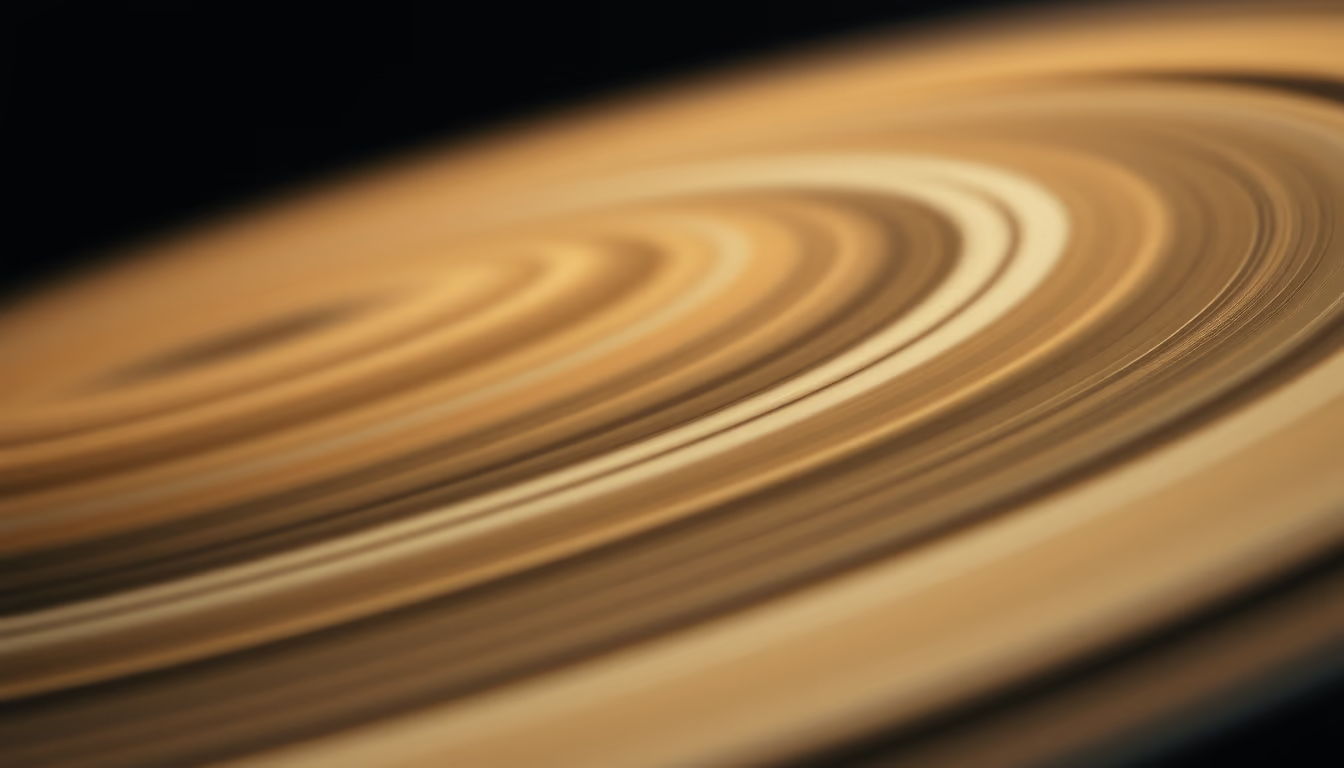
Saturn's rings are one of the most fascinating sights in the Solar System, composed of billions of ice particles and rocky debris.
About this subject
Saturn's rings span hundreds of thousands of kilometers but are only about 10 meters thick in most areas. They are composed predominantly of water ice, with particles ranging from dust grains to house-sized chunks. The rings are thought to be relatively young, less than 100 million years old, possibly originating from the destruction of a moon or comet by the planet's tidal forces.
The ring structure is complex, divided into several main sections. The A ring is the outermost of the bright rings, separated from the B ring by the Cassini Division, a gap about 4,700 kilometers wide. The B ring is the densest and brightest, while the C ring is fainter. Additional faint rings include D, E, F, and G. The Cassini spacecraft, which orbited Saturn from 2004 to 2017, revealed stunning details including density waves and small shepherd moons that maintain sharp edges.
Contrary to popular belief, the rings are not solid. They are composed of countless ice chunks that orbit Saturn independently, constantly colliding and reorganizing. Observations have shown that some particles can be as large as mountains. Gaps in the rings, such as the Cassini Division and Encke Gap, are maintained by gravitational resonances with Saturn's moons, especially Mimas and Enceladus.
Interestingly, the rings are gradually losing material, being pulled into Saturn's atmosphere by gravity. It is estimated that they may completely disappear in a few hundred million years. This dynamic makes Saturn's rings not only beautiful but also a natural laboratory for studying planetary processes and solar system evolution.
Frequently Asked Questions
Are Saturn's rings solid?
No, the rings are not solid. They are composed of billions of individual ice and dust particles orbiting Saturn, ranging in size from microscopic grains to chunks tens of meters across.
How did Saturn's rings form?
The rings are thought to be relatively young, less than 100 million years old. They may have formed from the destruction of a moon or comet that came too close to Saturn and was torn apart by tidal forces, or from leftover material from the planet's formation.
Why do Saturn's rings have gaps?
Gaps like the Cassini Division are created by gravitational resonances with Saturn's moons. These moons exert regular pulls that sweep particles out of the gaps, keeping them clear. For example, the moon Mimas governs the edge of the Cassini Division.
Direct URL
https://pub-c7d6a6ea828543ac903a74a341ccb2e1.r2.dev/imagens/saturn-rings-detail-closeup-macro-closeup-p5.avifHow to credit
Include a visible link back to UtilizAí. Copy one of the snippets below:
<a href="https://xn--utiliza-eza.com/en/midia/imagens/saturn-rings-detail-closeup-macro-closeup-p5">Saturn rings detail closeup</a> by <a href="https://xn--utiliza-eza.com">UtilizAí</a>, licensed under <a href="https://creativecommons.org/licenses/by/4.0/">CC BY 4.0</a>.
[Saturn rings detail closeup](https://xn--utiliza-eza.com/en/midia/imagens/saturn-rings-detail-closeup-macro-closeup-p5) by [UtilizAí](https://xn--utiliza-eza.com), CC BY 4.0
License: CC-BY-4.0