Saturn rings detail closeup
1344×768 · AVIF · CC BY 4.0
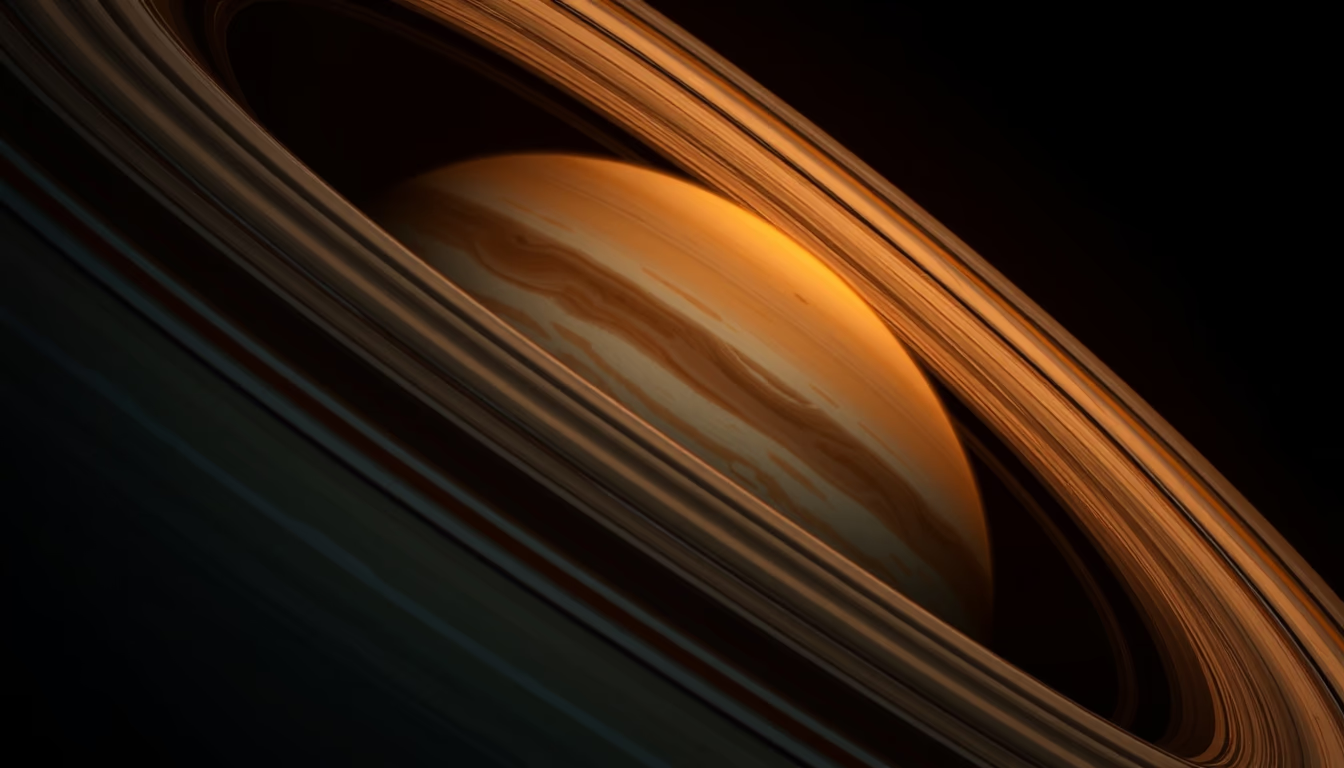
Saturn's rings are primarily composed of ice and rocky particles, with intricate structures that have intrigued astronomers for centuries.
About this subject
Saturn's rings form the most extensive and complex ring system in the Solar System. Spanning up to 282,000 km from the planet's center, they are only about 10 meters thick in most parts. Composed of 99.9% water ice and traces of dust, the particles range from micrometers to meters in diameter. The origin of the rings is still debated: they could be remnants of a moon or comet shattered by Saturn's gravity, or leftover material from the planet's formation.
The rings are divided into seven main groups, designated by letters A through G in order of discovery. The brightest are the A and B rings, separated by the Cassini Division, a 4,700 km gap discovered by Giovanni Cassini in 1675. The B ring is the densest, with particles stacked in vertical structures up to 2 km high. The F ring, kept in place by two shepherd moons (Prometheus and Pandora), displays dynamic braids and knots.
The Cassini spacecraft, in orbit around Saturn from 2004 to 2017, revealed stunning details: density waves and propeller-shaped structures created by tiny embedded moons. It also observed that the rings are slowly disappearing, with material falling onto Saturn at a rate of 10 tons per second. It is estimated that in 100 million years, the rings will cease to exist.
Culturally, Saturn's rings are an astronomical icon. Galileo mistook them for two lateral moons in 1610, but Huygens in 1655 correctly identified them as a ring. Today, they symbolize the vastness and beauty of the cosmos, and are a constant target for amateur and professional telescopes.
Frequently Asked Questions
What are Saturn's rings made of?
The rings are composed primarily of water ice (99.9%) with traces of dust and rocky particles. Particles range in size from microscopic dust to house-sized chunks.
How old are Saturn's rings?
The age of the rings is uncertain. Studies suggest they may be between 10 and 100 million years old, much younger than the planet (4.5 billion years). However, some scientists believe they could be as old as the Solar System.
Why are Saturn's rings disappearing?
The rings are losing material because ice and dust particles are pulled by Saturn's gravity and fall into its atmosphere. This process, called 'ring rain', removes about 10 tons of material per second. It is estimated that the rings could completely disappear in 100 million years.
Direct URL
https://pub-c7d6a6ea828543ac903a74a341ccb2e1.r2.dev/imagens/saturn-rings-detail-closeup-fine-art-photography-p7.avifHow to credit
Include a visible link back to UtilizAí. Copy one of the snippets below:
<a href="https://xn--utiliza-eza.com/en/midia/imagens/saturn-rings-detail-closeup-fine-art-photography-p7">Saturn rings detail closeup</a> by <a href="https://xn--utiliza-eza.com">UtilizAí</a>, licensed under <a href="https://creativecommons.org/licenses/by/4.0/">CC BY 4.0</a>.
[Saturn rings detail closeup](https://xn--utiliza-eza.com/en/midia/imagens/saturn-rings-detail-closeup-fine-art-photography-p7) by [UtilizAí](https://xn--utiliza-eza.com), CC BY 4.0
License: CC-BY-4.0