Saturn rings detail closeup
1344×768 · AVIF · CC BY 4.0
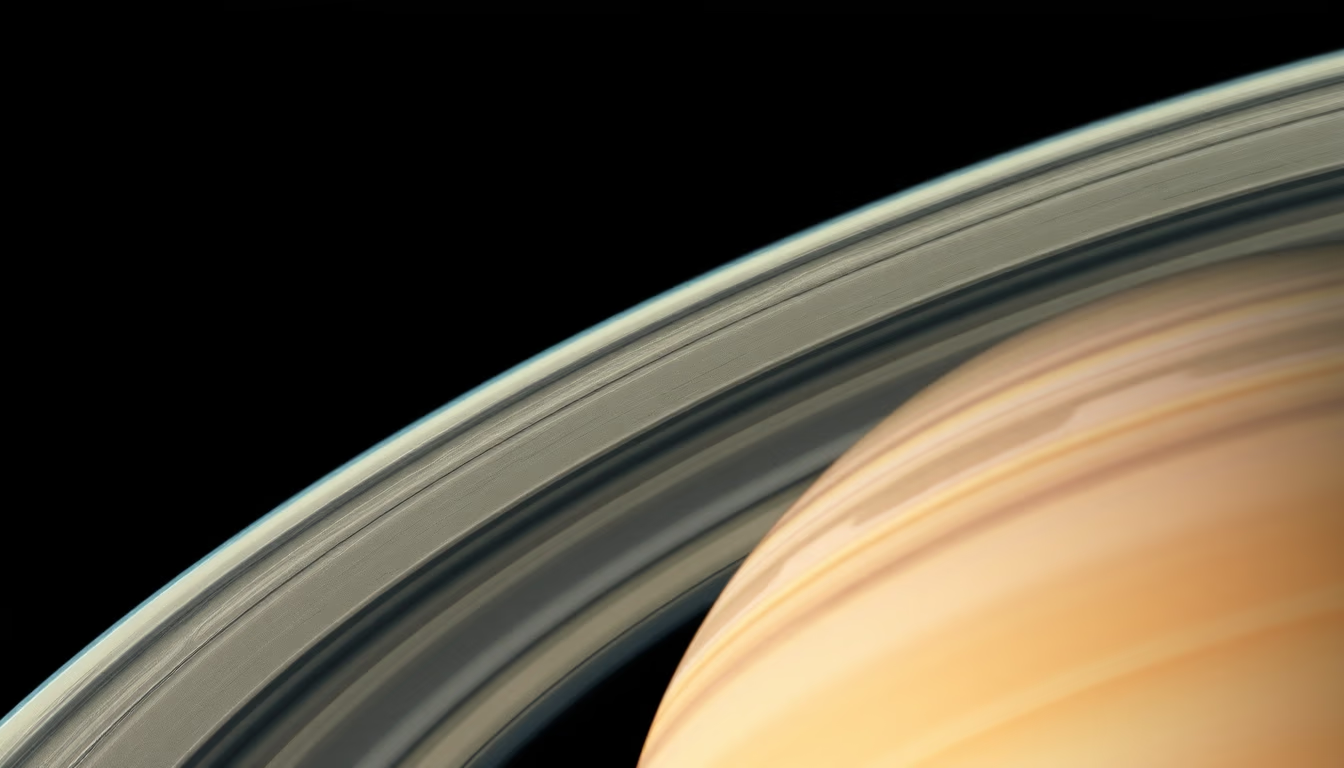
Detailed close-up of Saturn's rings, composed of billions of ice and rock particles orbiting the gas giant.
About this subject
Saturn's rings are among the most captivating features in the Solar System. Composed primarily of water ice with a small fraction of rocky debris, these rings extend hundreds of thousands of kilometers but are remarkably thin, ranging from 10 meters to 1 kilometer in thickness. Their intricate structure is maintained by gravitational interactions with Saturn's moons, especially the 'shepherd moons' that sculpt the sharp edges of the rings.
First observed by Galileo Galilei in 1610, Saturn's rings were initially described as 'ears' or moons. It was not until 1659 that Christiaan Huygens, using a more powerful telescope, correctly identified them as rings. Today, seven main ring groups are known, designated by letters (D, C, B, A, F, G, and E), with the B and A rings being the brightest and widest. Gaps such as the Cassini Division, a 4,800 km wide band separating the A and B rings, are also prominent.
The origin of the rings remains debated. One hypothesis suggests they are remnants of a moon or comet that disintegrated under Saturn's tidal forces. Another theory proposes they are primordial material from the protoplanetary disk that never coalesced into a larger body. Missions like Voyager (1980-1981) and Cassini (2004-2017) provided detailed images and crucial data, revealing features such as spiral density waves, embedded small moons, and compositional variations. Cassini, in particular, dove between Saturn and its rings, enabling unprecedented observations.
Saturn's rings are not static; they are constantly evolving. Ring material is slowly falling into the planet's atmosphere due to 'ring rain', suggesting that the rings may disappear within a few hundred million years. This process, detected by Cassini, underscores that the rings are a dynamic and temporary structure on geological timescales. Studying Saturn's rings also offers insights into the formation of planetary disks and satellite systems elsewhere in the universe.
Frequently Asked Questions
What are Saturn's rings made of?
Saturn's rings are composed mostly of water ice, with a small amount of rocky particles and dust. The particles range in size from microscopic grains to house-sized chunks.
How many rings does Saturn have?
Saturn has seven main ring groups, designated by letters D, C, B, A, F, G, and E. The most prominent are the B and A rings, separated by the Cassini Division.
Will Saturn's rings disappear?
Yes, the rings are slowly losing material to Saturn through a process called 'ring rain'. It is estimated that the rings may vanish entirely in about 300 million years.
Direct URL
https://pub-c7d6a6ea828543ac903a74a341ccb2e1.r2.dev/imagens/saturn-rings-detail-closeup-documentary-photography-p1.avifHow to credit
Include a visible link back to UtilizAí. Copy one of the snippets below:
<a href="https://xn--utiliza-eza.com/en/midia/imagens/saturn-rings-detail-closeup-documentary-photography-p1">Saturn rings detail closeup</a> by <a href="https://xn--utiliza-eza.com">UtilizAí</a>, licensed under <a href="https://creativecommons.org/licenses/by/4.0/">CC BY 4.0</a>.
[Saturn rings detail closeup](https://xn--utiliza-eza.com/en/midia/imagens/saturn-rings-detail-closeup-documentary-photography-p1) by [UtilizAí](https://xn--utiliza-eza.com), CC BY 4.0
License: CC-BY-4.0