Saturn rings detail closeup
1344×768 · AVIF · CC BY 4.0
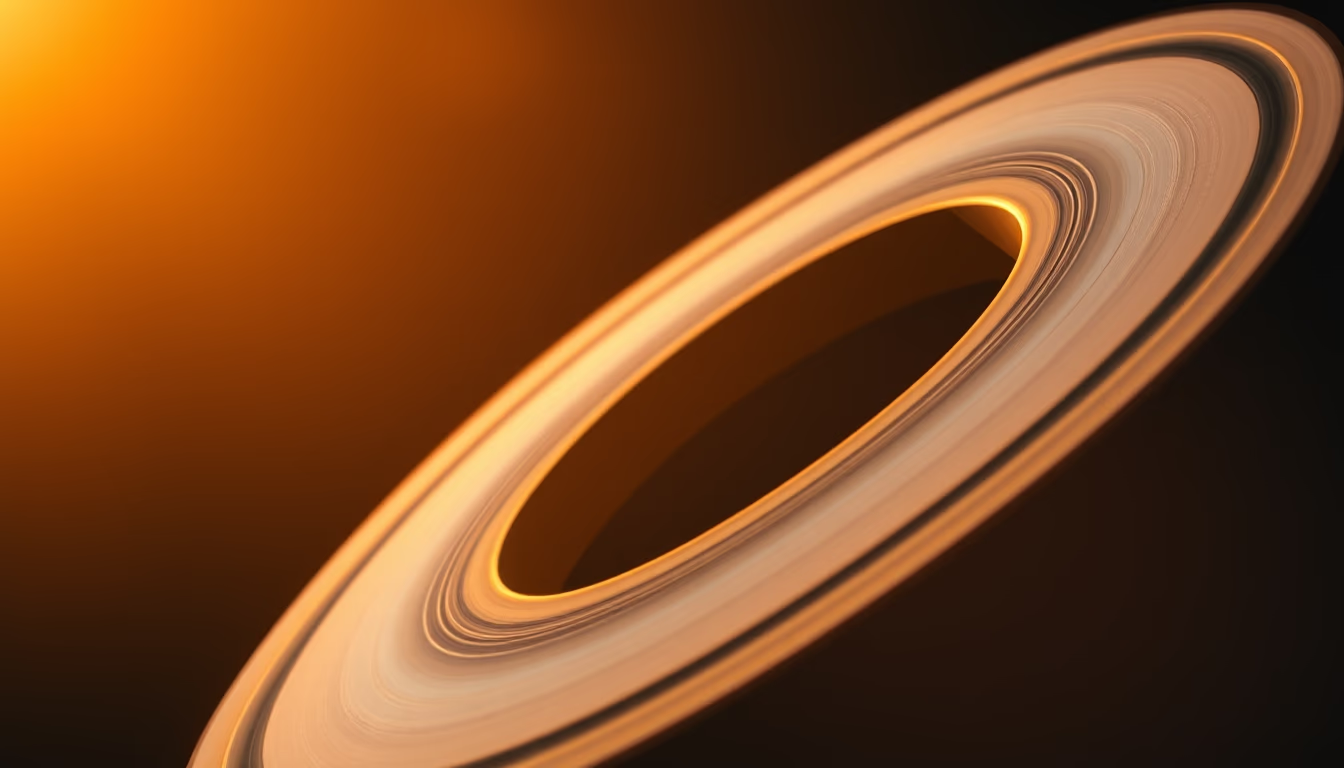
Saturn's rings are composed mainly of water ice, dust, and rocky debris, arranged in thousands of thin bands.
About this subject
Saturn's rings are one of the most iconic features in the Solar System, visible even with amateur telescopes. Spanning more than 280,000 km in diameter, they are surprisingly thin, ranging from 10 meters to 1 km in thickness. Their complex structure was revealed in detail by the Voyager missions and more recently by the Cassini spacecraft, which orbited Saturn from 2004 to 2017.
The composition is about 99% water ice, with traces of rocky material and organic compounds. Particles range from micrometers to meters in size. The origin of the rings is still debated, but the leading theory suggests they formed from the disintegration of an icy moon or from comets captured by Saturn's gravity, about 100 million years ago, relatively recent on a geological scale.
The rings are divided into seven main groups (D, C, B, A, F, G, E), with gaps such as the Cassini Division (between the A and B rings). Shepherd moons like Prometheus and Pandora help maintain their structure. The Cassini probe also discovered that the rings are losing mass to the planet, which may mean they will disappear in a few hundred million years. Additionally, the rings influence Saturn's upper atmosphere with falling ice particles.
Interestingly, the rings reflect a lot of sunlight but are dark at radio wavelengths. They also exhibit features like density waves and dust structures, studied to understand gravitational dynamics. The observation of Saturn's rings remains an active field of research, with implications for the formation of planetary systems.
Frequently Asked Questions
What are Saturn's rings made of?
The rings are composed mainly of water ice, with small amounts of dust and rocky debris. Particles range from microscopic size to boulders several meters across.
How many rings does Saturn have?
Saturn has seven main ring groups, designated D, C, B, A, F, G, and E. The brightest and widest is the B ring, and the outermost is the E ring, which is very diffuse.
Will Saturn's rings disappear?
Yes, according to data from the Cassini spacecraft, the rings are losing material to Saturn. They are estimated to disappear completely in about 100 to 300 million years.
Direct URL
https://pub-c7d6a6ea828543ac903a74a341ccb2e1.r2.dev/imagens/saturn-rings-detail-closeup-cinematic-wide-shot-p2.avifHow to credit
Include a visible link back to UtilizAí. Copy one of the snippets below:
<a href="https://xn--utiliza-eza.com/en/midia/imagens/saturn-rings-detail-closeup-cinematic-wide-shot-p2">Saturn rings detail closeup</a> by <a href="https://xn--utiliza-eza.com">UtilizAí</a>, licensed under <a href="https://creativecommons.org/licenses/by/4.0/">CC BY 4.0</a>.
[Saturn rings detail closeup](https://xn--utiliza-eza.com/en/midia/imagens/saturn-rings-detail-closeup-cinematic-wide-shot-p2) by [UtilizAí](https://xn--utiliza-eza.com), CC BY 4.0
License: CC-BY-4.0