Saturn rings detail closeup
1344×768 · AVIF · CC BY 4.0
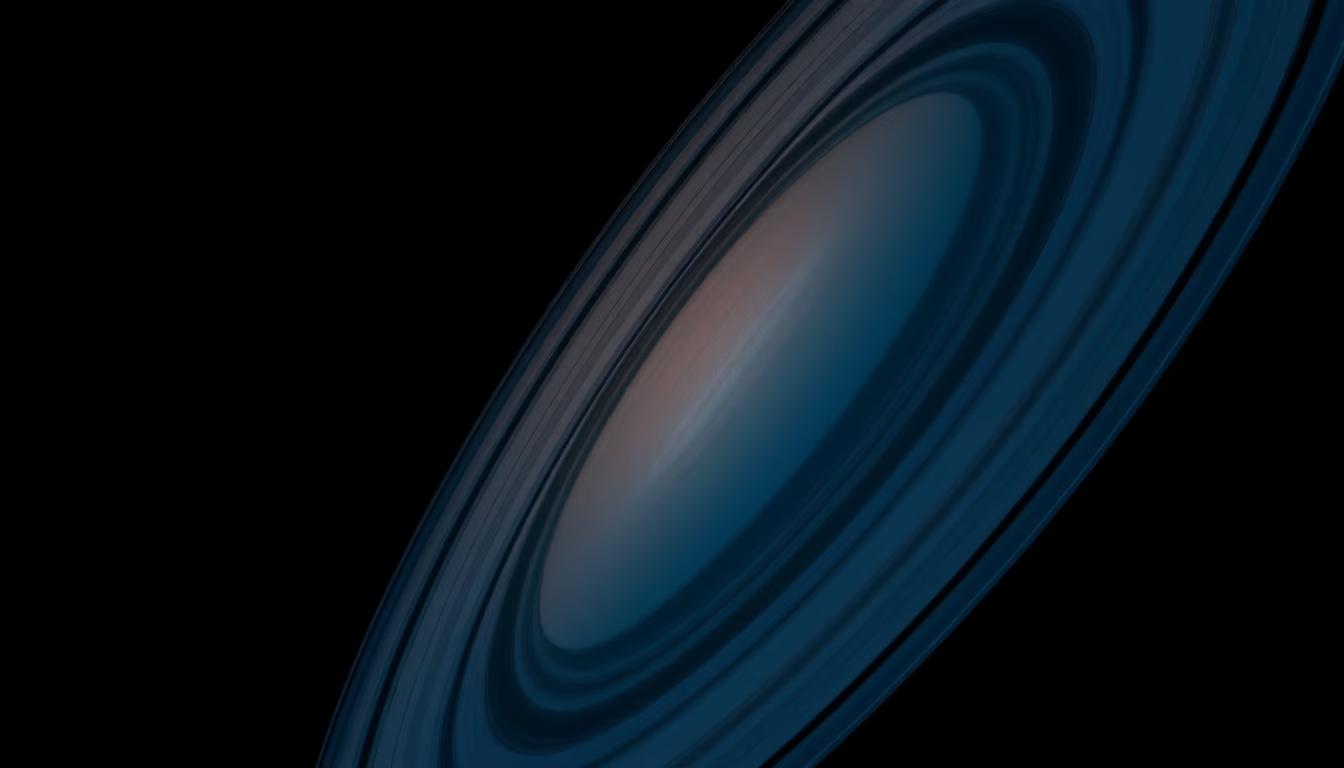
Saturn's rings are composed of billions of ice and rock particles, forming one of the most complex systems in the Solar System.
About this subject
Saturn's rings are one of the most iconic features in the Solar System, visible even with amateur telescopes. They extend approximately 282,000 kilometers from the planet's center but have a surprisingly thin thickness, on the order of 10 to 100 meters. The structure consists primarily of water ice particles, with traces of dust and rocky debris, ranging from microscopic grains to house-sized fragments.
The origin of the rings is still debated. One hypothesis suggests they are remnants of a moon or comet that disintegrated due to Saturn's tidal forces. Another theory points to leftover material from the planet's formation over 4 billion years ago. Observations from the Cassini spacecraft, which orbited Saturn from 2004 to 2017, revealed stunning details, including vertical structures and density waves caused by small shepherd moons.
The rings are divided into seven main groups designated by letters (D, C, B, A, F, G, E). The B ring is the densest and brightest, while the F ring shows braided patterns due to the influence of the moon Prometheus. The E ring is diffuse and fed by ice plumes from the moon Enceladus. The dynamics of the rings are influenced by orbital resonance with Saturn's moons, creating gaps like the Cassini Division, which separates the A and B rings.
Recent studies indicate that the rings may be relatively young, with an estimated age between 10 and 100 million years, which is minuscule compared to the age of the Solar System. This raises questions about their formation and longevity. The Cassini mission also detected that ring material is falling into Saturn's atmosphere, suggesting that the rings may be slowly dissipating over millions of years.
Frequently Asked Questions
What are Saturn's rings made of?
They are composed mostly of water ice particles, with small amounts of dust and rocky debris. The particles range from microscopic grains to house-sized chunks.
How many rings does Saturn have?
The rings are divided into seven main groups: D, C, B, A, F, G, and E. The B ring is the brightest, while the F ring is narrow and braided.
Are Saturn's rings permanent?
No, evidence from the Cassini spacecraft suggests the rings are slowly dissipating. Material falls into Saturn's atmosphere, and the rings may disappear in about 100 million years.
Direct URL
https://pub-c7d6a6ea828543ac903a74a341ccb2e1.r2.dev/imagens/saturn-rings-detail-closeup-aerial-drone-shot-p4.avifHow to credit
Include a visible link back to UtilizAí. Copy one of the snippets below:
<a href="https://xn--utiliza-eza.com/en/midia/imagens/saturn-rings-detail-closeup-aerial-drone-shot-p4">Saturn rings detail closeup</a> by <a href="https://xn--utiliza-eza.com">UtilizAí</a>, licensed under <a href="https://creativecommons.org/licenses/by/4.0/">CC BY 4.0</a>.
[Saturn rings detail closeup](https://xn--utiliza-eza.com/en/midia/imagens/saturn-rings-detail-closeup-aerial-drone-shot-p4) by [UtilizAí](https://xn--utiliza-eza.com), CC BY 4.0
License: CC-BY-4.0