Resistor color bands
1344×768 · AVIF · CC BY 4.0
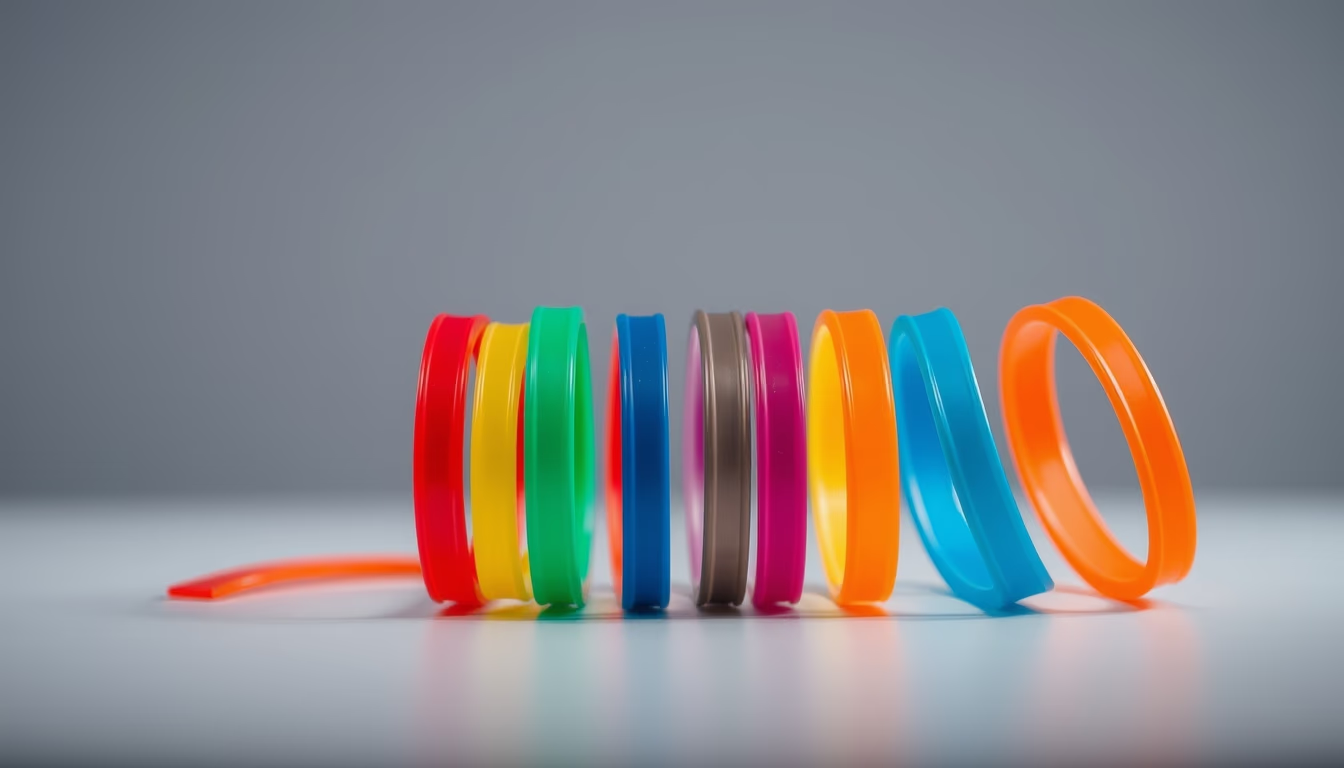
The colored bands on resistors encode their resistance value and tolerance, a fundamental standard in electronics since the 1920s.
About this subject
The resistor color code was developed by the Radio Manufacturers Association (RMA) in the 1920s to standardize component identification. Colors represent digits, multipliers, and tolerance, forming a readable system even on small components. Bands are read from left to right: the first two bands give the first two digits of the resistance value. The third band is the multiplier (a power of 10). The fourth band indicates tolerance: gold (5%), silver (10%), or none (20%). Precision resistors may have a fifth band for a third digit and a sixth band for temperature coefficient.
To read a resistor, locate the band closest to an end. The color sequence is: black (0), brown (1), red (2), orange (3), yellow (4), green (5), blue (6), violet (7), gray (8), white (9). The multiplier follows the same logic: brown (x10), red (x100), orange (x1000), etc. For example, a resistor with yellow, violet, red, gold bands equals 47 x 100 = 4700 ohms (4.7 kΩ) with 5% tolerance.
In practice, the color code allows quick identification without measurement equipment, crucial for circuit assembly and repair. Common mnemonics include "Bad Boys Run Over Yellow Grass But Violets Go Wild" or "Black Brown Red Orange Yellow Green Blue Violet Gray White". Tolerance is remembered by gold and silver colors.
Historically, standardization boosted mass production and circuit reliability. The Electronic Industries Alliance (EIA) and later IEC maintain the standard. Today, SMD resistors use numeric codes, but the color code remains popular for through-hole components, especially in hobbies and repairs.
Frequently Asked Questions
What do the colors on a resistor mean?
Each color represents a digit from 0 to 9: black (0), brown (1), red (2), orange (3), yellow (4), green (5), blue (6), violet (7), gray (8), white (9). The first two bands give the first two digits of the resistance, the third band is the multiplier, and the fourth band indicates tolerance (gold 5%, silver 10%, none 20%).
How can I memorize the resistor color code?
Use a mnemonic phrase like "Bad Boys Run Over Yellow Grass But Violets Go Wild" or "Black Brown Red Orange Yellow Green Blue Violet Gray White". Practice with real resistors to reinforce the color-value associations.
What is the difference between 4-band and 5-band resistors?
4-band resistors have two digit bands, a multiplier band, and a tolerance band. 5-band resistors have three digit bands, allowing higher precision (lower tolerance). The fourth band becomes the multiplier, and the fifth band is a third digit. A sixth band, if present, indicates temperature coefficient.
Direct URL
https://pub-c7d6a6ea828543ac903a74a341ccb2e1.r2.dev/imagens/resistor-color-bands-studio-still-life-p7.avifHow to credit
Include a visible link back to UtilizAí. Copy one of the snippets below:
<a href="https://xn--utiliza-eza.com/en/midia/imagens/resistor-color-bands-studio-still-life-p7">Resistor color bands</a> by <a href="https://xn--utiliza-eza.com">UtilizAí</a>, licensed under <a href="https://creativecommons.org/licenses/by/4.0/">CC BY 4.0</a>.
[Resistor color bands](https://xn--utiliza-eza.com/en/midia/imagens/resistor-color-bands-studio-still-life-p7) by [UtilizAí](https://xn--utiliza-eza.com), CC BY 4.0
License: CC-BY-4.0