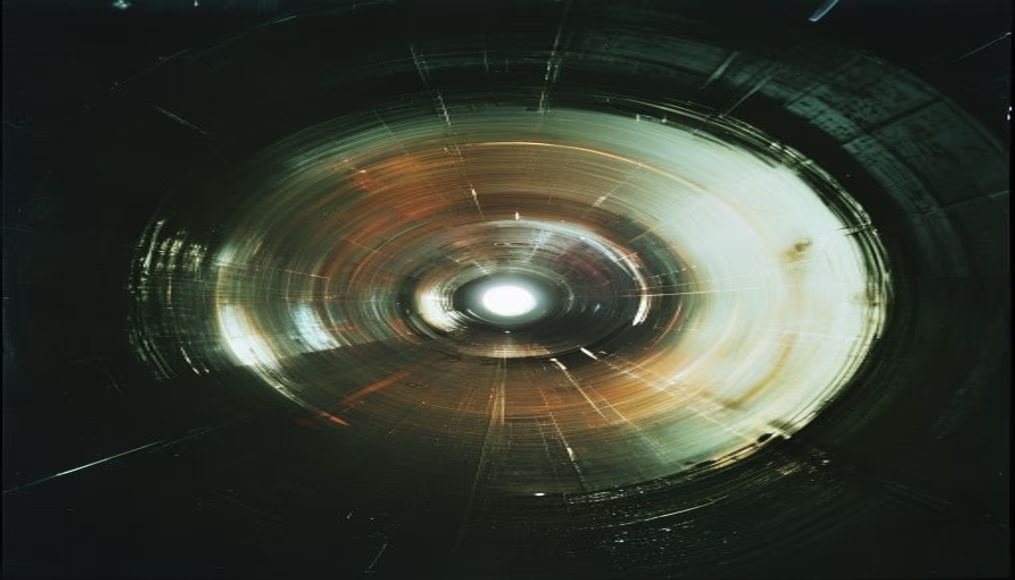
Red giant star expanding
1344×768 · AVIF · CC BY 4.0

Red giant stars represent the final phase of life for low to intermediate mass stars like the Sun, expanding enormously before becoming planetary nebulae.
About this subject
A red giant star is a late evolutionary phase for stars with masses between about 0.3 and 8 solar masses. When hydrogen in the core is exhausted, nuclear fusion temporarily ceases, causing the core to contract and heat up. This heating ignites hydrogen fusion in a shell around the core, drastically increasing radiation pressure and expanding the outer layers of the star. The radius can increase tens of times, while the surface temperature drops to about 3,000 to 4,000 Kelvin, giving the characteristic reddish color.
Notable examples include Betelgeuse in Orion, a red supergiant about 700 times the Sun's radius. Another is Aldebaran in Taurus. Red giant stars are important sources of mass loss through intense stellar winds, enriching the interstellar medium with heavy elements like carbon and nitrogen. This process contributes to the formation of new stars and planets.
The red giant phase lasts about 10% of the star's total lifetime, typically a few million years for solar-mass stars. Eventually, the core becomes hot enough to initiate helium fusion into carbon and oxygen. For stars like the Sun, after this phase, the outer layers are ejected to form a planetary nebula, leaving behind a white dwarf. Understanding this cycle is fundamental to stellar astrophysics.
Frequently Asked Questions
What happens after the red giant phase?
After the red giant phase, low-mass stars like the Sun eject their outer layers to form a planetary nebula, while the core becomes a white dwarf. More massive stars may explode as supernovae.
Why are red giants so large?
They expand due to increased radiation pressure from hydrogen fusion in a shell around the core, pushing outer layers outward, increasing the radius hundreds of times.
Will the Sun become a red giant?
Yes, in about 5 billion years, the Sun will become a red giant, expanding possibly to Earth's orbit, which will vaporize the planet.
Direct URL
https://pub-c7d6a6ea828543ac903a74a341ccb2e1.r2.dev/imagens/red-giant-star-expanding-studio-editorial-portrait-p4.avifHow to credit
Include a visible link back to UtilizAí. Copy one of the snippets below:
<a href="https://xn--utiliza-eza.com/en/midia/imagens/red-giant-star-expanding-studio-editorial-portrait-p4">Red giant star expanding</a> by <a href="https://xn--utiliza-eza.com">UtilizAí</a>, licensed under <a href="https://creativecommons.org/licenses/by/4.0/">CC BY 4.0</a>.
[Red giant star expanding](https://xn--utiliza-eza.com/en/midia/imagens/red-giant-star-expanding-studio-editorial-portrait-p4) by [UtilizAí](https://xn--utiliza-eza.com), CC BY 4.0
License: CC-BY-4.0