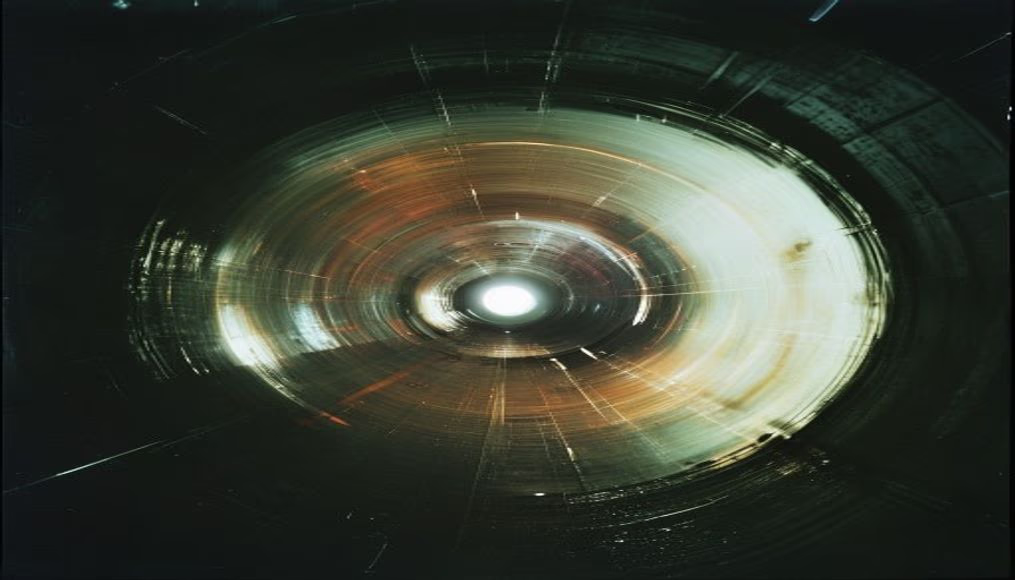
Red giant star expanding
1344×768 · AVIF · CC BY 4.0

Red giant stars represent an advanced stage of stellar evolution, characterized by expansion and cooling of the atmosphere after hydrogen depletion in the core.
About this subject
A red giant is a star that has exhausted the hydrogen in its core and begun fusing helium or heavier elements in shells around an inert core. This process causes a dramatic increase in size, reaching hundreds of times the original diameter. The reddish color comes from the lower surface temperature compared to stars like the Sun. Well-known examples include Betelgeuse in Orion and Aldebaran in Taurus.
The red giant phase is relatively short in astronomical terms, lasting from a few million to a few hundred million years depending on the star's initial mass. During this period, the star loses mass through intense stellar winds, which can eject outer layers to form planetary nebulae. The final fate varies: low-mass stars become white dwarfs, while more massive ones may explode as supernovae.
Interestingly, our Sun will enter this phase in about 5 billion years. When it does, its expansion will vaporize the inner planets, including Mercury, Venus, and possibly Earth, and may reach the orbit of Mars. The solar red giant will appear as a huge reddish disk in Earth's sky, before eventually contracting into a white dwarf.
Studying red giants is crucial for understanding the chemical evolution of the universe. They produce heavy elements like carbon and nitrogen, which are dispersed into interstellar space and incorporated into new stars and planets. Observing variable stars such as Cepheids, which are giants or supergiants, also allows precise measurement of cosmic distances.
Frequently Asked Questions
What happens to a star after the red giant phase?
The outcome depends on the star's mass. Low- to medium-mass stars like the Sun eject their outer layers to form a planetary nebula, and the core becomes a white dwarf. More massive stars may explode as supernovae, leaving behind a neutron star or black hole.
How long will the Sun's red giant phase last?
The Sun will become a red giant in about 5 billion years, and this phase will last roughly 1 billion years. During that time, it will expand to Earth's orbit, engulfing the inner planets.
Why are red giants important for chemical element production?
During the red giant phase, nucleosynthesis produces elements like carbon, nitrogen, and oxygen. These elements are released into interstellar space via stellar winds and planetary nebulae, enriching the material that forms new stars and planets.
Direct URL
https://pub-c7d6a6ea828543ac903a74a341ccb2e1.r2.dev/imagens/red-giant-star-expanding-cinematic-wide-shot-p3.avifHow to credit
Include a visible link back to UtilizAí. Copy one of the snippets below:
<a href="https://xn--utiliza-eza.com/en/midia/imagens/red-giant-star-expanding-cinematic-wide-shot-p3">Red giant star expanding</a> by <a href="https://xn--utiliza-eza.com">UtilizAí</a>, licensed under <a href="https://creativecommons.org/licenses/by/4.0/">CC BY 4.0</a>.
[Red giant star expanding](https://xn--utiliza-eza.com/en/midia/imagens/red-giant-star-expanding-cinematic-wide-shot-p3) by [UtilizAí](https://xn--utiliza-eza.com), CC BY 4.0
License: CC-BY-4.0