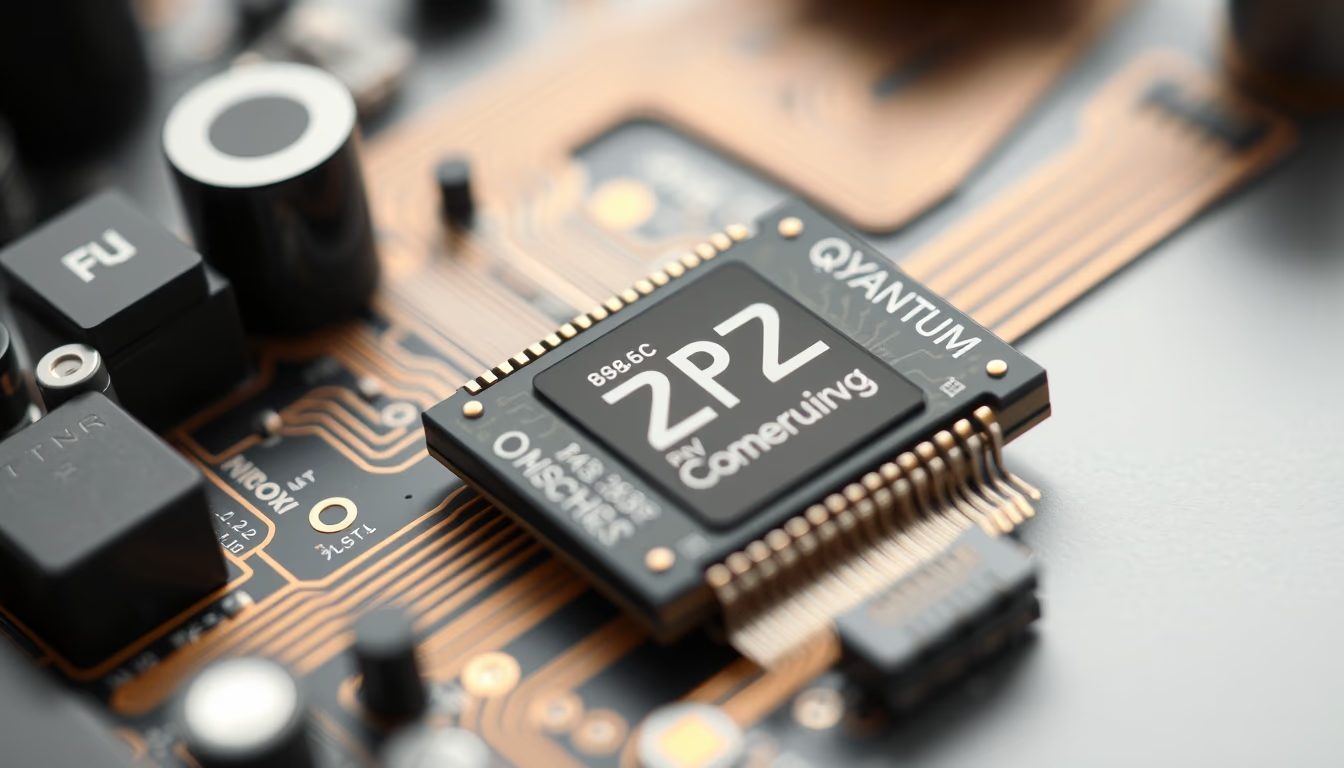
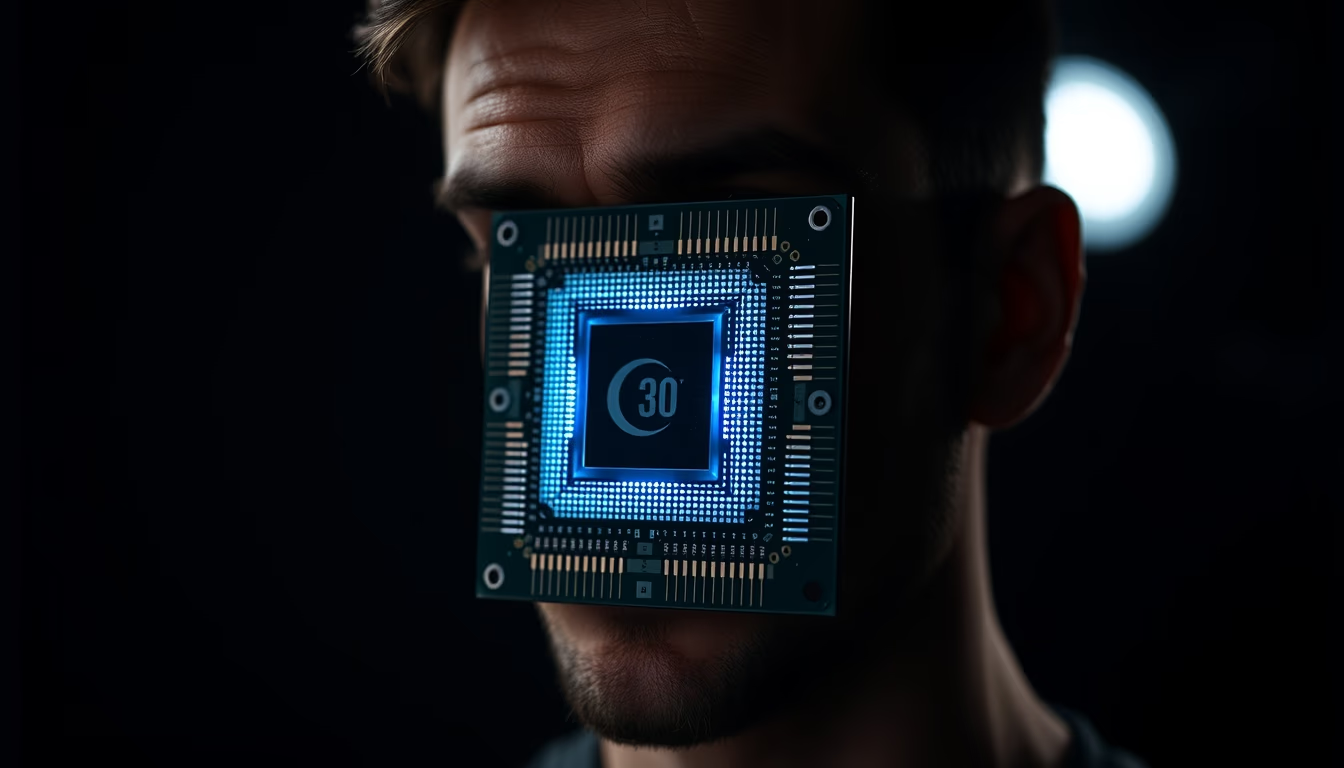
Quantum entanglement visualization
1344×768 · AVIF · CC BY 4.0

Understand quantum entanglement, a phenomenon where particles correlate instantly, challenging classical physics.
About this subject
Quantum entanglement is a quantum mechanical phenomenon where two or more particles become interconnected such that the state of one instantly influences the state of the other, regardless of distance. First described by Albert Einstein, Boris Podolsky, and Nathan Rosen in their famous 1935 EPR paper, Einstein derided it as "spooky action at a distance." Decades later, experiments such as those by Alain Aspect in the 1980s confirmed its reality by violating Bell's inequalities, proving that quantum mechanics cannot be explained by local hidden variable theories.
In practice, quantum entanglement underpins emerging technologies like quantum computing, quantum cryptography, and quantum teleportation. In a quantum computer, entangled qubits enable exponentially faster information processing than classical bits. In cryptography, entanglement allows quantum key distribution (QKD) that is theoretically unbreakable. Quantum teleportation, meanwhile, does not transport matter but transfers the quantum state of one particle to another distant one using entanglement as a resource.
Despite its strangeness, quantum entanglement is a well-established experimental fact. In 2022, the Nobel Prize in Physics was awarded to Alain Aspect, John Clauser, and Anton Zeilinger for their pioneering experiments with entangled photons. These experiments paved the way for new quantum technologies and helped clarify the foundations of the theory. Today, labs worldwide generate entangled photon pairs using nonlinear crystals and other techniques.
Interestingly, quantum entanglement cannot be used to transmit information faster than light, because the wavefunction collapse is random and uncontrollable. However, it yields correlations that defy classical intuition. Images like this one, attempting to visualize entanglement, often use abstract representations of particles connected by lines or colored spheres, symbolizing the non-local connection between them.
Frequently Asked Questions
What is quantum entanglement in simple terms?
It is a phenomenon where two particles behave as if connected, even when far apart. Measuring one instantly affects the state of the other.
Can quantum entanglement be used for faster-than-light communication?
No. The correlation is instantaneous, but it cannot transmit controlled information because measurement outcomes are random. Superluminal communication is impossible.
What practical applications does quantum entanglement already have?
Quantum key distribution (QKD) for secure cryptography, quantum computing, and quantum state teleportation. Still developing, but commercial QKD systems exist.
Direct URL
https://pub-c7d6a6ea828543ac903a74a341ccb2e1.r2.dev/imagens/quantum-entanglement-visualization-studio-still-life-p11.avifHow to credit
Include a visible link back to UtilizAí. Copy one of the snippets below:
<a href="https://xn--utiliza-eza.com/en/midia/imagens/quantum-entanglement-visualization-studio-still-life-p11">Quantum entanglement visualization</a> by <a href="https://xn--utiliza-eza.com">UtilizAí</a>, licensed under <a href="https://creativecommons.org/licenses/by/4.0/">CC BY 4.0</a>.
[Quantum entanglement visualization](https://xn--utiliza-eza.com/en/midia/imagens/quantum-entanglement-visualization-studio-still-life-p11) by [UtilizAí](https://xn--utiliza-eza.com), CC BY 4.0
License: CC-BY-4.0