Quantum entanglement visualization
1344×768 · AVIF · CC BY 4.0
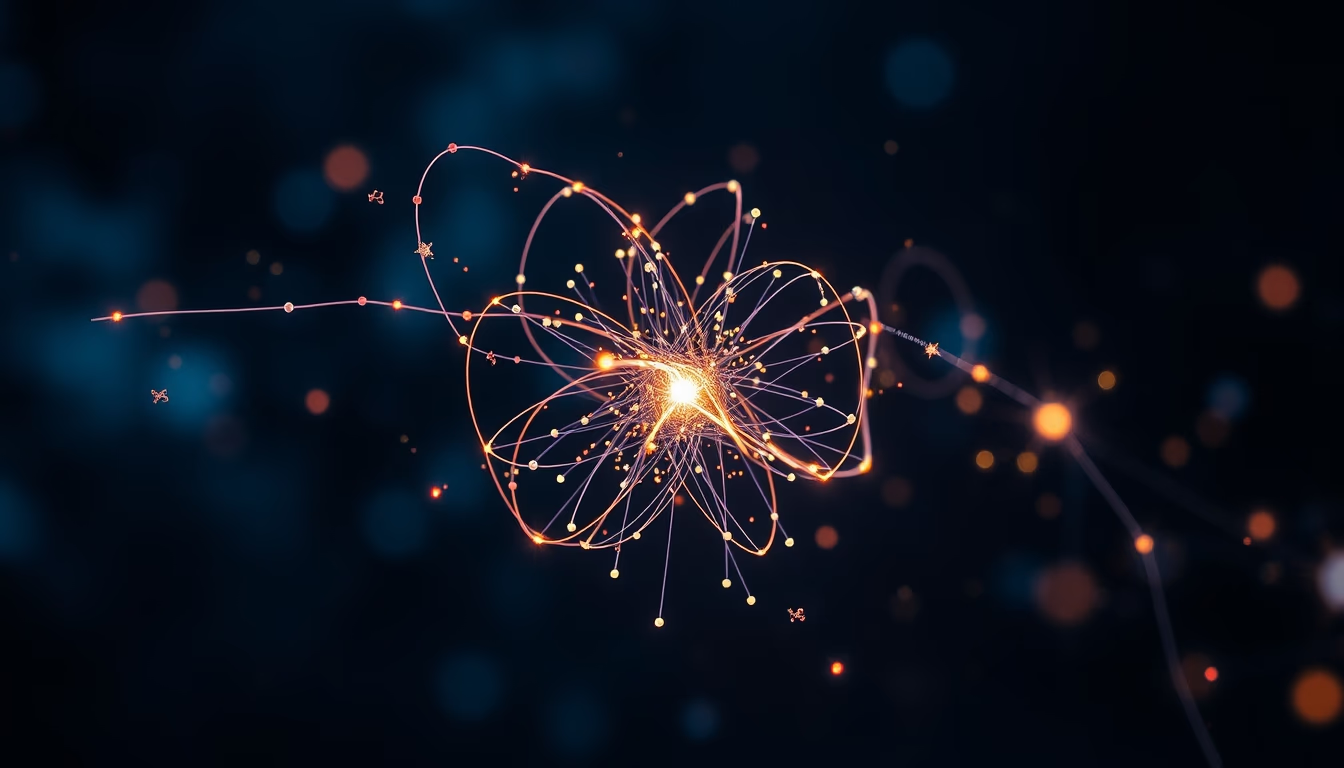
Conceptual visualization of quantum entanglement, a phenomenon where pairs of particles remain correlated regardless of distance.
About this subject
Quantum entanglement is one of the most fascinating and counterintuitive concepts in quantum mechanics. It describes a situation where two or more particles become linked so that the quantum state of one cannot be described independently of the others, even when separated by vast distances. This phenomenon was originally called "spooky action at a distance" by Albert Einstein, who questioned its validity. However, experiments from the 1970s onward, such as those by Alain Aspect, confirmed entanglement as a physical reality. Understanding entanglement is crucial for emerging technologies like quantum computing, quantum cryptography, and quantum teleportation. In 2022, the Nobel Prize in Physics was awarded to Aspect, John Clauser, and Anton Zeilinger for their groundbreaking experiments with entangled photons, demonstrating violation of Bell inequalities and paving the way for quantum information science. Visualizations like this help graphically represent the nonlocal correlation between particles, a concept that defies classical intuition. Entanglement also raises philosophical questions about the nature of reality and interpretations of quantum mechanics, such as the Copenhagen and many-worlds interpretations. In practice, entangled particles can be created by processes like spontaneous parametric down-conversion, where a high-energy photon splits into two lower-energy photons with correlated quantum states. These pairs are used in experiments testing the foundations of quantum physics and in applications like quantum key distribution for secure communications.
Frequently Asked Questions
What is quantum entanglement?
It is a quantum mechanics phenomenon where two or more particles become correlated so that the state of one instantly depends on the state of the other, regardless of distance.
How is quantum entanglement created in a lab?
A common method is spontaneous parametric down-conversion, where a laser photon passes through a nonlinear crystal and splits into two entangled photons.
What are the practical applications of quantum entanglement?
They include quantum cryptography for secure communication, quantum teleportation of information, and quantum computing for solving complex problems.
Direct URL
https://pub-c7d6a6ea828543ac903a74a341ccb2e1.r2.dev/imagens/quantum-entanglement-visualization-magazine-editorial-p3.avifHow to credit
Include a visible link back to UtilizAí. Copy one of the snippets below:
<a href="https://xn--utiliza-eza.com/en/midia/imagens/quantum-entanglement-visualization-magazine-editorial-p3">Quantum entanglement visualization</a> by <a href="https://xn--utiliza-eza.com">UtilizAí</a>, licensed under <a href="https://creativecommons.org/licenses/by/4.0/">CC BY 4.0</a>.
[Quantum entanglement visualization](https://xn--utiliza-eza.com/en/midia/imagens/quantum-entanglement-visualization-magazine-editorial-p3) by [UtilizAí](https://xn--utiliza-eza.com), CC BY 4.0
License: CC-BY-4.0