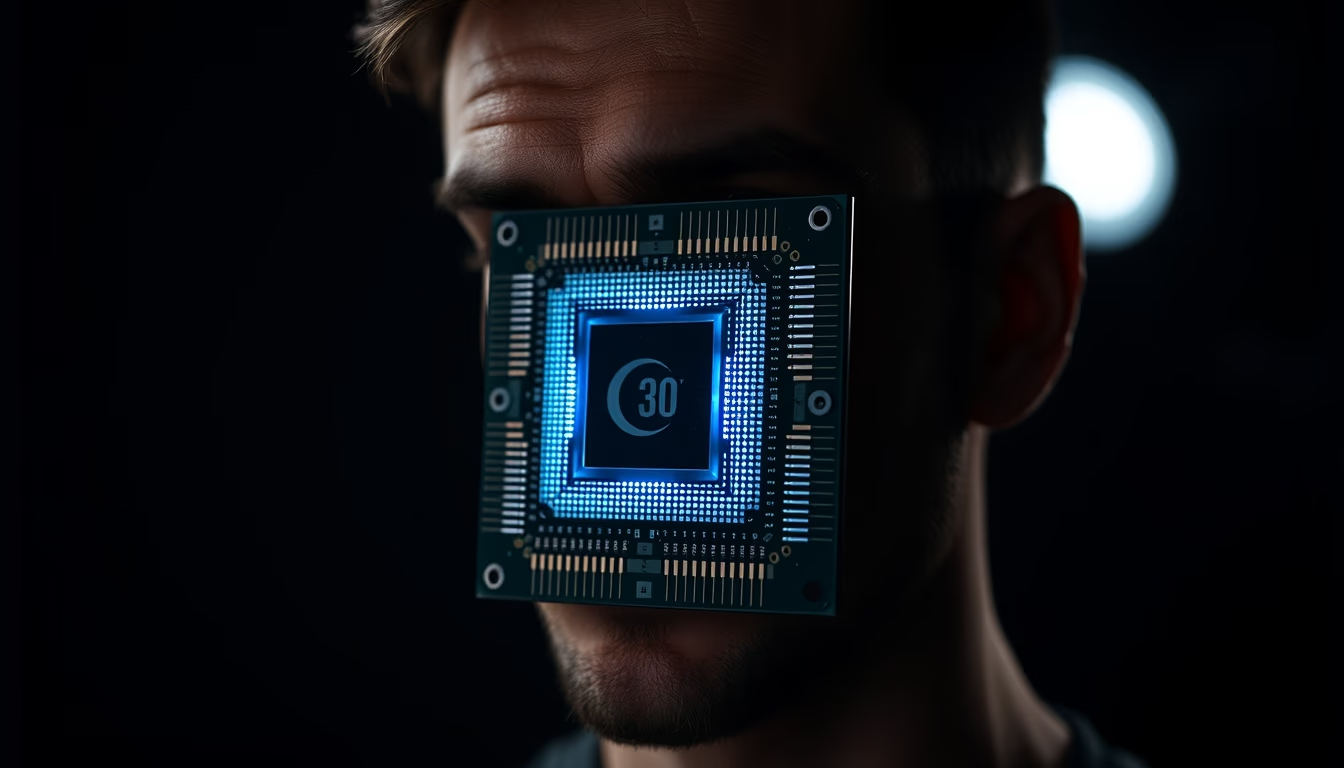
Quantum entanglement visualization
1344×768 · AVIF · CC BY 4.0

Quantum entanglement describes interconnected particles whose states correlate instantly, challenging classical physics and opening doors to revolutionary technologies.
About this subject
Quantum entanglement is a phenomenon where two or more particles become correlated such that the state of one cannot be described independently of the state of the other, even when separated by large distances. This behavior was called "spooky action at a distance" by Albert Einstein in a famous 1935 paper with Podolsky and Rosen (EPR paradox), which questioned the completeness of quantum mechanics. Decades later, John Bell formulated a theorem in 1964 that allowed experimental testing of these correlations, and Alain Aspect's experiments in the 1980s confirmed the violation of Bell inequalities, proving that nature is indeed nonlocal.
Understanding entanglement is central to the second quantum revolution. It is the key resource for quantum computing, where entangled qubits enable exponentially faster calculations for certain problems compared to classical computers. It also enables quantum cryptography, ensuring absolute security in communication because any eavesdropping attempt alters the entangled state. Moreover, quantum teleportation uses entanglement to transfer the quantum state of one particle to another without physical transport of matter.
Interestingly, entanglement does not allow faster-than-light information transmission, as a classical channel is required to communicate measurement results. Nevertheless, its implications for the philosophy of science and technology are profound. In 2022, the Nobel Prize in Physics was awarded to Aspect, Clauser, and Zeilinger for their groundbreaking experiments with entangled photons, solidifying the phenomenon as a cornerstone of modern physics. Abstract visualizations of this concept, like the macro close-up suggested by the image, help convey the counterintuitive and beautiful nature of these quantum correlations.
Frequently Asked Questions
What is quantum entanglement?
It is a phenomenon where particles become correlated so that the state of one instantly affects the state of another, regardless of distance, challenging classical locality.
How was quantum entanglement experimentally proven?
Through Alain Aspect's experiments in the 1980s, which violated Bell's inequalities, demonstrating correlations stronger than those allowed by classical physics.
What are the practical applications of entanglement?
Quantum computing (entangled qubits for parallel processing), quantum cryptography (secure key distribution), and quantum teleportation (transferring quantum states between distant particles).
Direct URL
https://pub-c7d6a6ea828543ac903a74a341ccb2e1.r2.dev/imagens/quantum-entanglement-visualization-macro-closeup-p0.avifHow to credit
Include a visible link back to UtilizAí. Copy one of the snippets below:
<a href="https://xn--utiliza-eza.com/en/midia/imagens/quantum-entanglement-visualization-macro-closeup-p0">Quantum entanglement visualization</a> by <a href="https://xn--utiliza-eza.com">UtilizAí</a>, licensed under <a href="https://creativecommons.org/licenses/by/4.0/">CC BY 4.0</a>.
[Quantum entanglement visualization](https://xn--utiliza-eza.com/en/midia/imagens/quantum-entanglement-visualization-macro-closeup-p0) by [UtilizAí](https://xn--utiliza-eza.com), CC BY 4.0
License: CC-BY-4.0