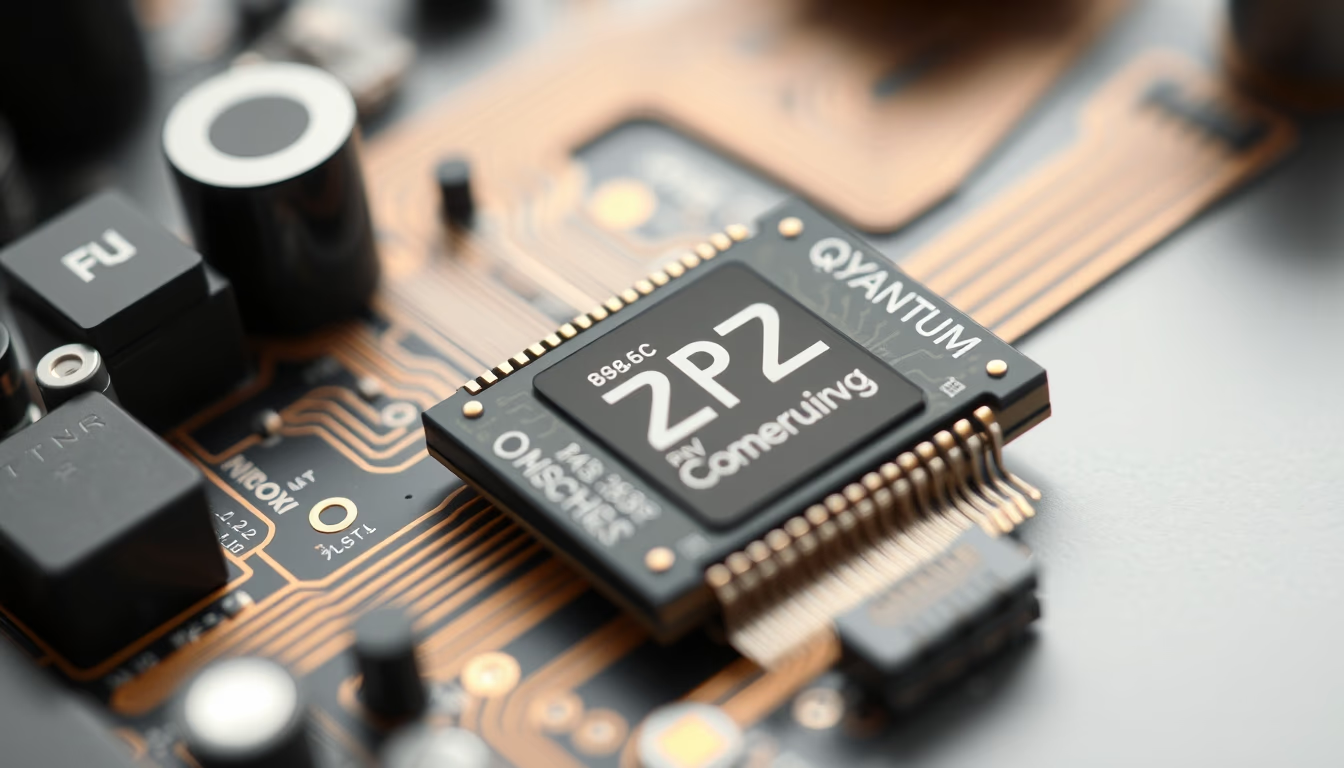
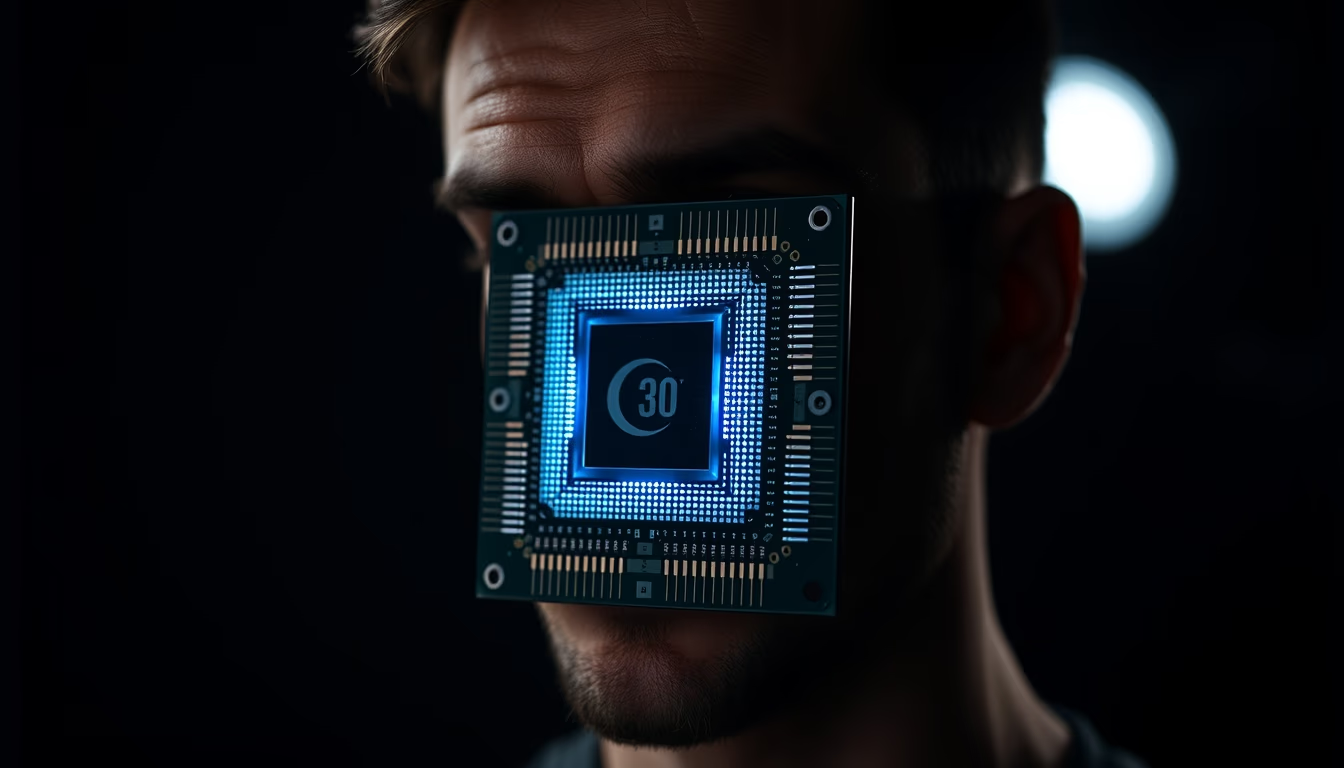
Quantum entanglement visualization
1344×768 · AVIF · CC BY 4.0

Quantum entanglement is a phenomenon where two particles become correlated such that measuring one instantly influences the state of the other, challenging classical intuition.
About this subject
Quantum entanglement, theoretically described by Einstein, Podolsky and Rosen in 1935, is one of the most intriguing properties of quantum mechanics. In it, two particles interact and share a single state, such that measuring one instantly determines the state of the other, regardless of the distance separating them. This behavior, which Einstein called "spooky action at a distance," was experimentally confirmed by Alain Aspect in the 1980s and more recently by the 2022 Nobel Prize in Physics tests.
The phenomenon does not allow faster-than-light information transmission, but it is the basis for technologies such as quantum cryptography, ensuring secure communications, and quantum teleportation, which transfers states between particles. Visualization of entanglement often uses representations like Bloch spheres or correlation graphs showing state interdependence. In laboratories, entangled photon pairs are generated through processes like spontaneous parametric down-conversion in nonlinear crystals.
Despite its complex name, entanglement is a fundamental resource for quantum computing, where entangled qubits enable massive parallel processing. Companies like IBM and Google exploit this principle to build quantum processors. In Brazil, researchers at the Instituto de Física de São Carlos and CBPF perform entanglement experiments to develop new technologies. Understanding this phenomenon continues to push the boundaries of physics and engineering.
Frequently Asked Questions
What is quantum entanglement?
It is a phenomenon where two particles become correlated so that the state of one instantly depends on the state of the other, even over large distances.
Can entanglement transmit information faster than light?
No. Although the correlation is instantaneous, it cannot transmit useful information, respecting relativity.
What practical applications does quantum entanglement have?
It is used in quantum cryptography, quantum teleportation, and quantum computing, as well as in fundamental physics tests.
Direct URL
https://pub-c7d6a6ea828543ac903a74a341ccb2e1.r2.dev/imagens/quantum-entanglement-visualization-fine-art-photography-p2.avifHow to credit
Include a visible link back to UtilizAí. Copy one of the snippets below:
<a href="https://xn--utiliza-eza.com/en/midia/imagens/quantum-entanglement-visualization-fine-art-photography-p2">Quantum entanglement visualization</a> by <a href="https://xn--utiliza-eza.com">UtilizAí</a>, licensed under <a href="https://creativecommons.org/licenses/by/4.0/">CC BY 4.0</a>.
[Quantum entanglement visualization](https://xn--utiliza-eza.com/en/midia/imagens/quantum-entanglement-visualization-fine-art-photography-p2) by [UtilizAí](https://xn--utiliza-eza.com), CC BY 4.0
License: CC-BY-4.0