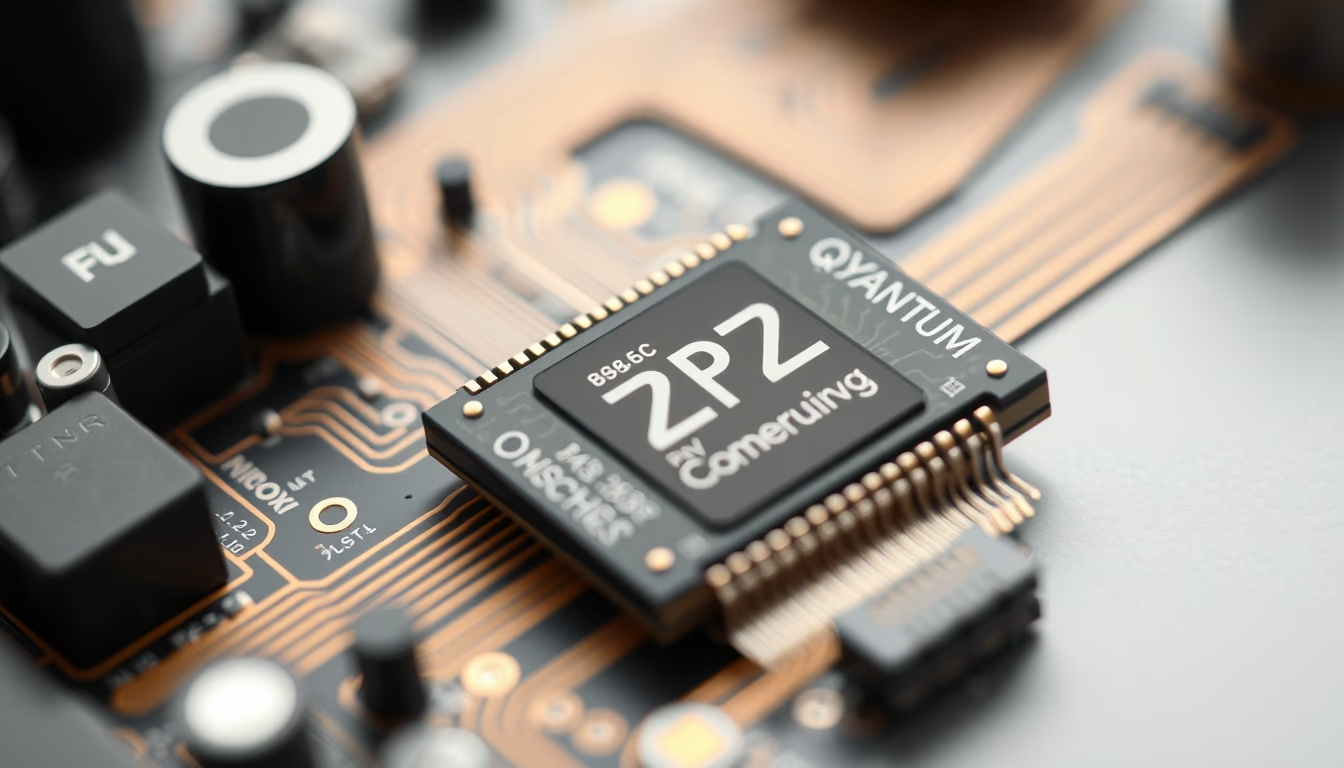
Quantum computer chip
1344×768 · AVIF · CC BY 4.0
Quantum chips are the heart of quantum computers, processing qubits to solve complex problems that challenge classical computing.
About this subject
A quantum chip is the central component of a quantum computer, responsible for manipulating qubits (quantum bits). Unlike classical bits, which can be either 0 or 1, qubits can exist in a superposition of both states, enabling exponential parallel processing. Companies such as Google, IBM, Rigetti, and IonQ lead the development of these chips, with architectures ranging from superconductors and trapped ions to photonics.
Google's Sycamore chip demonstrated quantum supremacy in 2019 by completing a calculation in 200 seconds that would take 10,000 years on a classical supercomputer. IBM, in turn, has the 127-qubit Eagle processor, while China's Origin Quantum achieved 66 qubits. Despite advances, the technology still faces challenges such as quantum decoherence, readout errors, and the need for cooling to near absolute zero temperatures to operate.
The importance of quantum chips lies in their ability to accelerate molecular simulations for drug discovery, optimize logistics chains, improve cryptography, and even model complex biological systems. In 2021, IBM introduced the 'Quantum Roadmap', predicting chips with over 1,000 qubits by 2025. Brazil is also investing in the field: the National Scientific Computing Laboratory (LNCC) maintains a quantum simulator, and startups like QuantumZero seek to develop national solutions.
Manufacturing quantum chips requires clean rooms and advanced lithography, similar to classical chip production, but with exotic materials such as niobium and aluminum at cryogenic temperatures. Many experts believe that quantum computing will not replace classical computing but will work together, creating hybrid systems that leverage the best of both paradigms.
Frequently Asked Questions
What is a quantum chip and how does it differ from a classical chip?
A quantum chip processes information using qubits, which can represent 0 and 1 simultaneously due to quantum superposition. A classical chip uses bits that are strictly 0 or 1.
What are the main challenges in manufacturing quantum chips?
Key challenges include maintaining quantum coherence (preventing qubits from losing information due to external interference), operating at cryogenic temperatures, and reducing readout errors. Scaling up to thousands of qubits also remains a significant technical hurdle.
Why is quantum computing important for Brazil?
Brazil aims to develop quantum computing capabilities through institutions like LNCC and national startups. The technology can boost sectors such as agriculture, energy, and healthcare, while also creating specialized workforce in quantum science.
Direct URL
https://pub-c7d6a6ea828543ac903a74a341ccb2e1.r2.dev/imagens/quantum-computer-chip-studio-editorial-portrait-p12.avifHow to credit
Include a visible link back to UtilizAí. Copy one of the snippets below:
<a href="https://xn--utiliza-eza.com/en/midia/imagens/quantum-computer-chip-studio-editorial-portrait-p12">Quantum computer chip</a> by <a href="https://xn--utiliza-eza.com">UtilizAí</a>, licensed under <a href="https://creativecommons.org/licenses/by/4.0/">CC BY 4.0</a>.
[Quantum computer chip](https://xn--utiliza-eza.com/en/midia/imagens/quantum-computer-chip-studio-editorial-portrait-p12) by [UtilizAí](https://xn--utiliza-eza.com), CC BY 4.0
License: CC-BY-4.0