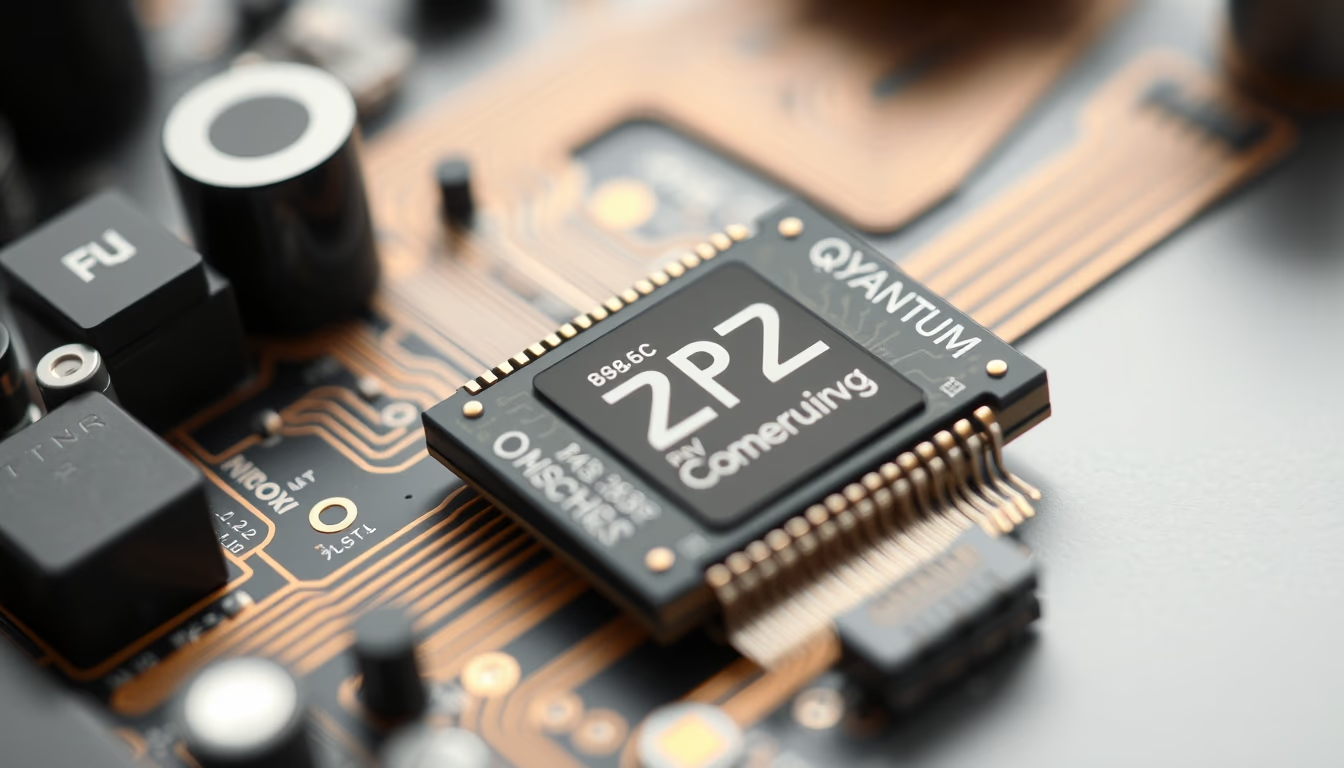
Quantum computer chip detail
1344×768 · AVIF · CC BY 4.0
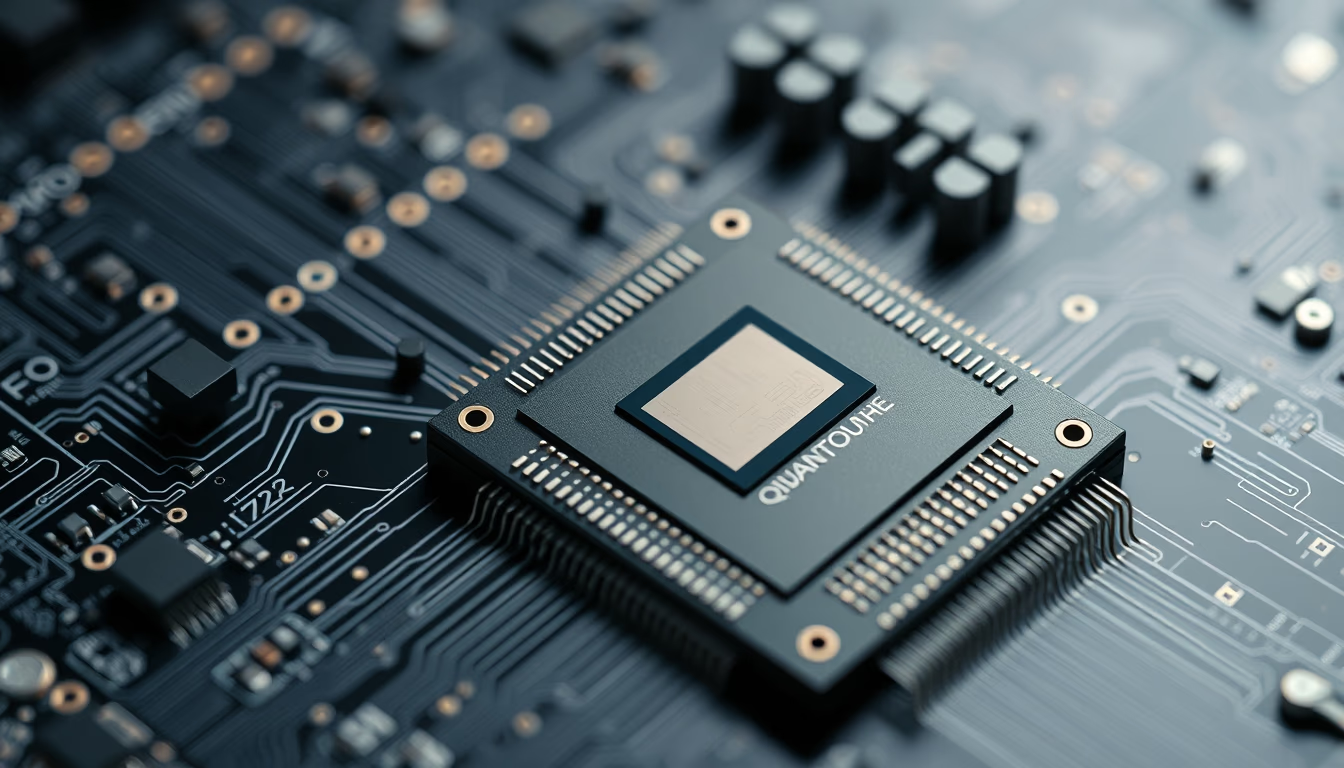
Quantum processors use qubits to process information, revolutionizing computing with potential to solve complex problems.
About this subject
A quantum chip is the core of a quantum computer, responsible for performing operations based on quantum mechanics principles. Unlike classical chips that use bits (0 or 1), quantum chips use qubits, which can be in superposition states. This allows a quantum computer to process multiple possibilities simultaneously, offering a theoretical advantage for problems like cryptography and molecular simulation.
Currently, several technological approaches exist for building quantum chips. The most common include superconducting qubits, which operate near absolute zero, and trapped ion qubits, which manipulate individual atoms. Companies like IBM, Google, and Rigetti develop superconducting chips, while IonQ and Honeywell focus on trapped ions. Each approach has specific advantages and challenges in terms of scalability and coherence time.
The biggest challenge in building quantum chips is maintaining quantum coherence, as qubits are extremely sensitive to external interference such as heat and radiation. To mitigate this, chips are kept in vacuum chambers and cooled to cryogenic temperatures. Quantum error correction is another crucial research area, necessary to make quantum computers reliable at large scales.
Although fully functional quantum computers are not yet commercially available, recent advances show significant progress. In 2023, Google's Sycamore processor demonstrated quantum supremacy by solving in minutes a problem that would take thousands of years on classical supercomputers. The expectation is that, in the coming decades, more robust quantum chips will enable applications in chemistry, artificial intelligence, and logistics optimization.
Frequently Asked Questions
How does a quantum chip work?
A quantum chip uses qubits that can be in superposition states (0 and 1 simultaneously). This enables parallel calculations, leveraging phenomena like entanglement and quantum interference to solve specific problems faster than classical computers.
What are the main challenges in building quantum chips?
Key challenges include maintaining quantum coherence (preventing qubits from losing their quantum state), reducing errors caused by environmental noise, and scaling the number of qubits to thousands or millions without increasing error rates.
When will commercial quantum computers be available?
There is no exact timeline, but experts estimate that practical quantum computers for commercial applications may emerge between 2030 and 2050. Currently, cloud services like IBM Q Experience and Amazon Braket provide access to experimental quantum chips.
Direct URL
https://pub-c7d6a6ea828543ac903a74a341ccb2e1.r2.dev/imagens/quantum-computer-chip-detail-isometric-flat-lay-p1.avifHow to credit
Include a visible link back to UtilizAí. Copy one of the snippets below:
<a href="https://xn--utiliza-eza.com/en/midia/imagens/quantum-computer-chip-detail-isometric-flat-lay-p1">Quantum computer chip detail</a> by <a href="https://xn--utiliza-eza.com">UtilizAí</a>, licensed under <a href="https://creativecommons.org/licenses/by/4.0/">CC BY 4.0</a>.
[Quantum computer chip detail](https://xn--utiliza-eza.com/en/midia/imagens/quantum-computer-chip-detail-isometric-flat-lay-p1) by [UtilizAí](https://xn--utiliza-eza.com), CC BY 4.0
License: CC-BY-4.0