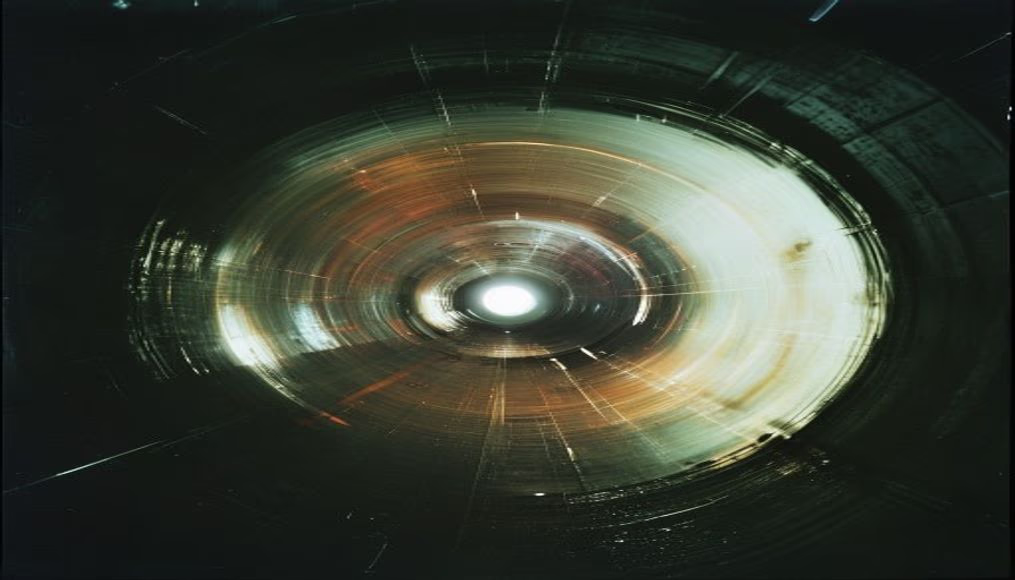
Protoplanetary disk forming
1344×768 · AVIF · CC BY 4.0

Discover how protoplanetary disks form and give rise to new solar systems, a fundamental process for understanding the origin of planets.
About this subject
A protoplanetary disk is a rotating structure of gas and dust surrounding a young star, recently formed. This material is the cradle where future planets aggregate through accretion over millions of years. The process begins when a giant molecular cloud collapses under its own gravity, forming a protostar at the center. Due to conservation of angular momentum, material that does not fall directly onto the star flattens into a disk around it. This disk is the visual signature of a planetary system in gestation.
Observations of protoplanetary disks are possible thanks to telescopes such as ALMA (Atacama Large Millimeter/submillimeter Array) in Chile, which captures millimeter and submillimeter wavelengths, and the Hubble Space Telescope, which records visible and infrared images. One of the most studied examples is the disk of the star HL Tau, photographed by ALMA in 2014, revealing rings and gaps indicating planets in formation. These structures are fundamental for testing theoretical models of planet formation.
The lifetime of a protoplanetary disk is relatively short, on the order of 1 to 10 million years. During this period, dust particles collide and coalesce, forming planetesimals and then protoplanets. Gas from the disk is also incorporated into gas giants, while rocky planets form closer to the star. Eventually, the disk dissipates, either by planetary accretion, stellar winds, or photoevaporation, leaving a mature planetary system.
Interestingly, the Solar System passed through this phase about 4.6 billion years ago. Studying protoplanetary disks in other regions of the galaxy helps us understand how our own system formed. High-resolution images from ALMA have shown that many disks exhibit symmetry and density variations, suggesting a diversity of evolutionary paths for planetary systems.
Frequently Asked Questions
What is a protoplanetary disk?
A protoplanetary disk is a flattened cloud of gas and dust orbiting a young star. It is the birthplace of planets through accretion of material.
How long does it take for a protoplanetary disk to form?
Protoplanetary disks form within a few million years after the collapse of the molecular cloud that gives rise to the central star. They last between 1 and 10 million years.
Which telescope is used to observe protoplanetary disks?
ALMA (Atacama Large Millimeter/submillimeter Array) is the primary observatory for studying protoplanetary disks. The Hubble Space Telescope also contributes with visible and infrared images.
Direct URL
https://pub-c7d6a6ea828543ac903a74a341ccb2e1.r2.dev/imagens/protoplanetary-disk-forming-travel-photography-p10.avifHow to credit
Include a visible link back to UtilizAí. Copy one of the snippets below:
<a href="https://xn--utiliza-eza.com/en/midia/imagens/protoplanetary-disk-forming-travel-photography-p10">Protoplanetary disk forming</a> by <a href="https://xn--utiliza-eza.com">UtilizAí</a>, licensed under <a href="https://creativecommons.org/licenses/by/4.0/">CC BY 4.0</a>.
[Protoplanetary disk forming](https://xn--utiliza-eza.com/en/midia/imagens/protoplanetary-disk-forming-travel-photography-p10) by [UtilizAí](https://xn--utiliza-eza.com), CC BY 4.0
License: CC-BY-4.0