Power supply unit
1344×768 · AVIF · CC BY 4.0
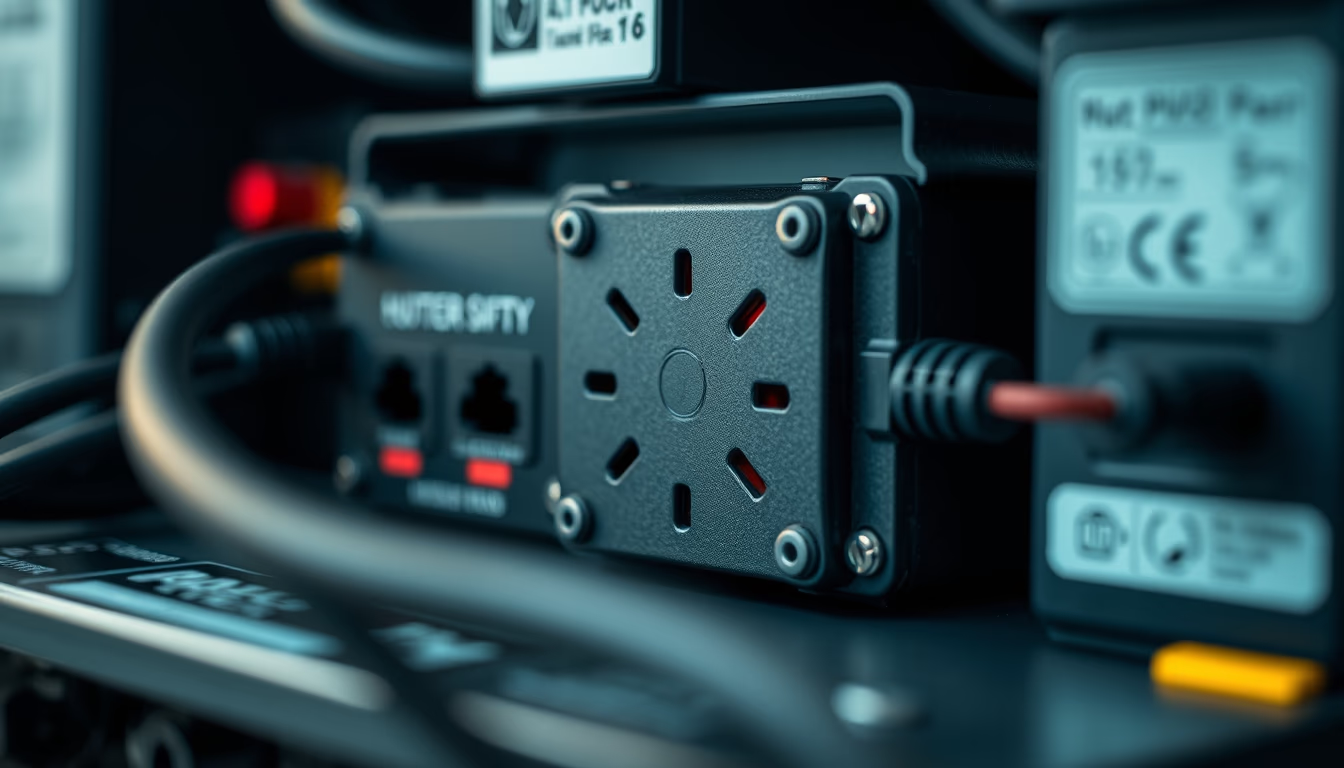
Computer power supply unit (PSU) macro close-up: components, wattage, and efficiency ratings explained for building and upgrading.
About this subject
The power supply unit (PSU) is the component responsible for converting alternating current from the wall outlet into low-voltage direct current, powering all other computer parts. Its wattage rating must meet or exceed the system's peak demand, typically with a 20, 30% safety margin. Low-quality units can cause instability, random reboots, and even permanent damage to motherboards and GPUs.
Energy efficiency certifications such as 80 Plus (Bronze, Silver, Gold, Platinum, Titanium) indicate the percentage of power converted without thermal loss. An 80 Plus Gold unit, for instance, guarantees at least 87, 90% efficiency under typical load. Internal topology, including synchronous rectification and LLC resonant conversion, directly affects voltage stability (+12V, +5V, +3.3V) and capacitor lifespan.
Key selection factors include the number of +12V rails (single vs. multi rail), built-in protections (OVP, UVP, OCP, SCP, OPP, OTP), and connector types (ATX12V, EPS12V, PCIe 6+2-pin). For systems with multiple graphics cards or extreme overclocking, modular PSUs with low-impedance cables and Japanese capacitors (e.g., Nichicon or Rubycon) are recommended, as they offer greater durability under high temperatures.
Interesting fact: the ATX (Advanced Technology eXtended) form factor, introduced by Intel in 1995, standardized PSUs for desktop PCs. Since then, variants like SFX (Small Form Factor) and TFX (Thin Form Factor) enable compact builds while maintaining the core AC-DC conversion function. Preventive maintenance, such as cleaning fans and replacing electrolytic capacitors after 5, 8 years of use, can extend PSU lifespan and prevent catastrophic failures.
Frequently Asked Questions
What wattage PSU is ideal for a gaming PC?
For a mid-range gaming PC with one GPU (e.g., RTX 3060 or RX 6600), 550W to 650W is recommended. High-end setups with RTX 4090 or multi-GPU may need 850W to 1200W. Always calculate total draw and add a 20% margin.
What does 80 Plus certification mean?
It is a label that certifies the PSU's energy efficiency. Higher tiers (Bronze, Silver, Gold, Platinum, Titanium) indicate less wasted energy as heat. An 80 Plus Gold unit achieves at least 87, 90% efficiency under typical load.
Is modular PSU worth the extra cost?
Yes, especially for compact cases or cable management. Modular units let you attach only necessary cables, improving airflow and aesthetics. For simple builds, semi-modular is sufficient.
Direct URL
https://pub-c7d6a6ea828543ac903a74a341ccb2e1.r2.dev/imagens/power-supply-unit-macro-closeup-p4.avifHow to credit
Include a visible link back to UtilizAí. Copy one of the snippets below:
<a href="https://xn--utiliza-eza.com/en/midia/imagens/power-supply-unit-macro-closeup-p4">Power supply unit</a> by <a href="https://xn--utiliza-eza.com">UtilizAí</a>, licensed under <a href="https://creativecommons.org/licenses/by/4.0/">CC BY 4.0</a>.
[Power supply unit](https://xn--utiliza-eza.com/en/midia/imagens/power-supply-unit-macro-closeup-p4) by [UtilizAí](https://xn--utiliza-eza.com), CC BY 4.0
License: CC-BY-4.0