Power drill cordless
1344×768 · AVIF · CC BY 4.0
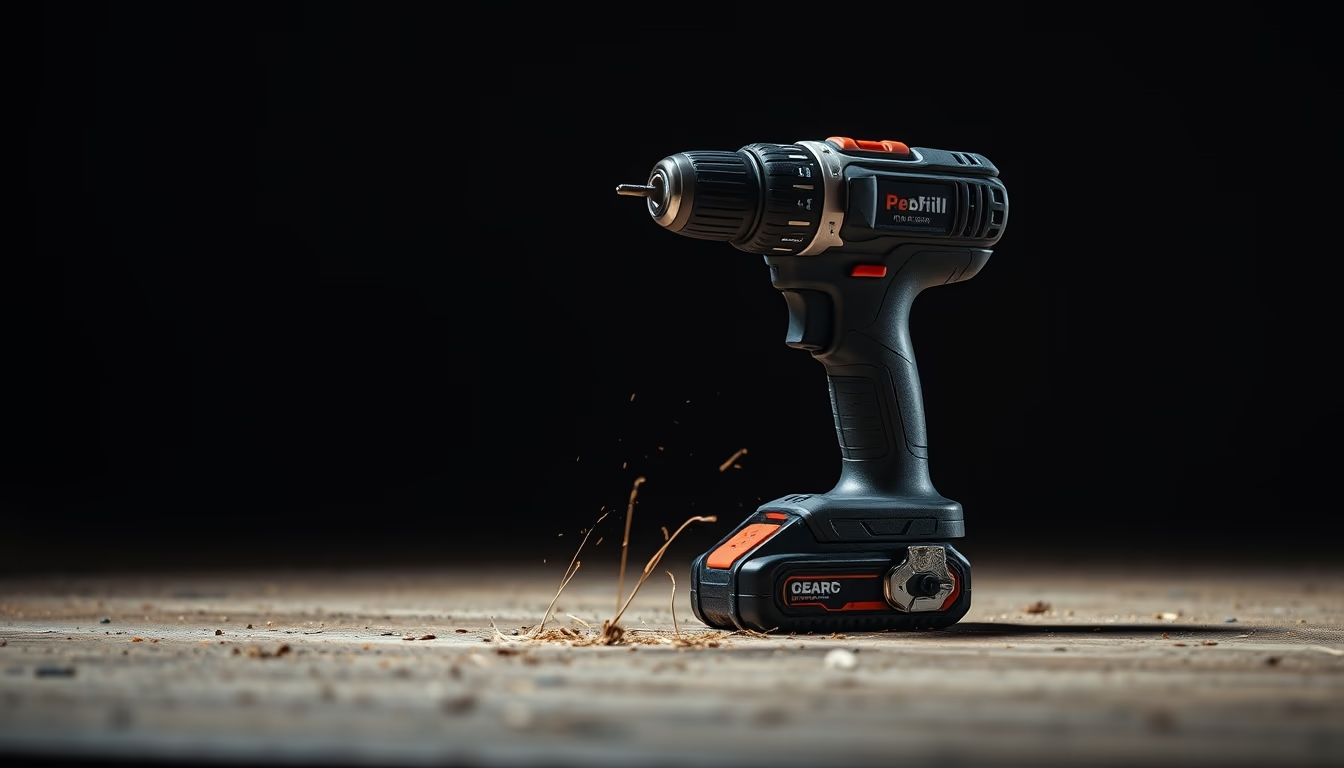
The cordless power drill revolutionized construction and DIY, offering portability and power in a single tool.
About this subject
The cordless power drill, also known as a screwdriver drill, has transformed how professionals and DIY enthusiasts perform drilling and fastening tasks. Unlike corded models, it runs on rechargeable batteries, typically lithium-ion, providing autonomy and freedom of movement. Early versions appeared in the 1960s, but it gained widespread popularity from the 2000s onwards, driven by advances in lithium battery technology.
The basic operation involves an electric motor powered by the battery, driving a chuck to hold drill bits or screwdriver bits. Modern models feature variable speed control, an adjustable clutch to prevent screw damage, and LED lights to illuminate dark workspaces. Battery voltage, measured in volts (V), indicates power: 12V models are lightweight for household tasks, while 18V or 20V are suited for heavy-duty work.
In the maker culture and professional market, the cordless drill is indispensable. It enables furniture assembly, shelf installation, light structure building, and even small automotive repairs. Manufacturers like Bosch, DeWalt, and Makita invest in technologies such as interchangeable batteries and brushless motors, which improve efficiency and tool lifespan.
Interesting fact: maximum torque, measured in Newton-meters (Nm), is a key performance indicator. A 12V drill may deliver around 30 Nm, sufficient for most home tasks; professional models exceed 100 Nm. For safety, wear protective glasses and avoid loose clothing during operation.
Frequently Asked Questions
What is the difference between a cordless drill and a corded electric drill?
The main difference is portability: cordless runs on a battery, allowing use anywhere, while corded needs a power outlet. Cordless typically has less continuous power but offers convenience.
How do I choose the right voltage for a cordless drill?
For light tasks like furniture assembly, 12V is enough. For professional use or masonry drilling, opt for 18V or 20V. Higher voltage means more torque and runtime, but also more weight.
What does torque in Newton-meters (Nm) mean on a drill?
Torque is rotational force. Higher Nm means better ability to drill into hard materials or drive screws without stalling. 30-40 Nm is suitable for home use; above 80 Nm for heavy-duty work.
Direct URL
https://pub-c7d6a6ea828543ac903a74a341ccb2e1.r2.dev/imagens/power-drill-cordless-fine-art-photography-p6.avifHow to credit
Include a visible link back to UtilizAí. Copy one of the snippets below:
<a href="https://xn--utiliza-eza.com/en/midia/imagens/power-drill-cordless-fine-art-photography-p6">Power drill cordless</a> by <a href="https://xn--utiliza-eza.com">UtilizAí</a>, licensed under <a href="https://creativecommons.org/licenses/by/4.0/">CC BY 4.0</a>.
[Power drill cordless](https://xn--utiliza-eza.com/en/midia/imagens/power-drill-cordless-fine-art-photography-p6) by [UtilizAí](https://xn--utiliza-eza.com), CC BY 4.0
License: CC-BY-4.0