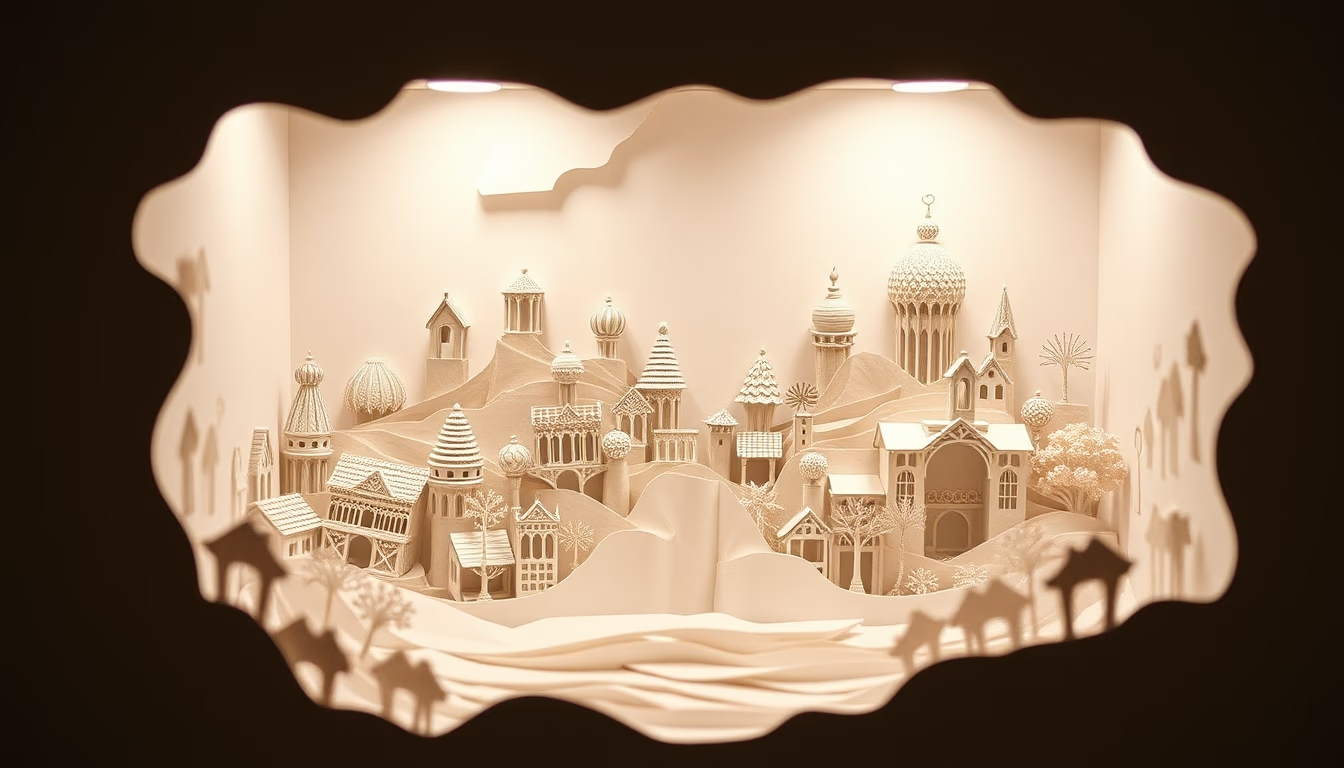
Pop-up book opened
1344×768 · AVIF · CC BY 4.0

Pop-up books combine paper engineering and visual storytelling in three-dimensional works that have delighted readers since the 13th century.
About this subject
Pop-up books, also known as movable books or three-dimensional books, have a rich history dating back to the 13th century, when English monk and mathematician Matthew Paris created the first paper hinges to calculate religious dates. However, it was in the 18th century that the format gained popularity with children's 'toy books', especially in Germany and England. The term 'pop-up' emerged in the 20th century, driven by publishers like English S. Louis Giraud and his 'Bookano' collections. Techniques such as flaps, pull-tabs, and V-folds allow scenes to jump off the pages, creating an immersive experience.
The art of pop-up books requires millimeter precision. Every crease and cut must be calculated so that the structure rises and folds smoothly. Artists like Robert Sabuda, Matthew Reinhart, and David A. Carter have elevated the technique to paper sculpture levels, with works ranging from classic tales to detailed anatomies. Sabuda, for example, spent over 1000 hours creating 'The Wonderful Wizard of Oz', with intricate layers that recreate the world of Oz in miniature.
Culturally, pop-up books have transcended the children's niche. They are used in architecture, medicine, and engineering as teaching tools. 'Pop-Up! A Manual of Paper Mechanisms' by Duncan Birmingham is a technical reference. Museums like the 'Museo del Pop-up' in El Papiol, Spain, and traveling exhibitions celebrate the intersection of book and sculpture. In Brazil, artists like Márcio Lacerda and the publisher 'Casa de Papel' produce works that blend folklore and modernity, showing that the tradition of three-dimensional books remains alive and innovative.
Frequently Asked Questions
What is the origin of pop-up books?
Pop-up books originated in the 13th century with Matthew Paris, but gained popularity in the 18th century as children's toy books. The term 'pop-up' was coined in the 20th century, notably with S. Louis Giraud's 'Bookano' collections.
What techniques are used in creating pop-up books?
Key techniques include flaps, pull-tabs, V-folds, and parallel structures. Each movement requires precise cutting and creasing so that the piece rises and folds smoothly.
Who are the leading pop-up book artists?
Robert Sabuda, Matthew Reinhart, and David A. Carter are global references. In Brazil, Márcio Lacerda and publisher Casa de Papel produce works with Brazilian themes.
Direct URL
https://pub-c7d6a6ea828543ac903a74a341ccb2e1.r2.dev/imagens/pop-up-book-opened-minimalist-composition-fresh10.avifHow to credit
Include a visible link back to UtilizAí. Copy one of the snippets below:
<a href="https://xn--utiliza-eza.com/en/midia/imagens/pop-up-book-opened-minimalist-composition-fresh10">Pop-up book opened</a> by <a href="https://xn--utiliza-eza.com">UtilizAí</a>, licensed under <a href="https://creativecommons.org/licenses/by/4.0/">CC BY 4.0</a>.
[Pop-up book opened](https://xn--utiliza-eza.com/en/midia/imagens/pop-up-book-opened-minimalist-composition-fresh10) by [UtilizAí](https://xn--utiliza-eza.com), CC BY 4.0
License: CC-BY-4.0